

Manufacturing technologies
Efficient machining of precious metals
Gold and platinum are among the most technically important precious metals. They perform important functions in industrial processes, electronics and the jewelry industry. Despite their similar chemical stability, they differ significantly in terms of mining quantity, price behavior and machinability. With its tool portfolio, Paul Horn offers a wide range of precision tools for the economical machining of precious metals.
Mining companies produce around 3,660 tons of gold worldwide every year. Countries such as China, Australia, Russia, Canada and the USA are driving this production forward, thereby securing global availability. The global reserves of around 54,000 tonnes create additional security of supply and stabilize the market in the long term. Platinum is produced at a lower level: mines worldwide extract around 180 tons per year. South Africa supplies more than two thirds of this quantity and therefore plays a key role in determining global supply. Russia and Zimbabwe supplement global production.
Gold reacts strongly to economic developments. Investors buy gold particularly in phases of economic uncertainty, which often causes the price to rise. The price of platinum usually remains below that of gold, although it occurs much less frequently. As industry drives most of the demand for platinum, the price of platinum fluctuates more strongly and closely follows the production cycles of the automotive and chemical industries.
The electronics industry uses gold because it offers reliable electrical conductivity and does not oxidize even under demanding environmental conditions. Manufacturers use it in contact surfaces, conductor structures and microelectronics to ensure high signal stability and a long service life. Medical technology uses gold for its biocompatibility in dental alloys, implants and diagnostic systems. Gold is also still the most important precious metal for the jewelry industry due to its warm color and stability.
Industrial applications
Platinum primarily fulfills industrial functions. The automotive industry uses platinum in exhaust catalytic converters to chemically convert pollutants and reduce emissions. Chemical plants use platinum as a catalyst in processes for the production of silicones, active pharmaceutical ingredients, fertilizers and various polymers. Due to its high melting temperature and high corrosion resistance, the industry also uses platinum in thermocouples, laboratory equipment and high-temperature components. In the jewelry sector, platinum achieves lower sales volumes than gold, but customers appreciate its hardness, color and abrasion resistance.
The machining properties of the two metals differ significantly. Gold is easy to machine. Small cutting forces are generated. This results in minimal tool wear and allows the production of very high surface qualities with a mirror finish. Goldsmiths, precision mechanics and electronics manufacturers benefit from this ductility, which enables tight tolerances and complex geometries. Platinum places significantly higher demands on machining. Its high strength and toughness increase the cutting forces and place greater stress on the tools. Machining generates high temperatures in the shear zone. For filigree geometries, users require special tool geometries and optimized cutting parameters. These factors increase the effort and production costs for platinum components.
From the field
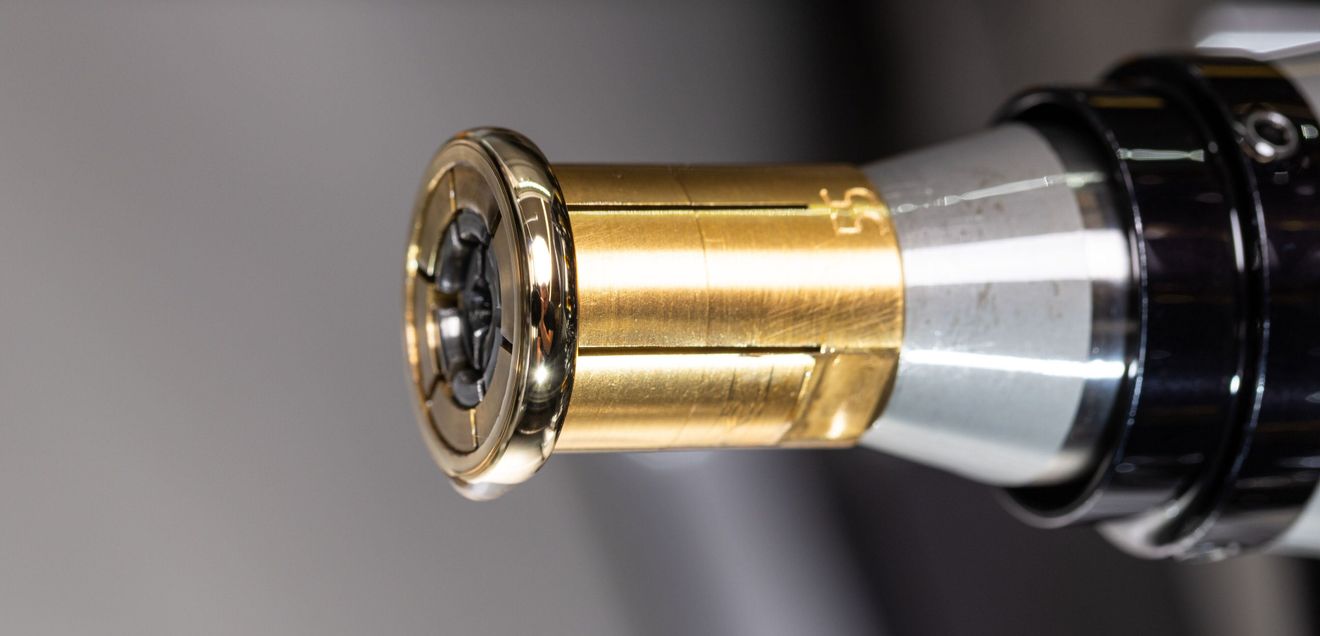
A user from the jewelry industry consistently relies on a uniform tool concept from Horn for wedding ring production, which consists of PCD and MCD-tipped cutting edges. PCD tools are mainly used for roughing and enable precise pre-machining of external and internal contours, while MCD cutting edges are responsible for high-gloss finishing and produce mirror-smooth surfaces. The 11P system in particular combines external and internal machining in one tool, thereby increasing efficiency and accuracy. The quality of the cutting edge is decisive for the end result and is manufactured by hand with the highest precision.
Overall, gold and platinum fulfill clearly defined technical tasks. Gold supports high-quality electronics and precision applications thanks to its high malleability and conductivity. Platinum, on the other hand, enables demanding industrial processes that generate high thermal and chemical loads.
Both metals remain indispensable components of modern technologies due to their unique properties. Horn offers an optimum tool portfolio for machining these precious materials.


You might also be interested in
Up to 50 percent higher cutting speeds
The current market situation is putting pressure on companies that rely on carbide tools: Rising raw material costs, volatile supply chains and limited predictability are putting pressure on the industry. Fette Werkzeugtechnik, a member of the LMT...
 read more...
Association of the German Turned Parts...
Turned parts industry looks cautiously to the future
Rising order intake, new members, cautious optimism: the members of the Association of the German Turned Parts Industry are confident. At the spring conference in Leipzig, around 150 participants discussed current market developments, strategic...
read more...Thinking loops in the system
Grinding is often used for high-precision component production or demanding surfaces. The combination of machine, measuring technology, expertise and tools is becoming increasingly important for this. Targeted developments for specific applications,...
read more...High metal removal rate for high maneuverability
Large module gears for ship drives place high demands on machining. Switching from skiving to 5-axis simultaneous milling with high-feed tools considerably shortens the roughing process. Process parameters and a well thought-out tool selection are...
read more...The bottom of the valley is no place to linger
Where the precision tool industry stands now
At the press conference of the VDMA Precision Tools Association, the precision tools industry presents the annual balance sheet for 2025: production decline, export development, shortage of raw materials and outlook for 2026.
read more...Drilling cycles optimized
A new replaceable head drill from Walter can reduce machining time in series production thanks to its patented interface and screwless design.
read more...Production, metalworking, robots
Precise 5-axis machining
The new Kern Fortis HD five-axis machining center will provide manufacturing companies with high precision requirements with a new machine from 2026.
read more...Review of the EMO Hannover 2025
About trends, innovations and sustainable production in metalworking
Almost three months after EMO Hannover 2025, we take a look at the most important innovations: smart machine tools, AI-supported assistance systems, additive manufacturing and sustainable production solutions for the industry of the future.
read more...Chip formation as the key to process...
Standardized chip breaker geometry for P and M steels
MAPAL presents standardized chip breaker geometries for unalloyed, alloyed and stainless steels. Optimum chip formation, higher process stability and reduced tool life in machining.
read more...