

ISO P turning grades
Economical machining
Economically efficient production is crucial for a company's profitability. In the case of metal cutting, safe and predictable processes and production environments are crucial: firstly, to ensure maximum production output in the long term, and secondly, to keep production costs as low as possible. New ISO-P turning grades help with this.
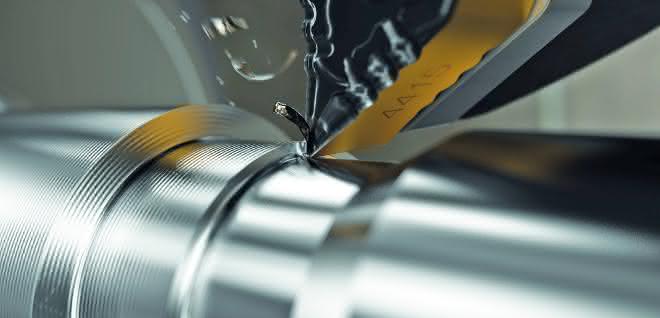
According to a survey by the National Association of Manufacturers (NAM), 53% of manufacturing companies in the US expect COVID-19 to impact their business. According to PricewaterhouseCoopers (PwC), this is already a reality in view of falling oil prices and demand, supply chain bottlenecks, reluctance to buy and nervousness on the credit markets. As the competitive pressure on steel component manufacturers is also growing against this backdrop, Sandvik Coromant is investigating how an alternative approach to steel turning processes can help to optimize costs per component and overall profitability.
When turning steel, the main aim is to minimize the costs per component. These are calculated from the total fixed costs plus the total variable costs, divided by the total units produced. Challenges in reducing unit costs arise from bottlenecks, production slowdowns or restrictions on the number of components produced per run. Other parameters arise from market demand, which may make it necessary to either reduce production costs or increase output.
Scenarios with low demand require tools that can produce more components per cutting edge while offering process reliability with fewer rejects. High demand scenarios require tooling solutions that enable higher metal removal rates, shorter cycle times and high machine utilization with minimal production interruptions. Regardless of the scenario, manufacturing companies should always maximize their output. Sandvik Coromant estimates that companies can reduce component costs by 15 percent. To achieve this while maximizing process reliability, it also makes sense to use an alternative tool concept.
Reduce chipless time
Sandvik Coromant has calculated that the cost of tools accounts for 3 to 5 percent of total manufacturing costs. Therefore, when purchasing tools such as carbide indexable inserts, which wear out over time, you should not only consider the initial unit costs. Instead, an approach is recommended in which the tool costs are included in the entire production cost process, i.e. including all operating costs such as machine depreciation.
If we look at a typical working day and assume that during two shifts totaling 14.4 hours, 60 percent of the time is dedicated to production, i.e. machining. 40 percent of the total time is spent on other things and therefore not on machining. The goal must therefore be to reduce non-cutting time and maximize machining time.
The best way to achieve this is to reduce the production time per component and at the same time increase the utilization of the machine tool. A 20 percent increase in machine utilization can result in a 10 percent higher gross profit margin.
Longer tool life
Manufacturers measure production rates in different ways. One measurement is the number of components completed over a certain period of time, for example per shift. Frequent insert changes, production interruptions and the search for the right inserts for each application or material are the biggest obstacles here. These are also considered to be the worst time wasters in modern manufacturing.
The question is: How can manufacturers overcome these challenges when working with tough workpieces made of aluminum, unalloyed steels and other workpiece materials? First of all, the insert grade should be selected primarily according to its suitability for the workpiece. This is a challenging task, as many variables influence the performance of the inserts. Procuring a single grade that meets the wide-ranging requirements of steel alloys in the ISO ranges
P15 to P25 often proves to be difficult. P15 to P25 refer to the requirements that different working conditions place on the machining parameters: Cutting data, surface finish, cutting depth, machined or rough surfaces, continuous or interrupted cuts.
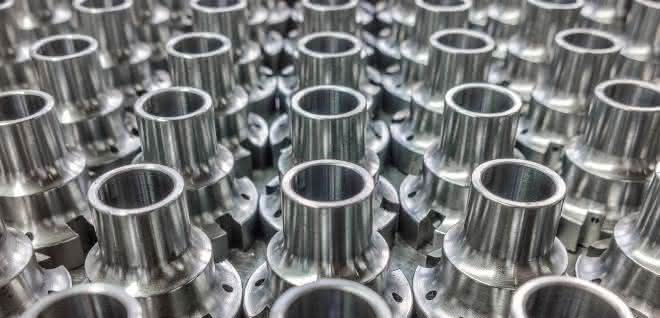
Each grade from these areas must therefore fulfill numerous requirements: For example, fracture resistance is of the utmost importance, as the cutting edge must be hard enough to withstand plastic deformation caused by the extreme temperatures in the cutting zone. In addition, the indexable insert coating must prevent flank wear, crater wear and built-up edge formation. Furthermore, the quality of the coating adhesion is crucial, as otherwise the substrate is exposed and there is a risk of premature tool failure.
To avoid such problems, delaying continuous, controllable wear and eliminating discontinuous, often uncontrollable wear are the keys to success. Predictable tool wear is therefore the goal. Given the trend towards machining with limited or even no monitoring, this is not easy to achieve.
In any case, the optimum wear pattern for any indexable insert is controlled flank wear, as this leads to a predictable service life of the cutting edges. The ideal grade for this is one that limits the development of undesirable types of wear or even prevents them from occurring in the first place.
It all depends on the right variety
To maximize the number of components produced, it is crucial to choose the right carbide insert. For this reason, Sandvik Coromant has developed the new ISO P turning grades GC4415 and GC4425 for machining steel alloys in the ISO P15 and P25 ranges. While GC4425 offers improved wear resistance, heat resistance and toughness, GC4415 has been developed to complement it for all machining operations that require higher performance and even greater heat resistance.
Both grades are suitable for machining low-alloy and unalloyed steel. They can machine a larger number of components within large and small series production and help to extend tool life. They also prevent unexpected tool breakage and reduce reworking and scrap rates.
Both grades feature second-generation Inveio technology with a unidirectional crystal orientation in the aluminum oxide coating. Its properties become clear on a microscopic level: each crystal in the aluminum oxide coating is lined up in the same direction, which creates a strong barrier to the cutting zone. The crystal orientation of the second-generation Inveio coating has been significantly improved once again. Inveio gives the indexable insert high wear resistance and ensures a longer tool life, which helps to reduce the cost per component.
Other parameters must also be taken into account, in particular the geometry of an indexable insert and how this influences chip control and machining performance.
Improved geometry
The geometry refers to the design of the insert, which is designed according to the type of machining. Finishing, medium machining and roughing each have specific effects on the cutting speed and their own working range in terms of acceptable chip breaking in relation to feed and depth of cut.
In turning, the three most important cutting parameters - cutting speed, feed rate and cutting depth - have a significant influence on tool life and therefore on the cost per component. After all, a 20 percent increase in cutting data can reduce the cost of a component by 10 percent.
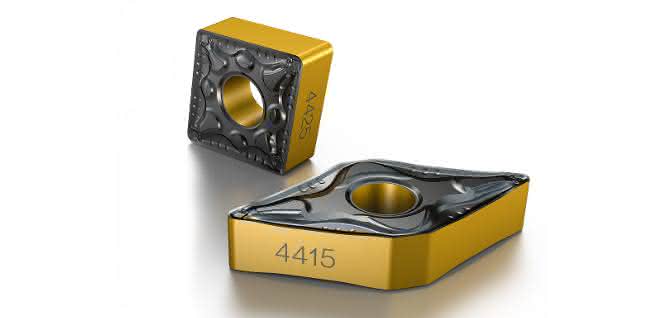
To help users select the best inserts and grades for their application, Sandvik Coromant offers the free online application CoroPlus Tool Guide.
Holistic approach to turning
A model developed by the American mechanical engineer Frederick Winslow Taylor at the beginning of the 20th century establishes a relationship between cutting speed, tool wear and tool life. Taylor came to the conclusion that using the greatest possible cutting depth reduces the number of machining passes required and therefore the machining time. At the same time, he pointed out that optimized turning of steel depends on the stability of tool clamping, workpiece fixturing and coolant application as well as the performance of the machine tool. Taylor's model shows that optimized steel turning goes beyond the choice of grades and geometries. Manufacturers should consider the entire tool concept. Everything from the insert grade to the clamping design to the tool holder helps to increase output, reduce costs and achieve a higher level of process reliability.
This holistic approach was put to the test by a general engineering company. It used the GC4425 carbide indexable insert to manufacture a drive shaft from heat-treated, low-alloy steel 42CrMo4 (material no. 1.7225) with a hardness of 40 HRC. The wear-resistant, heat-resistant and tough grade is capable of working with higher cutting data and is commonly used for machining gears and pumps as well as for various applications in the automotive and plant industries.
The workpiece was subjected to multidirectional external roughing. The performance of the GC4425 was compared with that of a competitor's ISO indexable insert. As a result, the GC4425 was clearly ahead, as the cutting speed vc could be increased and the feed rate fn multiplied. While the competitor's indexable insert was only able to cut at vc = 183 m/min and fn = 0.33 mm/rev, GC4425 achieved vc = 244 m/min and fn = 0.51 mm/rev.
Ultimately, the use of the GC4425 carbide indexable insert enabled a 100 percent increase in productivity with a 50 percent reduction in cycle time. Overall, the customer achieved a cost reduction of 30 percent.
This result shows that manufacturing companies that consider the entire tooling concept can achieve more profitable production and lower costs per part. And this holistic approach to insert grades, geometry and the overall economics of the machining process is crucial if companies are to remain competitive in the face of the ongoing impact of COVID-19.
Rolf Olofsson, Product Manager at Sandvik Coromant / ag


You might also be interested in
Association of the German Turned Parts...
Turned parts industry looks cautiously to the future
Rising order intake, new members, cautious optimism: the members of the Association of the German Turned Parts Industry are confident. At the spring conference in Leipzig, around 150 participants discussed current market developments, strategic...
 read more...
World premieres at the EMO 2025
From September 22 to 26, 2025, Grob will be presenting several innovations at EMO Hannover. The focus of the trade fair appearance will be on the latest 4- and 5-axis universal machining centers and the associated automation solutions.
read more...Efficient complete machining
Index-Werke will be bringing the Index G220 turn-mill center and the Traub TNA400 universal lathe to Intec.
read more...Digitization of process chains
CAM system Hypermill in practice
At EMO 2023, Open Mind will focus on turning, milling and the importance of CAM software and MES in networked production environments.
read more...High-speed spindle in handbag format
Modules for milling and turning
At Weiss, the focus is on the new 1.5 kilogram micro-mill spindle, which rotates at up to 60,000 revolutions per minute.
read more...Handling and workpiece clamping
Networked production starts with the component
Schunk is coming to Hanover with a 360-degree portfolio covering all aspects of machine tools. The focus will be on more sustainable production, connectivity and e-mobility.
read more...Stroll through the city
DMG Mori is inviting visitors to take a stroll through the city at EMO: In a specially constructed DMG Mori City, the machine tool manufacturer is concentrating on its focus topic of Machining Transformation (MX).
read more...Efficiency with digital twins
Digitalization and automation are the way to increase efficiency and flexibility in machining. The Tebis team will be presenting suitable solutions for mechanical engineering at EMO.
read more...The future of machining
Machine tool manufacturer Soraluce will be demonstrating its position in the fields of milling, turning, multitasking and automation solutions at the EMO 2023 trade fair.
read more...