
handling award 2020
Category 1 - First place: Feed at a new level
With ROTU and PARU, the manufacturer has combined the flexibility of a robot with the performance of a vibratory conveyor. The increase in performance is possible thanks to digitalization: AI evaluates feasibility, simulation designs the sorting tools.
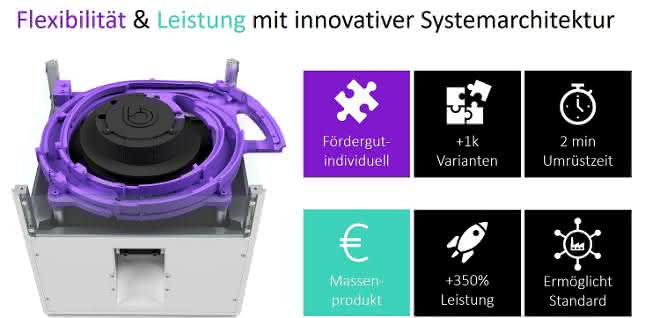
Hofmann & Stirner Zuführsysteme won first place in the handling and assembly category with its ROTU and PARU feeding systems. Based on a new type of machine architecture with a standardized drive unit and a sorting tool for individual conveyed goods, flexible feeding systems have been created that can be set up to transport up to 800 parts per minute and can be set up within two minutes. With these systems, the manufacturer has combined the flexibility of a robot with the performance of a vibratory conveyor. Hofmann & Stirner claims a 350 percent increase in performance compared to conventional feeding systems and a delivery time of only around six weeks.
The ROTU circular vibratory feeder is designed for sorting tasks, while the PARU linear vibratory feeder is used as an accumulation section. The manufacturer has developed simulation software for the digital design of the feed systems. The Digital Motion module calculates how the systems move. The Digital Feeder module simulates how the conveyed goods behave in the feeding system and in the sorting section. With the final simulation model, the entire feeding system that is delivered to the customer is available as a digital twin. Artificial intelligence (AI) is used for the feasibility analysis and quotation preparation, so that a fully-fledged quotation can be submitted within 24 hours in response to customer inquiries. The customer can upload a material to be conveyed as a 3D CAD model and specify their feeding task. This eliminates the need to create a specification sheet. Using 3D deep analysis of the material to be conveyed, the feasibility of the output position, performance data, costs, delivery time, hooking and other parameters are determined and transferred to a pdf quotation.
Every sorting tool works on every ROTU of the same size: Plug & Feed. The changeover is purely mechanical; no complex sensor technology is installed to adjust the operating parameters. The adjustment is carried out completely in advance using a digital twin. ROTU is available in two system sizes, both left- and right-handed. The system combines vibratory drive, conveyor bowl, parts storage and housing in a standardized mass product. The PARU linear vibratory feeder achieves conveying speeds of up to ten meters per minute. It is available in three basic sizes S, M and L. These can be combined by flanging them together to create additional lengths of 400 to 3,200 millimetres of continuous accumulation distance. PARU does not need to be adjusted in terms of spring setting angle or compensation masses. Adjustments are made exclusively digitally via the digital twin. The initial commissioning time for a new material to be conveyed is usually only a few minutes with PARU. pb


You might also be interested in
Plagiarius 2024 negative prize
On January 26, 2024, the Plagiarius campaign awarded its dreaded "Plagiarius" negative prize for the 48th time to manufacturers and retailers of particularly brazen counterfeits and fakes.
 read more...
Ivalua honors winners of the Generative AI...
AI-supported "add-ons" for buyers within 48 hours
Ivalua, provider of cloud-based spend management solutions, announced the winners and innovations of the first Generative AI Innovation Cup. The competition took place in December 2023. It was open to all Ivalua partners and employees - more than...
read more...Efaflex celebrates 50 years of high-speed...
The emphasis is on "fast"
Since day one, Efaflex has wanted to use new technologies as early as possible and drive progress in the industry. This year, the family business is celebrating its 50th anniversary under the motto "Fast Forward".
read more...Security of supply even during power outages
In the winter of 2022, Germany was worried about energy shortages. The drugstore retailer dm did not paint any horror scenarios, but nevertheless saw the possibility of controlled, temporary, regional power cuts (brownouts).
read more...Safety technology in mechanical engineering
Modules with new functions
Euchner's product highlights at EMO 2023 include the communication-capable solenoid interlocks.
read more...Transforming the paper industry towards climate neutrality
Together with partners from industry and research, Voith is developing a project for the optimization of energy and material flows in paper production. The aim of the research project is to develop a digital framework that enables effective process...
read more...Up to 95 percent less flue gas thanks to direct extraction
The requirements for occupational safety measures and safety technology are also constantly increasing in welding technology. The Technical Rules for Hazardous Substances (TRGS) stipulate that welding fumes and harmful substances must be extracted...
read more...Competitive advantages with large machines
Whether 3D-printed components for machines and systems, prototypes or aids for design: additive manufacturing is almost indispensable for modern companies in mechanical and plant engineering and automation if they want to play in the premier league.
read more...Transport technology from the modular system
Many transport tasks can be realized with the help of linear technology. Pre-configured solutions are available to simplify the interaction between the linear unit, motor, gearbox and controller. This minimizes the effort required for research and...
read more...