

Tube 2018
"Predictive maintenance is becoming more interesting"
At Tube in Düsseldorf, SCOPE spoke to Stefanie Flaeper, Managing Director at Transfluid Maschinenbau, about how the future of bending technology is shaping up - particularly with regard to Industry 4.0 and flexibilization through the use of robots.
SCOPE: Ms. Flaeper, what are the trends in tube forming and bending technology?
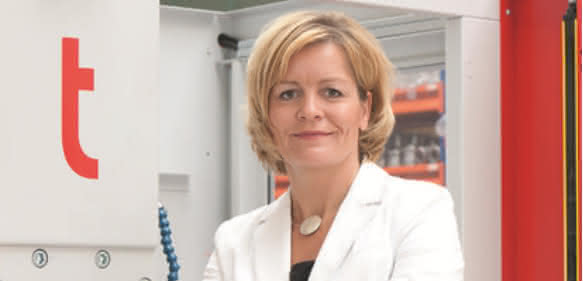
Stefanie Flaeper: Basically, it can be assumed that a high degree of flexibility will be required even more than before for the processing of tubes. Because in the future, there will probably not only be large series. Production will have to adapt to this. In principle, this can also be applied to the development of bending technology. The demand for ever more dynamic production of complete kits with a wide range of geometries and diameters will increase.
SCOPE: How is software-controlled process optimization for Industry 4.0 being received?
Flaeper: The connection is in demand in a wide variety of areas. But not all customers want complete networking. Especially when it comes to data backup. At Transfluid, we are set up accordingly and are able to implement the appropriate connections and integrations. All control adaptations have already been implemented via new control systems.
SCOPE: In which areas does robotics ensure faster processes?
Flaeper: The robot is certainly not the fastest automation solution. Here we offer high-performance linear handling systems. But - the robot can be highly flexible and can be used for different components. When it comes to handling already bent parts in further processing steps, the robot is therefore the most economical solution. In addition, the robot is sometimes also the bending machine and can therefore be used excellently for the implementation of complex geometries. And as a robot bender, it is an extremely efficient and effective solution for processing long tubes with small tube diameters. Of course, it can also take on handling tasks. Programming is based on coordinates and CAD data can be imported.
SCOPE: How useful is it to overhaul old tube processing machines to make them 4.0-capable?
Flaeper: Old bending machines can only be retrofitted if they have new control components and these allow processes to be linked and controlled. This is a basic requirement. Retrofitting old systems to this level of control can be viewed very ambivalently and it depends on the individual case. If an older system only performs a rudimentary task in the process, the upgrade may be sufficient. But quite apart from the 4.0 capability, new systems enable faster, better and more economical processes. And much more sustainably.
SCOPE: What is important when it comes to sustainable machine use - what in particular needs to be considered when it comes to maintenance and servicing?
Flaeper: Of course, it is important that the service is easy to carry out, that downtimes are avoided and that spare parts are available from the customer or manufacturer. The service intervals must be recorded, displayed and acknowledged. The service life and process capability of systems can be significantly improved through preventive service calls, for example via maintenance contracts, and through predictive maintenance. Predictive maintenance in particular is becoming increasingly interesting for our customers in order to ensure reliable production and a long machine service life in the long term. This has already been demonstrated by the trend in 2017.
Tube, Hall 5, Stand G34


You might also be interested in
Predictive maintenance in retrofit
Predictive maintenance pays off. This is because early detection of impending failures means that systems can be serviced in a targeted manner before production downtime occurs. But how complex is it to integrate such a maintenance concept into an...
 read more...
Maintenance instead of replacement
The circular economy starts with the machinery
Sustainability in industry starts with machines, says our guest author from Deguma: How maintenance, modernization and the 5R strategy save resources, energy and CO₂.
read more...3D printing for unplanned requirements
The material fails and the machine suddenly stops? Then you need to take the right measures to be able to resume production quickly. Material failure in the form of faulty components or material wear in the frame are a risk for any production.
read more...High demands in terms of safety, application and robustness
Demanding work in the electrical trade and energy supply as well as smooth processes in production require innovative and customized measurement technology that scores points for safety, ease of use and resilience.
read more...Car meets e-bike: riding with lubrication-free polymer bearings
Studies show that the proportion of pedestrian and bicycle traffic is increasing in urban areas. With the JetBike, JetBike GmbH from Braunschweig presents a mixture of e-bike and car and relies on lubrication-free polymer bearings from Igus.
read more...Hydraulic hub for more efficient servicing
Bosch Rexroth presents a digital toolbox for service and maintenance. With a comprehensive range of digital services, the Hydraulic Hub simplifies and accelerates the service and maintenance of hydraulic products and increases machine availability.
read more...Arnold Umformtechnik expands after-sales...
Faster help with VR glasses
Arnold Umformtechnik is expanding the after-sales service for its machines to include digital remote services. The focus is on data security, simple operation and clear processes.
read more...147,000 euros per hour: high costs for German companies due to unplanned downtime
According to the "Value of Reliability" study, 67% of industrial companies in Germany experience unplanned downtime at least once a month. This costs the German economy 147,000 euros per hour. Nevertheless, reactive maintenance concepts are not...
read more...Maintenance starts with a maintenance planner
Legal requirements stipulate that machines and systems must be serviced regularly. The maintenance work serves to ensure occupational safety and economic efficiency.
read more...