

Integrated electronics
Short-stroke linear actuator instead of pneumatic cylinders
The new short-stroke linear actuator (KuLi) from Ketterer Antriebe and halstrup-walcher is characterized by high dynamics and a large stroke in a compact size. Thanks to the integrated electronics, the drive is easier to control than pneumatic cylinders.
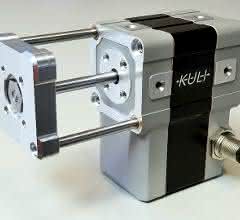
The new electrically operated linear actuator is extremely compact and highly dynamic. With a length of 82 mm, the stroke is 40 mm, which can be covered in less than 100 milliseconds. The standard version of the KuLi offers thrust forces of up to 300 N. Depending on the task, the stroke speed, stroke force, stroke length and mechanical connection can be selected to suit the application.
The drive is particularly suitable for use in automation and conveyor technology as well as in special machine construction, where pneumatic cylinders have been widely used to date. Unlike these, the KuLi short-stroke linear actuator does not require any sealing or throttling technology to achieve uniform piston speeds. In addition, all ancillary components for pneumatic cylinders such as hoses, valves, compressed air tanks and silencers are no longer required. The short-stroke linear actuator is therefore significantly more cost-effective. A company achieves the greatest savings with the use of short-stroke linear drives if it dispenses with the entire compressed air system as a result of the conversion. The drive from Ketterer and halstrup-walcher is maintenance-free and there is no need for expensive servicing as with pneumatic cylinders.
The linear actuator is also superior to pneumatic alternatives in terms of handling. The speed and force can be adjusted to suit the application requirements. The KuLi can be controlled with a computer via a parameterization adapter with USB interface. The focus here is on simple handling. The software has a particularly user-friendly interface that can be operated without programming knowledge. Another advantage of the KuLi is the new technology in which the rotational movement of the motor is converted into a linear movement by a smooth shaft. This enables very good sealing of the shaft against the motor.


You might also be interested in
Maintenance and Pumps&Valves in February
Final preparations are underway in Dortmund: On February 21, 2024, maintenance will start as the leading trade fair for industrial maintenance and with it Pumps&Valves as the trade fair for industrial pumps, fittings and valves.
 read more...
Cooling and temperature control units
Hygienic packaging sells safely
In few industries are the requirements for hygiene in the production process as strict as in the food sector - the health of consumers has top priority. This results in enormous challenges for all machines and components involved, especially in...
read more...Cooperation between SMC and Yaskawa
Another chapter in the cooperation between Yaskawa and SMC: The new European Yaskawa Europe headquarters is also home to an academy with robots and cobots, to which various SMC solutions are exclusively connected.
read more...Proportional flow control
With the Asco 209 series, Emerson has introduced a proportional valve for flow applications in the medical technology, food and beverage, heating, ventilation and air conditioning (HVAC) industries.
read more...Double piston pump and proportional valve
High-precision gluing of folding boxes
Thanks to their sustainability, cardboard packaging is increasingly replacing plastic packaging. An important production step in the manufacture of folding boxes is the high-precision gluing of the cardboard blanks.
read more...Three leak tests at once
Systems for leak testing modern components for electromobility and hydrogen fuel cells are a key focus of Worthmann Maschinenbau and its subsidiary Maceas.
read more...Bonding and lubricating - precise dosing
Jet valves from Vieweg lubricate and grease electromechanical switches and bond and seal electronic components. More and more customer-specific solutions are being used.
read more...digital networking days Sustainability
Predictive maintenance for semiconductor production
The control valves for ultrapure water are an important supply medium in semiconductor production. While specialists used to check these valves personally on site, an IoT solution now checks the critical components.
read more...Seamless product and process traceability
After exploring the market, a plastics processor decided in 2019 to have WSW Software develop a new MES. The web-based ME system called Valeris is now in productive use and is marketed as an industry-neutral standard solution.
read more...