
Control technology
Optimize workpiece accuracy and surfaces
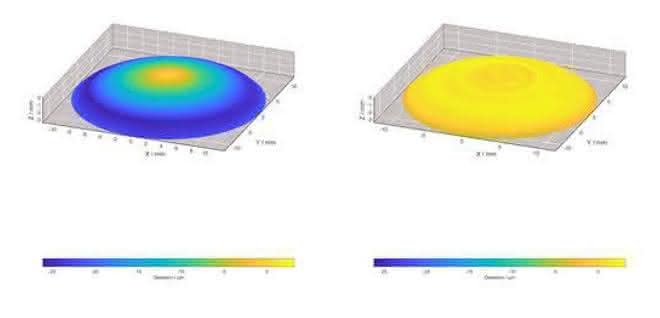
Despite all the precision in tool production, radius milling cutters in particular do not have a uniform geometry. The radius of each individual tool usually deviates individually from the ideal circular shape. Studies show that deviations of up to 0.015 mm can be expected with standard tools. Even high-quality, expensive precision milling cutters can exhibit deviations in the µm range.
This is a shortcoming for high-precision machining, as the contact point of the cutter radius with the workpiece calculated by the control does not match the actual radius - and this is the case every time a new cutter is inserted. With the 3D-ToolComp option from Heidenhain and the Cycle 444 3D probes, these deviations can be compensated for quickly and easily. To determine the radius deviations of a milling cutter to be used, the user carries out a test machining operation with the tool on a test workpiece. He then measures the milled contour with a touch probe that was previously calibrated with the help of 3D-ToolComp. The Heidenhain TNC control immediately converts the deviations of the milled contour from the ideal contour determined in this way into radius deviations on the tool and writes them into a compensation value table. This compensation value table can be used to define angle-dependent delta values that describe the deviation of the tool from the ideal circular shape. During subsequent full machining, the TNC control then corrects the radius value defined at the current point of contact between the tool and the workpiece.
The machining example of an aspherical lens with a diameter of 20 mm shows the effect of 3D-ToolComp very clearly. After the test cut, a touch probe with the 444 3D probing cycle detects considerable deviations of up to 25 µm from the desired lens shape. After compensating for the radius deviations, the shape deviations over the entire surface of the aspherical lens are less than 5 µm.
In order to be able to determine the contact point precisely, the NC program must be generated by the CAM system with surface standard blocks (LN blocks). In addition to the position of the tool, the contact point with the workpiece and optionally the tool orientation in relation to the workpiece surface are also defined in the surface standard blocks. The correction is carried out automatically by the TNC-controlled machine tool.
According to documents from Heidenhain


You might also be interested in
Virtual PLCs in practice: How vPLCs make production systems more flexible and scalable
The increasing networking of IT and OT is fundamentally changing industrial automation. The IT/OT Integration Summit shows how modern technologies can make production environments more efficient, flexible and future-proof. The event will focus on...
 read more...
Experience with virtual control systems in real production environments
The end-to-end networking of IT and OT is considered one of the key levers for industrial transformation. The IT/OT Integration Summit addresses precisely this area of tension and brings together experts from production, automation and IT. The focus...
read more...Increased demand for control and drive...
Sieb & Meyer expands production capacities in Lüneburg
Sieb & Meyer AG is expanding its production space in Lüneburg by 1,800 m² in response to continued high demand in the wake of strong sales growth in the 2025 financial year and increasing investment in AI infrastructure.
read more...Hanover Fair starts
Topics such as digitalization and sustainable production will shape Hannover Messe 2026, and a number of prizes will also be awarded during the trade fair.
read more...Strike at the start of the Hannover Messe
On the occasion of the strike announced by ver.di on the first two days of Hannover Messe 2026 (20 and 21 April), which will paralyze public transport in Hanover, the organizer, Deutsche Messe, is expressing clear criticism and great concern about...
read more...Use data consistently and uniformly
New connectors and an app solution for the IIoT framework from PLCnext Technology make it easier to collect data from controllers, sensors and field devices - especially in existing systems.
read more...Beckhoff at the Light + Building 2026
Interdisciplinary building automation
At Light + Building from March 8 to 13, Beckhoff will be demonstrating PC-based control as a universal lever for sustainable building automation. Visitors can experience on site how the integration of all systems on an open platform can lower...
read more...Control platform for dynamic safety
Flexible and dynamic production environments place high demands on automation technology in terms of functional safety. At SPS, Phoenix Contact will be presenting approaches for functional safety in dynamic production areas - including systems for...
read more...Drive systems for modular machines
Modularization increases flexibility and efficiency in mechanical engineering, but places new demands on drive technology. The article compares centralized, decentralized and cabinet-less architectures and shows how flexible drive systems support...
read more...