

Materials for 3D printing
Material development for additive manufacturing
In order to help additive manufacturing technology achieve a breakthrough in industry, new, robust and wear-resistant printing materials will be required in addition to high-performance 3D printers in the future. Materials researchers are therefore pushing ahead with development at full speed. By Gerhard Baus
Prototypes, spare parts, series and tools are increasingly coming from 3D printers. According to a Bitkom survey, 78% of companies consider 3D printing to be a key technology that will profoundly change value chains. Igus also offers a 3D printing service for industrial companies and has noticed an increase in demand. "Customers have accepted the 3D printing service so well that we tripled our laser sintering capacities in 2018," says Tom Krause, Head of Additive Manufacturing. "We have already doubled our capacities in 2019."
The advantages of 3D printing are obvious. Printers can produce one-offs and even series quickly and cost-effectively. Conventional production technologies such as injection molding, on the other hand, reach the limits of cost-effectiveness for small production runs, as the initial costs are high due to the time-consuming production of casting molds and are only profitable for large series. 3D printing also offers designers greater freedom: Complex geometries and internal structures can be produced in no time at all. Traditional processes, such as subtractive turning and milling, primary molds such as casting and forging, fail or require joining techniques such as gluing, welding or screwing.
New polymers for 3D printing
To ensure the success of additive manufacturing technology, not only high-performance 3D printers are required. New types of printing materials are also required - currently mainly made of plastic and metal. However, classic polymers such as polylactide (PLA), polyamide (PA12) and arylonitrile butadiene styrene (ABS) cannot be used to manufacture products that meet industrial requirements in terms of durability and wear resistance; high coefficients of friction, high wear rates and low temperature resistance are not an option. New types of high-performance polymers for industrial 3D printing are in demand. Their quality will determine how quickly the 3D printing of plastic components spreads in industry. Researchers around the world are therefore developing new types of high-performance polymers.
Igus has been offering materials for 3D printers since 2014. The range includes special filaments for 3D printing using the filament deposition process (FDM/FFF) and plastics for selective laser sintering (SLS). The developers' main focus is on wear and abrasion resistance, properties that lead to a long service life for components such as bearings, gears, rollers, grippers and joints. "In terms of robustness, 3D printing can even keep up with the injection molding process," says Krause. "Tests have shown that the wear resistance of additively manufactured parts is absolutely comparable to injection-molded parts. Our tribologically optimized filaments are up to 50 times more abrasion-resistant than conventional 3D printing materials."
The developers don't just focus on wear resistance. "The range extends from 3D printing materials for simple processing and filaments with high strength and elongation at break to chemical-resistant materials and high-temperature materials." As the company focuses on moving applications, all 3D printing materials are optimized for high abrasion resistance and low coefficients of friction. The all-rounders include Iglidur I180-PF, a filament suitable for small series or one-off productions. Iglidur J260-PF, on the other hand, is predestined for high application temperatures. The filaments can be used on all commercially available printers. Igus also offers Iglidur I3-PL and I6-PL for the SLS process. These materials are also very robust and wear-resistant. "Our tribological tests show: The high-performance plastic Iglidur I3 has at least a factor of 3 better abrasion resistance than conventional materials for laser sintering," says Krause.
But this is not the only reason why the Cologne-based 3D printing service produces most of its laser sintering parts from this material. It also has the best price-performance ratio among the company's own 3D printing materials. To use this service, the customer only needs to provide the CAD file of a wear part. If this is not available, Igus can digitize the component using a 3D scanner. Alternatively, the customer can create a 3D model of their component themselves using the free configurator. The next step is to select a printing material that is suitable for their application. An online tool that draws on the latest results from the test laboratory provides guidance here. Then the printing begins. Igus has both fused deposition modeling (FDM) printers and devices for selective laser sintering (SLS). In the FDM process, molten plastic flows through a nozzle. In the SLS process, on the other hand, a laser melts plastic powder. Both processes can be used to cost-effectively produce one-offs and series of up to 5,000 pieces. Gear wheels with a diameter of 12 mm and a depth of 16 mm cost 1.70 euros per piece for 100 pieces using the SLS process. The milled counterpart costs around 2.80 euros.
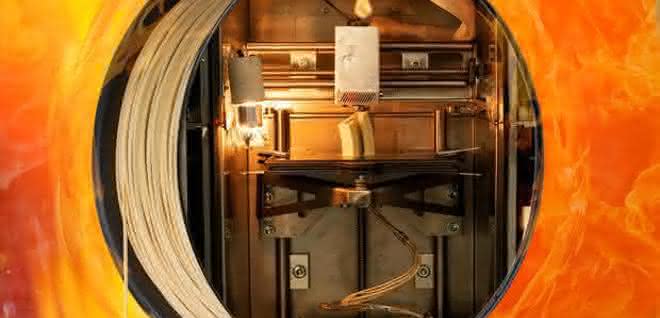
Igus also builds its own 3D printers for in-house research and development. In a high-temperature 3D printer, the designers have installed a nozzle that melts the printing material at a heat of 370 °C. Lubricant-free linear bearing foils and spindle nuts made from Iglidur high-performance plastics are used to enable precise adjustment of the build plate at build temperatures of up to 200 °C. Heat-resistant stainless steel components of the Drylin W linear guide and Dryspin lead screws in the X, Y and Z axes are also used.
3D-printed injection molding tools
3D printing is not suitable for all orders. Many customers want materials that could previously only be processed by injection molding or from semi-finished products. However, this requires time-consuming and cost-intensive special injection molds. Igus therefore manufactures the molds additively under the name "Print2mold". "With Print2mold, we are able to produce injection molds within one day and reduce costs by up to 80 percent compared to milled or eroded molds," says Krause. "Thanks to the process, particularly fine details and complex structures can also be realized." The user can choose freely from the Iglidur range of materials. The company has integrated the Print2mold process into its online 3D printing service. The production of special parts using this process is characterized above all as a time-saving solution for prototype development and small series. This gives customers the opportunity to obtain components identical to those used in series production at an early stage of development.
And what does the future hold? "One exciting question is the economical production of multi-material components for the introduction of even more specific material properties," says Tom Krause. "For example, hard-soft combinations have already been implemented. However, further technological developments are still required for scalability. Igus is also working intensively on making all existing Iglidur materials suitable for 3D printing."
Gerhard Baus, Head of New Business Development, Igus / am


You might also be interested in
Up to 50 percent higher cutting speeds
The current market situation is putting pressure on companies that rely on carbide tools: Rising raw material costs, volatile supply chains and limited predictability are putting pressure on the industry. Fette Werkzeugtechnik, a member of the LMT...
 read more...
A robot for all occasions
Industrial robots take on many tasks. Even milling with accuracies in the sub-millimeter range is now possible.
read more...High metal removal rate for high maneuverability
Large module gears for ship drives place high demands on machining. Switching from skiving to 5-axis simultaneous milling with high-feed tools considerably shortens the roughing process. Process parameters and a well thought-out tool selection are...
read more...Schunk shows flexible systems for electronics production
Schunk Electronic Solutions will be exhibiting modular, flexible systems for electronics production at Productronica 2025 - from stand-alone depaneling systems to fully integrated inline solutions.
read more...Hydraulic 4-jaw chuck for automated workpiece clamping
HWR Spanntechnik presents a hydraulically actuated 4-jaw chuck for automated workpiece changing. The clamping device is designed to enable short set-up times, precise clamping and high productivity in automation.
read more...Corner, face and plunge milling
Paul Horn is expanding the DA milling system for corner, face and plunge milling. With the DA65 variant, the system offers a larger cutting insert compared to the existing DA62.
read more...World premieres at the EMO 2025
From September 22 to 26, 2025, Grob will be presenting several innovations at EMO Hannover. The focus of the trade fair appearance will be on the latest 4- and 5-axis universal machining centers and the associated automation solutions.
read more...Flexible and efficient processing
New high-performance CNC series
Fanuc's presentation at EMO will focus on the new FS500i-A CNC series. The new CNC generation offers high user-friendliness, process optimization as well as digital and network technologies.
read more...New PCD milling program
As part of the new PCD milling program, Paul Horn has developed the DM70 and DM90 series, which are specially designed for face and corner milling operations. The focus here is on high milling and surface qualities as well as burr-free milling.
read more...