

handling award 2020
Category 2 - 1st place: Vision becomes seeing
Robominds presents a flexible robotic vision system based on artificial intelligence (AI) to solve pick-and-place and bin-picking applications and wins first place in the robotics category.
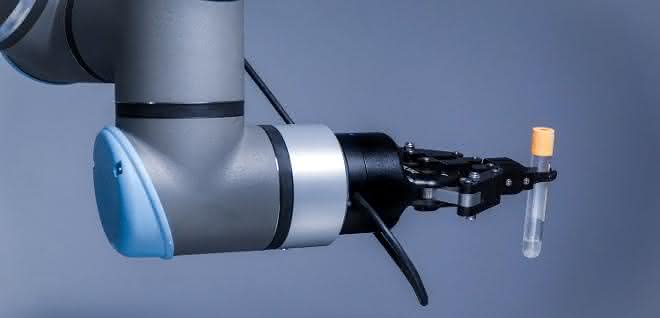
Robobrain.vision from the Munich-based company Robominds took first place in the robotics category. It is an AI-based vision platform that gives robots a sense of sight. The solution consists of a hardware package with an industrial PC and camera and a software architecture for executing the most complex image processing algorithms. As the central element of the solution, the Robobrain industrial PC provides the necessary computing power for industrial robot applications. The robust and secure platform architecture can be used flexibly thanks to its modular design. Examples of this are the robobrain.control modules for controlling robots and other automation components or robobrain.fleet for managing the entire robot fleet. This enables modular expansion of the system right down to the process control level.
The camera system combines 2D and 3D data for optimum part recognition results. Thanks to its compact design, the camera can be mounted directly on the robot flange in addition to conventional static mounting. Its low weight reduces the possible robot payload only minimally. Attachment to the robot flange increases the flexibility of the application and enables even deeper process integration. The flexible detection algorithm for optimum gripping point detection makes pick-and-place applications possible without teach-in. A wide variety of object types are already supported, from sheet metal parts to packaging and consumer goods. Gripping point detection is independent of the object, which makes it possible to grip new components without teach-in time or CAD models. This allows the system to react independently to small changes in the products or the environment. For particularly complex cases, it is also possible to increase the performance of the system by re-learning process data.
The manufacturer has designed the user interface and industrial components of this robot AI to be extremely user-friendly. The system can be commissioned without specific knowledge of computer vision using just a few parameters, which reduces maintenance and commissioning costs. The settings can be flexibly parameterized directly in the process via a web interface and adapted to the specific application. The modular design of the software means that different grippers can be used. With the help of so-called "AI skills", various functionalities can be integrated and executed for the respective process step. In addition to vacuum grippers, parallel grippers with integrated collision avoidance are also supported during gripping. The user can also integrate special grippers - for handling boxes, for example.
Multi-compatible interfaces, such as OPC UA, enable the robot to grip the object directly - both via the manufacturer's integrated solution and via the Robominds robotic controller robobrain.control. By combining AI with state-of-the-art image processing algorithms, the gripping point is calculated in less than 500 milliseconds. These algorithms are based on a coordinate-independent mode of operation so that superimposed and randomized objects can be gripped reliably. pb


You might also be interested in
Basler acquires 76% of Indian image processor
Basler, supplier of image processing components for computer vision solutions, has acquired 76% of the Indian sales partner Alpha TechSys Automation.
 read more...
Process monitoring and fault detection
Cameras ensure quality during laser melting
Powder bed-based laser melting (PBF-LB/M) opens up new possibilities in additive manufacturing. Modern camera systems provide crucial process data to further increase quality and efficiency.
read more...Vision Sensor is three times faster than its predecessor
The 'CS-62' vision sensor from di-soric is around three times faster than its predecessor, the 'CS-60'. In combination with the 'nVision-i 25.1' software, it enables image processing solutions that were previously reserved for smart cameras.
read more...Thermal imaging cameras for quality control
Automated thermal imaging cameras are often suitable for quality control applications where temperature plays a role. However, while there are various solutions on the market for slow processes, it is challenging to select a camera that reliably...
read more...Easy entry into industrial VGA thermography
Reliable temperature measurement is a prerequisite for the success of many industrial processes. Berlin-based manufacturer Optris presents the Xi 640 infrared camera, a new member of its Compact Line, which enables non-contact temperature...
read more...Powder bed-based laser melting optimized
Aconity3D has set itself the goal of optimizing the stability of the manufacturing method of powder bed-based laser melting and thereby promoting its use in a wide range of industries. By using high-speed industrial cameras from SVS-Vistek, the...
read more...INDUSTRIAL Production Products of the year...
2nd place, category handling, assembly and production logistics: SICK
safeVisionary2 is the first 3D time-of-flight camera with Performance Level c safety certification. It enables safe three-dimensional environmental detection and won 2nd place in the competition for Product of the Year 2024 in the handling, assembly...
read more...Nomination Products of the Year 2024
SICK: Camera systems safeVisionary2
safeVisionary2 is the first 3D time-of-flight camera with Performance Level c safety certification. It enables safe three-dimensional environmental detection and has been nominated in the 2024 Product of the Year competition in the handling,...
read more...AI vision brings additional opportunities
The seamless integration of AI into the consumer sector has helped to improve our quality of life and make interactions with technology more efficient. In industry, AI vision with machine learning opens up new possibilities that are not covered by...
read more...