

Play it safe
How transport robots give people a helping hand
Autonomous transport robots move freely through factories or warehouses. They are equipped with safety features to ensure that they do not collide with people, forklift trucks or shelves. A practical look at Whirlpool shows how everything runs smoothly when using mobile robots.
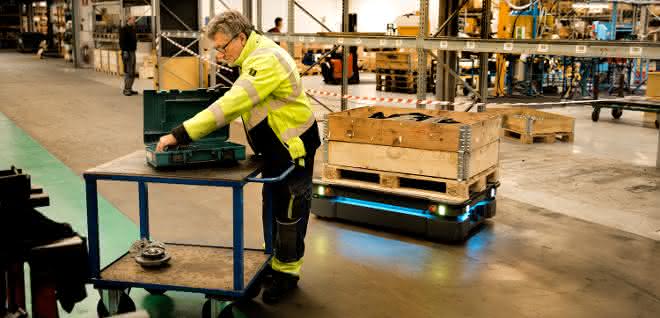
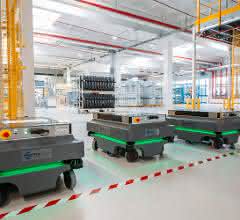
Many people associate the name Whirlpool with bubbling luxury bathtubs that you lie down in to relax. But the company also produces large household appliances such as dryers, washing machines and ovens. This is also the case in Lodz, Poland: "In our factory, a dryer rolls off the production line every 15 seconds," explains Szymon Krupiński, plant manager at the site. "This means an enormous amount of work for production logistics, which has to transport a large number of individual parts to the production lines." Krupiński and his team are now supported in this task by three autonomous transport robots from Mobile Industrial Robots (MiR). They transport dryer doors from pre-assembly to assembly - completely autonomously.
Standards lag behind technological progress
The robots can only provide such flexible support because they can move safely and freely. Safety and autonomy go hand in hand with MiR technology. However, regulation through uniform standards is proving difficult, as mobile robotics is developing rapidly and is therefore always one step ahead of the standards situation. Manufacturers, system integrators and users therefore make do with a combination of different regulations. In particular, the European standard (EN) 1525 has been used to date. However, this was designed with traditional AGVs and industrial trucks in mind, which are usually larger and more cumbersome than maneuverable mobile robots. The strict criteria for safety assessment therefore only meet these to a limited extent. However, the standard neglects special features of mobile robots such as their autonomous control. The ISO 3691-4 standard published in 2020 addresses these characteristics in regulatory terms for the first time and can therefore define much more precise safety requirements for mobile robots. This should speed up the risk assessment of autonomous robotics applications.
Sensor-assisted navigation allows freedom of movement
Manufacturers like MiR already equip their robots with a range of safety functions. Sensor technology plays a key role here: all MiR robots are equipped with two laser scanners. These allow them a 360-degree view so that they can recognize people, objects or other AGVs next to or in front of them. Two 3D cameras also help them to see objects at a height of up to 1.7 meters. The two heavy-duty models MiR500 and MiR1000, which can carry up to 500 or 1,000 kilograms, also have 24 proximity sensors in each corner. These prevent them from running over the feet of employees, for example. Thanks to the speedometer and gyroscope, the wheels do not skid on slippery floors.
In addition to sensor technology, software is also very important for the safety of mobile robots: integrated algorithms process the sensor input and enable the robots to react to their environment, for example by avoiding obstacles or braking if necessary. At Whirlpool, for example, many forklift trucks also drive through the aisles - their drivers do not always have the low robots in view. To avoid collisions, the robots can also be programmed to slow down when they are in a busy zone or to avoid it altogether. They also draw attention to themselves with signal lights and acoustic signals.
In addition to these features, there are also mandatory safety functions that allow the robot to operate safely even in the event of a defect. If a robot is defective and has a short circuit, for example, even the best navigation concept is useless. The ISO 13849-1 standard therefore stipulates four functions for all mobile robots: Emergency stop, protective field switching, person detection and speed monitoring. For robots with a higher payload, it requires additional functions such as field muting or a stricter speed limit.
However, technology is only as good as its user - this also applies to the safety of mobile transport robots. First of all, it is up to the manufacturer to provide a technically flawless product that is CE-certified and complies with current market safety standards. The integrator, in turn, is responsible for the correct integration of the application into the respective operating environment. This is not just about the robot itself, but about the entire application including the add-on module, trailer, charging station and other equipment. CE certification is also required here in accordance with the planned use. As part of a comprehensive risk assessment, the integrator also identifies potential hazards in the operating environment and programs the robot so that it can react to them in accordance with safety standards.
Both the manufacturer and the system integrator must make it clear where the possibilities and limits of the robot's use lie. Only if the user follows these in turn can the robot support him and his employees without risk. It is also important that the respective user company defines precise processes for the maintenance and servicing of its robots. Ultimately, safety is therefore also a question of transparency: each party must provide the relevant information on the product, application and use in full so that the robot can be used correctly. And this applies not least to the target group of employees who will ultimately be working with the robot: It is crucial to pick up all employees right from the start and make it clear to what extent the MiR technology will support them in their day-to-day work. This means that nothing stands in the way of safe robot use.


You might also be interested in
Micro motors as the driving force behind intralogistics
Suitable transport structures in intralogistics are a prerequisite in all industries in order to withstand competitive pressure in the future. The basis for this is comprehensive automation, which would be inconceivable without an armada of powerful...
 read more...
E-scooter with customizable damping
The startup Scuddy has significantly improved the flexibility, performance, customizability and ergonomics of its second-generation foldable e-scooter of the same name - thanks in part to damping technology from ACE.
read more...Electric multidirectional counterbalanced...
360-degree steering on three wheels
Hubtex has given its FluX electric multidirectional counterbalanced truck an update: The new generation for the three-ton capacity class.
read more...New FLUX: 360-degree steering on 3 wheels
HUBTEX presents the new generation of the FLUX 30 electric multidirectional counterbalanced truck (load capacity 3 t). The innovative 2-in-1 stacker is both a front and sideloader. With its patented 360-degree HX steering, it transports both long...
read more...Norelem supports VDI Racing Camp
Mastering the challenges of e-mobility
Promoting young talent has been a priority at Norelem for many years: the company supports young talents with components and the necessary know-how and provides schools with illustrative material.
read more...igus:bike honored with German Design Award 2023
A wide, angular frame made of plastic, black wheels with Y-spokes: The futuristic look of the bicycle designed by Dutch bicycle developer mtrl with motion plastics from Igus can look forward to the prestigious German Design Award 2023.
read more...Floating garbage trap cleans up the Rhine
Every day, a ton of garbage flows down the Rhine. To catch some of it, the Cologne-based Krake association has now inaugurated a floating garbage trap. One of the sponsors of the so-called Rhine octopus is the plastics specialist Igus.
read more...Torwegge presents FlexO rollers
Visitors to the FMB - Supplier Fair for Mechanical Engineering can once again look forward to a new product at the Torwegge stand this year: the FlexO rollers.
read more...Igus partner Mura's project is making progress
Recovering crude oil from plastic: This is the goal that the British company Mura Technology is pursuing with the HydroPRS process. Igus has been supporting the project as an investor since 2020. The first HydroPRS plant for the chemical recycling...
read more...