
Simcenter Testlab
Increase test productivity and collaboration
Siemens Digital Industries Software presents the latest version of the Simcenter Testlab software. It is part of the portfolio of Simcenter simulation and test solutions as part of the overarching portfolio of integrated software from Siemens Xcelerator.
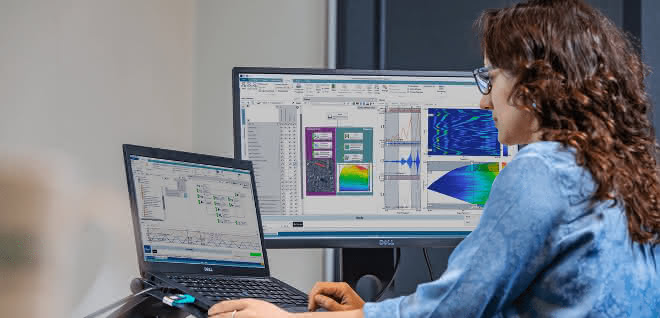
The new version brings updates to Simcenter Testlab Neo, improves model-based system testing with Model Based System Testing (MBST), introduces Digital Image Correlation (DIC) as a new technology for structural dynamics and enables earlier analysis of acoustics and vibration behavior (NVH) of the whole vehicle in the design process. Test and simulation engineers will benefit from this latest version for multidisciplinary, test-based performance engineering, as will test campaign managers, because it offers their teams in particular new opportunities to innovate intelligent products more productively.
The latest developments in the industry mean innovation, but also bring with them new demands and requirements. These include the need to achieve realistic and predictable results more efficiently than ever before. Test teams are now working closely with simulation teams because fewer and fewer prototypes are available and digital twins are required from the earliest stages of development. At the same time, there is also a need to maximize the benefits of the vast amounts of data generated during simulation and captured during testing.
With Siemens Simcenter Testlab, test engineers can access new technologies that increase productivity when collecting and processing data. The effort required to compare and correlate test and simulation results is minimized, and validated simulation models - digital twins - generate valuable additional data during physical tests. At the same time, Simcenter Testlab offers direct data access to simulation results in many formats. This allows simulation engineers to utilize the data processing capabilities of the software as well as ensure the comparability of processing functions and parameters between the physical and virtual tests.
The characterization of the behaviour of materials and structures under load alone makes a significant contribution to improving designs and developing high-performance products. New developments in digital camera technology combined with high performance Digital Image Correlation (DIC) allow the user to extract full-field 3D geometry, displacement and strain information under any load and for almost any material - all with limited metrology input. DIC can then be used to determine material properties, validate numerical models and assess the strength of materials and components, as well as analyze structural vibrations and dynamic response. This allows development cycles to be designed more quickly and in line with requirements.
With the component-based transfer path analysis in Simcenter Testlab, vehicle characteristics can be evaluated at an early stage of development. This unique and comprehensive solution ensures the optimal use of available information on subsystems and components in the form of measurement data or simulation results. It calculates and provides accurate and consistent NVH models of components. It provides the user with optimized component characterization methods and predictive NVH synthesis that supports the evaluation of acoustics and vibration behavior of virtual prototypes.
The new software version Simcenter Testlab 2021.1 brings these and many other improvements for test and simulation teams together in a solution that combines physical testing and virtual simulation across the entire development cycle, creating new opportunities to innovate smart products more efficiently.


You might also be interested in
AI automation specialist reorganizes...
Generation change at Insiders Technologies
After almost 30 years at the helm, Werner Weiss is handing over the management of Insiders Technologies. Andree Albrecht takes over the management after a transition phase.
 read more...
Intelligent brownfield networking
Many industrial companies are struggling with established plant structures and proprietary interfaces. Stefan Klaus' presentation will show in a practical way how brownfield environments can be efficiently networked with open technologies and made...
read more...Factory-X in practice
How can set-up processes in highly variant production be automated efficiently? Markus Benndorff from soffico shows how Factory-X, industrial data rooms and modular architectures create new possibilities for flexible production concepts.
read more...Quality controls in production
Robots check car floor pans fully automatically
How can complex components in automotive production be inspected fully automatically and in real time with the help of machine vision and robotics? The case study shows how floor pans are measured and inspected fully automatically.
read more...Measurement software with integrated calibration wizard
The WinControl measurement software from Ahlborn is designed for the acquisition and processing of measurement data with Almemo measuring devices and offers functions for complex calibration tasks. A graphical user interface and context-sensitive...
read more...New platform facilitates chip design
Siemens opens access to EDA software in Europe
Siemens is cooperating with the Chips JU within the framework of EuroCDP and is facilitating access to modern EDA software for chip design, development and innovation for European companies. The aim is to strengthen start-ups, SMEs and research...
read more...AI and virtual twins for the industry
Dassault Systèmes confirms annual forecast after solid start to 2026
The French software group Dassault Systèmes has made a solid start to 2026 and is continuing to focus on artificial intelligence, cloud applications and virtual twins as growth drivers in its industrial business.
read more...Use data consistently and uniformly
New connectors and an app solution for the IIoT framework from PLCnext Technology make it easier to collect data from controllers, sensors and field devices - especially in existing systems.
read more...How companies can prevent cyberattacks
Instead of using traditional malware, attackers use legitimate programs and system tools within their victims' IT environments. Malicious behavior can hardly be distinguished from normal user behavior. For companies, this means that security...
read more...