

Conveyor technology in use at glass manufacturer
Step by step to an automated material flow
Bottles, packaging glass, hexagonal glass, tureen glass, tumblers, wire bow glass or various special glasses: the medium-sized company Noelle + von Campe, based in Boffzen, Lower Saxony, has more than 600 glass shapes in its range. And the forecast for the glass industry? Constantly growing sales. An increasing scale that recently prompted the company, founded in 1866, to expand its Plant II, which opened in 2009.

For more than 150 years, Noelle + von Campe has been producing glass packaging in all conceivable sizes and shapes, exporting throughout Europe and thus maintaining its position as a sole proprietorship to this day. The family business is therefore considered to be the last remaining one in the region in the field of glass production.
Up to two million units of glass packaging leave the two plants in Boffzen every day. And Noelle + von Campe is certain that the boom in glass will continue: "In view of the current debate about waste and glass packaging, we expect the glass boom to continue," says the company. However, it is not only in terms of sustainability that the family-run company is taking a consistent approach; the company has also been continuously focusing on technological progress in terms of efficiency and automation in the area of logistics: Noelle + von Campe equipped its production and logistics lines with innovative conveyor technology back in 1993, 2008 and 2014, thereby fully automating previously manual processes. Since then, the company has relied on the more than 60 years of experience of HaRo Anlagen- und Fördertechnik, a family business based in Rüthen, Sauerland: since 1957, HaRo's range of services has included the implementation of complex applications using efficient material flow technology. Depending on the requirements, standard components or special designs are used that promise a cost-effective and high-quality solution. Valuable benefits from which Noelle + von Campe also sought to profit in a new project: the company deepened its long-standing business relationship with the HaRo Group by installing a passageway for forklift trucks and a doppler to supplement the existing system.
Looking back: Basic installations 1993
HaRo was able to acquire Noelle + von Campe as a new customer with two orders back in 1992. Initially, the outfeed of production was almost completely automated: HaRo installed pallet dispenser systems for palletizing the glassware for five production lines. The individual lines in the basement were then supplied with empty stacks by forklift trucks. Vertical conveyors transported the stack to the first floor and a motorized push fork transferred a single empty pallet to the palletizing station.
In the second project, HaRo implemented the shipping preparation: After shrink-wrapping and labeling the pallets, they were guided into the cold hall area of the shipping department through a climate lock, scanned and ordered via data exchange into 6 parallel target storage routes for the forwarding logistics.
Extensions after 1993 to 2004
Steadily increasing sales figures at Noelle + von Campe necessitated a corresponding expansion of the machinery just a few years later. Two additional production lines were gradually installed. HaRo supplied the corresponding equipment for the pallet dispenser systems and enlarged the dispatch warehouse. Due to constant increases in product quality controls, the single glass transport system area had to grow. The complex task of relocating all the systems installed by HaRo by around 25 m was completed on schedule.
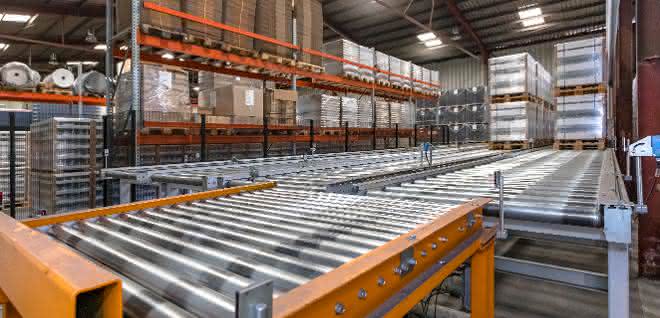
2008: Basic systems plant II
Meanwhile, the production space was exhausted, so Noelle + von Campe built a second plant around 700 m away from the old location. Here, too, the family-owned company relied on proven HaRo technology: in line with the requirements in Plant I, pallet dispenser systems and a dispatch station were installed for five production lines; using state-of-the-art technology with numerous innovations, such as Profibus architecture in the control technology, Siemens S7, graphic operating panels for maintenance and manual operation and Ethernet modems for remote analyses. Data exchange with the ERP system was modernized. The mechanics also grew with the tasks; particular attention was paid to ease of maintenance and durability. Two of the five pallet dispensers were functionally equipped with additional strokes. These allow employees to carry out checks more easily directly at the palletizing station and make this workstation more ergonomic.
2013: Extensions to Plant I and II
In the meantime, the capacity of the dispatch stations in Plant I had also been exhausted. In Plant II, a complete night shift production was to be automatically and purposefully buffered in dispatch.
HaRo designed a completely new storage system at Plant I. An optimum solution was found using process simulations. The previous dispatch storage facility was dismantled for this purpose; the pallets were then transported directly from production via a bridge that could be driven underneath into a separate cold storage building. The goods reached the new storage station via a lift. To increase capacity, certain goods were doubled, i.e. placed on top of each other in the correct position after prior alignment. After barcode scanning, the goods were automatically distributed to the target buffers, with some of the pallets being offset by 90° using a manipulator to maximize the usable space on the transport trucks.
Following a query to the ERP system, a complete truck load was put together and compacted.
In addition, the basement of the production facility for swing glasses was connected to the new warehouse using a lift and conveyor technology.
In Plant II, HaRo implemented an additional dispatch storage facility with an approximately 100 m long feed system from the existing storage facility. This enabled a complete night shift production to be prepared for dispatch on ten parallel buffer lines. The goods reached the target route predetermined by the ERP system via scanner. A transfer trolley distributed the goods effortlessly and reliably.

2014: External warehouse
Noelle + von Campe has the advantage of being able to react quickly and flexibly - even for large order volumes. The company has its own large covered outdoor storage areas around the production sites for this purpose. The internal supply of these warehouses using automated trucks had to be optimized with downstream conveyor technology. At two strategically favorable delivery points, the truck placed the entire load onto a pre-storage conveyor in one go. The HaRo systems separated the compacted pallets from each other in two lanes and, depending on the situation, made them available to the forklift truck via corner transfer units for zero-pressure accumulation removal.
2018: Plant II extensions
Optimum utilization of the production lines and increased product variety led to the upgrading of three pallet dispenser systems with additional strokes at the palletizing station. This also improved ergonomics and minimized inspection times, which also increased efficiency.
2019: Plant II extensions
At the end of production in Plant II, the newly installed pallet doubler increased the capacity of the dispatch stations. A forklift truck passageway in the feed section to the second night shift storage area provided access to the adjoining storage area. The use of a hall door separated two hygiene areas. For high cycle rates, the transfer car took over five pallets in one go. Comprehensive personal and plant protection measures provided complete safety. Step by step, Noelle + von Campe succeeded in automating and optimizing the internal material flows.


You might also be interested in
Predictive maintenance in retrofit
Predictive maintenance pays off. This is because early detection of impending failures means that systems can be serviced in a targeted manner before production downtime occurs. But how complex is it to integrate such a maintenance concept into an...
 read more...
Maintenance instead of replacement
The circular economy starts with the machinery
Sustainability in industry starts with machines, says our guest author from Deguma: How maintenance, modernization and the 5R strategy save resources, energy and CO₂.
read more...3D printing for unplanned requirements
The material fails and the machine suddenly stops? Then you need to take the right measures to be able to resume production quickly. Material failure in the form of faulty components or material wear in the frame are a risk for any production.
read more...High demands in terms of safety, application and robustness
Demanding work in the electrical trade and energy supply as well as smooth processes in production require innovative and customized measurement technology that scores points for safety, ease of use and resilience.
read more...Car meets e-bike: riding with lubrication-free polymer bearings
Studies show that the proportion of pedestrian and bicycle traffic is increasing in urban areas. With the JetBike, JetBike GmbH from Braunschweig presents a mixture of e-bike and car and relies on lubrication-free polymer bearings from Igus.
read more...Hydraulic hub for more efficient servicing
Bosch Rexroth presents a digital toolbox for service and maintenance. With a comprehensive range of digital services, the Hydraulic Hub simplifies and accelerates the service and maintenance of hydraulic products and increases machine availability.
read more...Arnold Umformtechnik expands after-sales...
Faster help with VR glasses
Arnold Umformtechnik is expanding the after-sales service for its machines to include digital remote services. The focus is on data security, simple operation and clear processes.
read more...147,000 euros per hour: high costs for German companies due to unplanned downtime
According to the "Value of Reliability" study, 67% of industrial companies in Germany experience unplanned downtime at least once a month. This costs the German economy 147,000 euros per hour. Nevertheless, reactive maintenance concepts are not...
read more...Maintenance starts with a maintenance planner
Legal requirements stipulate that machines and systems must be serviced regularly. The maintenance work serves to ensure occupational safety and economic efficiency.
read more...