

Project H2Ports
Electric reachstacker for the port of Valencia
Hyster Europe is developing a zero-emission reachstacker with a fuel cell for the port of Valencia as part of the EU's Horizon 2020 program and the H2Ports project. The Spanish port will be the first in Europe to use hydrogen as an energy source in its operations.
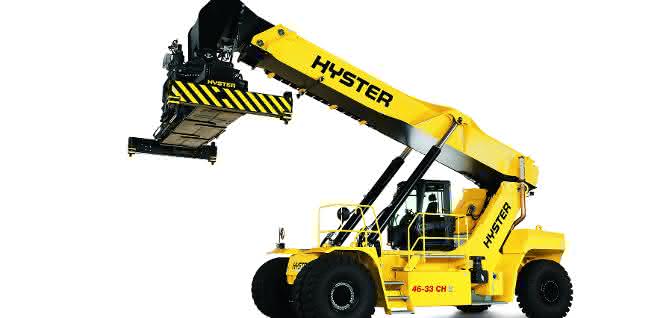
"The integrated hydrogen fuel cell charges the battery of the Hyster reachstacker, which is powered exclusively by electricity," says Jan Willem van den Brand, Director Big Truck Product Strategy and Solutions at Hyster Europe. The reachstacker for the H2Port project is being tested at the MSC Valencia terminal, which can currently accommodate the largest container ships and offers around 260,000 square meters of container storage space. The newly developed machine is expected to go into operation in 2021 and will be put through its paces handling loaded sea containers.
First reachstacker of its kind
"The new Hyster reachstacker is the first of its kind. We expect it to run uninterrupted and emission-free over the entire shift and achieve a comparable performance to a conventional combustion engine reachstacker," says van den Brand. The machine has electric motors that are powered by high-voltage batteries. In addition, the reachstacker's noise level is low and ports can expect a reduction in their energy costs. Hyster also expects lower maintenance costs as a result of the switch to electric drive, as the gearbox and other mechanical components are no longer required.
According to van den Brand, the reachstacker offers advantages for ports in areas with demanding conditions. "We want to maximize uptime, minimize recharge cycles and optimize energy consumption. We also comply with all applicable environmental regulations and meet the requirements for EU funding."
The Hyster-Yale Group is collaborating on the H2Ports project with the Port Authority of Valencia, the Valenciaport Foundation, the National Hydrogen Center, the MSC Terminal Valencia, the Grimaldi Group, Atena, Ballard Power Systems Europe and ENAGAS. The project was financed by the Fuel Cells and Hydrogen Joint Undertaking (FCHJU), which also includes the construction of a mobile hydrogen supply station. as


You might also be interested in
Predictive maintenance in retrofit
Predictive maintenance pays off. This is because early detection of impending failures means that systems can be serviced in a targeted manner before production downtime occurs. But how complex is it to integrate such a maintenance concept into an...
 read more...
Maintenance instead of replacement
The circular economy starts with the machinery
Sustainability in industry starts with machines, says our guest author from Deguma: How maintenance, modernization and the 5R strategy save resources, energy and CO₂.
read more...3D printing for unplanned requirements
The material fails and the machine suddenly stops? Then you need to take the right measures to be able to resume production quickly. Material failure in the form of faulty components or material wear in the frame are a risk for any production.
read more...High demands in terms of safety, application and robustness
Demanding work in the electrical trade and energy supply as well as smooth processes in production require innovative and customized measurement technology that scores points for safety, ease of use and resilience.
read more...Car meets e-bike: riding with lubrication-free polymer bearings
Studies show that the proportion of pedestrian and bicycle traffic is increasing in urban areas. With the JetBike, JetBike GmbH from Braunschweig presents a mixture of e-bike and car and relies on lubrication-free polymer bearings from Igus.
read more...Hydraulic hub for more efficient servicing
Bosch Rexroth presents a digital toolbox for service and maintenance. With a comprehensive range of digital services, the Hydraulic Hub simplifies and accelerates the service and maintenance of hydraulic products and increases machine availability.
read more...Arnold Umformtechnik expands after-sales...
Faster help with VR glasses
Arnold Umformtechnik is expanding the after-sales service for its machines to include digital remote services. The focus is on data security, simple operation and clear processes.
read more...147,000 euros per hour: high costs for German companies due to unplanned downtime
According to the "Value of Reliability" study, 67% of industrial companies in Germany experience unplanned downtime at least once a month. This costs the German economy 147,000 euros per hour. Nevertheless, reactive maintenance concepts are not...
read more...Maintenance starts with a maintenance planner
Legal requirements stipulate that machines and systems must be serviced regularly. The maintenance work serves to ensure occupational safety and economic efficiency.
read more...