

"Intelligent Guided Vehicle (IGV)
Controlled with swarm intelligence
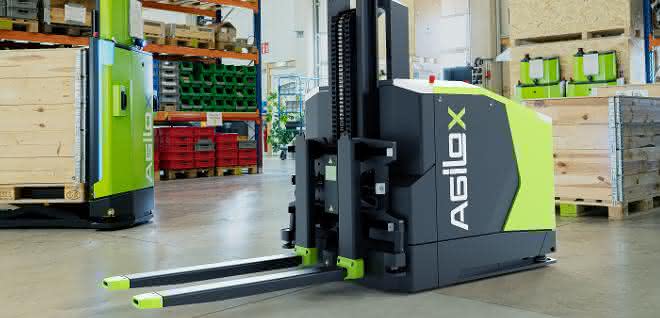
The "ONE" is followed by the "OCF": Agilox is expanding its range of intelligent transport systems controlled by swarm intelligence to include an autonomous, omnidirectional counterbalance truck. The Austrian company is thus targeting the area of application of classic intralogistics in incoming goods, outgoing goods and warehouses.
With the ONE light industrial truck, the manufacturer had rethought the concept of AGVs: the compact vehicle moves autonomously and navigates freely in production or in the warehouse. The fleets do without a central control system. Instead, they organize their routes according to the (decentralized) principle of swarm intelligence. This makes them more flexible. In addition, programming or teaching the vehicles is simpler; central software programs, including maintenance and updates, are not required. Agilox is now expanding its range of IGVs (Intelligent Guided Vehicles) to include the OCF. This designation stands for "Omnidirectional Counterbalance Forklift". While the ONE is equipped with a scissor lift as a load handling device and thus transports the load within the vehicle contour, the OCF is designed according to the counterbalance forklift principle. It can pick up pallets or pallet cages and other load carriers with a maximum weight of 1,500 kilograms, transport them to their destination and set them down at a height of up to 1,600 millimetres.
This opens up new areas of application for the manufacturer's IGV concept. While the ONE vehicles are primarily used for material supply in production, the OCF is aimed at classic intralogistics tasks in incoming/outgoing goods, order picking and warehousing - and also in production, provided the transport there is pallet-based.
Just like the ONE, the OCF uses an omnidirectional drive concept. This means it can also drive crosswise into rack aisles, turn on the spot and maneuver in the tightest of spaces. The lithium iron phosphate (LiFePO4) battery ensures short charging times and long operating cycles. The IGV fleets can be connected to customer software systems (LVR, ERP, WMS, MES) via an API interface. An additional IO box enables the integration of external infrastructure, such as roller shutters and stationary conveyor systems, into the intelligent control system. An analytics module provides the user with all relevant operating data and KPIs.
One advantage is the mixed operation of ONE and OCF in a "swarm": the smaller vehicles can provide feeder services to assembly workstations or supply E-Kanban racks, while the OCF take over pallet transport and use the same control and WiFi infrastructure. Series production of the OCF will start shortly; the first vehicles will be delivered to customers in the first quarter of 2021.


You might also be interested in
CU-Flex copper processing center
Process copper in three stations
Boschert also presented the revised CU-Flex copper processing center with its three stations for punching, bending and shearing in Hanover. This allows users to completely manufacture copper parts in just one work process.
 read more...
Transportation of sheet metal blanks
ACE industrial gas tension springs relieve the strain on blank grippers
Two medium-sized suppliers have joined forces to increase safety when designing a new blank gripper for the automotive industry.
read more...Safelog expands its portfolio
The AGV family from Safelog is growing. With the AGV M4-C, the technology company from Markt Schwaben is launching a new transport robot with a scissor lift system.
read more...Koenig's discipline
AMF clamping technology pulverizes production times at the world's oldest printing press manufacturer Koenig & Bauer in Würzburg
read more...Moving heavy loads easily
For a manufacturer of lift tables, the collaboration with Blickle has paid off in full. The wheel and castor specialist supplied castor solutions with the ErgoMove electric drive system.
read more...More safety for smooth warehouse processes
Ergonomics and an improved workstation layout, the introduction of a safety culture, specific work instructions and the introduction of regular safety checks ensure a safe environment in a warehouse.
read more...New AGV generation presented
Safelog has launched the first "Generation 21" model on the market. The centerpiece is a newly developed brushless DC motor.
read more...Trend towards ergonomic workstations: lifting tables for a more efficient production process
Lift tables are real all-rounders in workshops. They serve as a flexible workstation, can lift heavy loads and facilitate intralogistics tasks in the mobile version.
read more...Relieved by five tons
The Japanese pharmaceutical company Takeda has started to use robots in packaging. A collaborative CR-15iA from Fanuc now relieves employees of five tons per shift in 24/7 operation.
read more...