

Retrofit in Industry 4.0
How to take the step towards the smart factory
The benefits of Industry 4.0 are now within reach for all manufacturing companies - even if they operate older machinery. This is made possible by innovative solution concepts for connecting existing equipment to the Internet of Things (IoT). The necessary software and hardware solutions can be integrated at a later date.
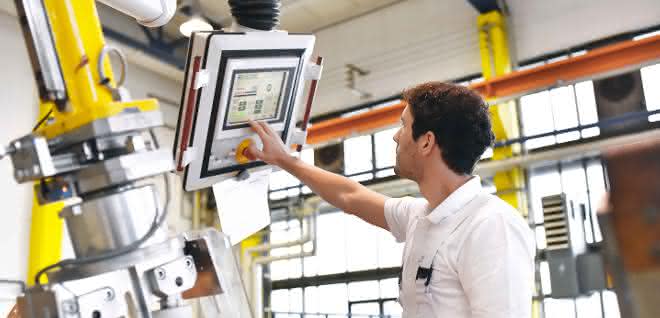
Tracking the location of a specific object in real time and replacing components today that would be defective tomorrow: The networking of industrial plants opens up a wide range of potential and creates the greatest possible transparency with regard to production processes. The information obtained helps to answer business management questions - for example, whether it is worth outsourcing a particular process step or why a machine is not performing at full capacity. With the help of industrial PCs and business intelligence software individually tailored to the required application, machines and systems of all ages can be networked. This enables SMEs to participate in the Internet of Things without having to make the enormous investment in state-of-the-art machinery. As system integrators, IT architecture firms supply the entire necessary infrastructure from a single source - from software and hardware to IT security and stable WLAN networks.
Retrofit - the path to an intelligent machine
The Osnabrück-based IT architecture company Sievers-Group offers users who want to make their existing systems and machinery fit for Industry 4.0 a simple solution: retrofitting with the help of edge computing systems. These are attached directly to the machine, where they centrally record and evaluate system data such as temperatures, pressures or vibrations. Only relevant information - for example measured values outside a defined tolerance range - is then forwarded to central databases. "Some robots generate four gigabytes of data per second. Such a flood of information cannot be fully recorded and historicized. The edge computing systems act as gatekeepers here," explains Robert Brockbals, Division Manager Business Solutions at the Sievers Group. This relieves the data networks and reduces latency. The measured values of the individual machines are summarized in a database and linked with data from ERP, CRM or PDA systems. On this basis, the information can be used for reporting, planning or simulations with the help of business intelligence solutions. If anomalies occur on a machine, companies can react immediately and avoid potential downtime. In combination with business information on production or sales, the system data can also be used to derive optimization potential for the entire production process. To this end, the company advises users and develops the mathematical-statistical models for calculating and evaluating the mass data.
Stability and security as basic requirements
The networking of production facilities in the industrial environment generates large volumes of data streams that need to be routed and secured. As part of Industry 4.0 concepts, IT architecture firms provide stable WLAN networks and resilient security concepts on request. The creation of a highly available network is the basic prerequisite for the smart factory. This is the only way to process large volumes of data and gain an insight into the status quo of the factory. Technologies such as radiating cables are used to equip production facilities with reliable Wi-Fi. These slotted cables function like an antenna with uniform radiation. This ensures seamless network coverage with high-speed Wi-Fi of up to 150 Mbit/s. There are also user-specific factors that require the use of slotted cables. For example, there are certain materials that absorb conventional WLAN signals. These include aluminum.
As soon as the production plant is networked, it is important to protect the sensitive data in the machinery against external attacks. IT security is becoming an increasingly important issue, especially for highly specialized medium-sized companies with leading expertise. "In order to keep an eye on our customers' data security at all times, we actively monitor the system environment and operate a security control center that is available 24/7," says Brockbals. The company also simulates external attacks on request in order to uncover vulnerabilities, such as open firewall ports. Afterwards, the customer receives a log and a risk assessment so that acute security gaps can be eliminated.
Transparency as the key to efficiency
The networking and monitoring of an existing machine park is essentially developed by companies via four application areas of Industry 4.0: condition monitoring, energy management, asset tracking and predictive maintenance. The goal is always the needs-based use of operating resources.
With asset tracking, the permanent analytical inventory of tools, objects are continuously located using RFID. In this way, companies can optimally manage the use of valuable equipment and avoid the time and costs associated with searching for or losing required tools. "Intelligent" objects permanently record data about their condition or surroundings and are able to communicate with their operator, other objects and ICT systems.
With condition monitoring, the condition of machines and systems is monitored by sensors collecting data about the direct environment of an object.
The principle of predictive maintenance is the early, needs-based alignment of maintenance cycles based on this data. As every user uses their machine differently, it is advantageous to be able to calculate wear precisely and individually using this technology. Analysis software records the sensor data, evaluates it and detects potential component failure at an early stage. Defective components that threaten to bring a system to an early standstill can be detected and replaced before any actual damage occurs. The associated savings potential is huge, as power consumption is reduced and maintenance costs are lowered in addition to shortening downtimes.
This is also important with regard to energy management, which enables efficiency to be maximized by saving energy costs. Energy data can also indicate an expected defect - for example, if a machine is consuming an unnecessary amount of energy because one of the components is worn out.
Retrofit in practice
One of the users that has already successfully completed the networking of its machinery with the help of the Sievers Group comes from the plastics processing industry. The new sensor technology used now continuously checks the injection molding machines that produce liquid plastic for wear. The challenge: the plastic must be injected into the molds at a constant speed to ensure uniform filling. However, the plastic contains glass fiber particles whose grain size causes abrasion. When this wear occurs, the injection molding machine rotates faster in order to achieve a uniform flow rate. Over time, this results in excessive energy consumption. "The energy data can be used to predict when a component should be replaced in order to make consumption more economical and prevent an impending defect," explains Brockbals. The step into the Internet of Things thus enables users to produce plastics economically and reliably.
According to documents from the Sievers Group / ag


You might also be interested in
Predictive maintenance in retrofit
Predictive maintenance pays off. This is because early detection of impending failures means that systems can be serviced in a targeted manner before production downtime occurs. But how complex is it to integrate such a maintenance concept into an...
 read more...
Maintenance instead of replacement
The circular economy starts with the machinery
Sustainability in industry starts with machines, says our guest author from Deguma: How maintenance, modernization and the 5R strategy save resources, energy and CO₂.
read more...3D printing for unplanned requirements
The material fails and the machine suddenly stops? Then you need to take the right measures to be able to resume production quickly. Material failure in the form of faulty components or material wear in the frame are a risk for any production.
read more...High demands in terms of safety, application and robustness
Demanding work in the electrical trade and energy supply as well as smooth processes in production require innovative and customized measurement technology that scores points for safety, ease of use and resilience.
read more...Car meets e-bike: riding with lubrication-free polymer bearings
Studies show that the proportion of pedestrian and bicycle traffic is increasing in urban areas. With the JetBike, JetBike GmbH from Braunschweig presents a mixture of e-bike and car and relies on lubrication-free polymer bearings from Igus.
read more...Hydraulic hub for more efficient servicing
Bosch Rexroth presents a digital toolbox for service and maintenance. With a comprehensive range of digital services, the Hydraulic Hub simplifies and accelerates the service and maintenance of hydraulic products and increases machine availability.
read more...Arnold Umformtechnik expands after-sales...
Faster help with VR glasses
Arnold Umformtechnik is expanding the after-sales service for its machines to include digital remote services. The focus is on data security, simple operation and clear processes.
read more...147,000 euros per hour: high costs for German companies due to unplanned downtime
According to the "Value of Reliability" study, 67% of industrial companies in Germany experience unplanned downtime at least once a month. This costs the German economy 147,000 euros per hour. Nevertheless, reactive maintenance concepts are not...
read more...Maintenance starts with a maintenance planner
Legal requirements stipulate that machines and systems must be serviced regularly. The maintenance work serves to ensure occupational safety and economic efficiency.
read more...