

Bitkom on artificial intelligence
Massive implementation problems with AI
Artificial intelligence is a megatrend. Machine learning in particular is on the rise, according to the digital association Bitkom. However, there is still a lack of implementation.

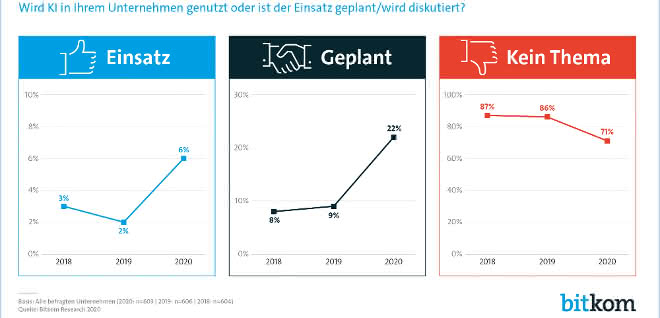
The digital association Bitkom conducted a representative survey on artificial intelligence and its use among 603 companies from all sectors with 20 or more employees. The result: around 73 percent of companies with 20 or more employees in Germany believe that AI is the most important technology of the future. However, just 6 percent use AI themselves and only 22 percent are planning to use AI or are discussing it. A year ago, however, the proportion was significantly lower, with 2 percent using AI and 9 percent planning or discussing it.
However, the central finding of the study is that there is not a problem of knowledge but a massive implementation problem with artificial intelligence. Bitkom President Achim Berg: "There is a broad consensus in companies about the outstanding importance of the technology for the future viability of our economy. But the majority find it difficult to use this knowledge for their own business."
AI in companies - now and in the future
Advanced applications tend to be the exception for companies that are already using AI today. "Currently, companies tend to use artificial intelligence for simple tasks and where it can quickly bring them concrete benefits," says Berg. "The public debate on the use of AI in companies very often revolves around personnel issues and concerns about discriminatory application procedures, for example. In the vast majority of companies, however, the use of AI to select applicants is not an issue at all."
The applications in detail: around two thirds (69%) of the companies surveyed state that they use AI in marketing for targeting and personalized advertising. In 4 out of 10 (40 percent), AI supports the automated booking of payments and the automated response to inquiries or complaints. One in three (32%) state that they use AI for price optimization and one in four (25%) for predictive maintenance. 19 percent use AI to plan transport routes, 17 percent to create automated forecasts. AI is used almost not at all for the pre-selection of applicants (2 percent) and in product development, for example through simulations (1 percent).
However, if you ask those companies that do not yet use AI, the picture is completely different. They mainly envisage scenarios where an AI automatically answers inquiries and complaints (95%), plans transport routes (88%), recommends predictive maintenance (86%), automatically books payments (84%) and personalizes advertising (83%). The use of AI for automated forecasts (78 percent) and price optimization (70 percent) is also frequently mentioned. However, companies can also imagine using AI for product development (56%) and the pre-selection of applicants (54%).
Increasing demand for training data expected
In a further survey, Bitkom questioned 503 companies from all sectors with 50 or more employees. Among other things, they were asked,
- the extent to which companies are already using or planning to use AI,
- whether, in their opinion or experience, the analysis of personal data is necessary for AI applications to provide usable analysis results,
- what measures are planned to ensure data protection when training AI systems with personal data
- how the demand for training data for artificial intelligence will develop in the company over the next five years.
The result: machine learning in particular is becoming increasingly important. This involves not only programming AI systems, but also training them with suitable data. Once the training process is complete, the systems can transfer the patterns and information recognized in the training data to previously unknown data sets. The demand for such training data will increase significantly in the coming years. Almost all companies (94%) that deal with AI assume that the need for training data will increase. Two thirds (66%) also say that personal data must be used in order for AI to deliver usable analysis results. "Data is the fuel for artificial intelligence," says Berg. "Companies that develop or use AI will therefore quickly reach the point where they also need to draw on data sets that contain personal data."
High legal costs
Companies go to great lengths to comply with legal requirements when training machine learning systems with personal data. Most of them, namely 69%, comply with data protection regulations by obtaining the consent of the data subjects. For 63% of the companies surveyed, there is no way around anonymizing the data, even though this removes the personal reference that is particularly valuable for many AI analyses. One in five companies uses pseudonymization, in which personal references are replaced. 42 percent process the data on the basis of a weighing of interests under data protection law and 16 percent use a service provider to ensure data protection. At the same time, one in ten companies (10 percent) state that they do not use personal data from the outset. "There is a large area of legal uncertainty and legal risks when using data. When in doubt, many companies decide against using data and against developing AI models," said Berg. "Data sovereignty and data accuracy must replace data minimization as the guiding principle if we want to successfully tackle the major challenges of the future."
More impetus from research desired
According to the digital association, companies would like to see more impetus from research when it comes to artificial intelligence. Only around one in three (39%) believe that Germany is a world leader in AI research. And only 38% believe that the German government's AI strategy is sufficient to prepare the economy and society for AI. Two thirds (69%) believe that more AI experts need to be trained at universities in Germany. The AI strategy includes plans to create 100 new AI professorships in Germany in order to strengthen AI research. However, after more than a year, only two professorships have been filled and the process is well advanced for around ten others.
For this reason, Bitkom has published the impulse paper "AI research in Germany - The difficult path to 100 new AI professorships", which takes stock of AI research at universities in Germany. According to the paper, there are currently 164 AI professorships at universities in Germany. By far the most are in Baden-Württemberg (39), Bavaria (30) and North Rhine-Westphalia (23), with the fewest in Saxony (2) and Mecklenburg-Western Pomerania (1). "The German government has set itself ambitious goals in its AI strategy with regard to AI research at universities," says Berg. "Under the current conditions, however, it is likely to be very difficult to fill 100 new professorships within a reasonable period of time as planned."
Four measures for more speed
Bitkom therefore proposes four measures to increase the speed at which jobs are filled:
- AI professorships should not only be filled in computer science, but also in other disciplines. Among other things, this would promote a plurality of AI research and underline the role of AI as a key technology that offers great opportunities for medicine or mobility, for example, but also for law and business studies.
- In view of the importance of AI, Bitkom advocates paying particular attention to diversity when filling vacancies.
- Existing regional strengths should be promoted. A new professorship at an already strong AI location is more attractive to applicants than a lone fighter who is to be appointed to a university out of regional proportionality.
- With a "Chair 2.0", AI professorships can go beyond traditional junior or W2/W3 professorships, which are often unattractive for internationally sought-after AI experts. Leading universities worldwide are leading the way here, where AI professors often only teach and research part-time on site and at the same time run their own start-ups or take on leading research tasks at large companies.
"If we are serious about strengthening AI research at German universities, then we must be prepared to make our university system as a whole more competitive internationally," said Berg. "With an AI Chair 2.0, we are not only strengthening research, we are also creating a significantly better transfer of research results from science to industry."


You might also be interested in
Predictive maintenance in retrofit
Predictive maintenance pays off. This is because early detection of impending failures means that systems can be serviced in a targeted manner before production downtime occurs. But how complex is it to integrate such a maintenance concept into an...
 read more...
Maintenance instead of replacement
The circular economy starts with the machinery
Sustainability in industry starts with machines, says our guest author from Deguma: How maintenance, modernization and the 5R strategy save resources, energy and CO₂.
read more...3D printing for unplanned requirements
The material fails and the machine suddenly stops? Then you need to take the right measures to be able to resume production quickly. Material failure in the form of faulty components or material wear in the frame are a risk for any production.
read more...High demands in terms of safety, application and robustness
Demanding work in the electrical trade and energy supply as well as smooth processes in production require innovative and customized measurement technology that scores points for safety, ease of use and resilience.
read more...Car meets e-bike: riding with lubrication-free polymer bearings
Studies show that the proportion of pedestrian and bicycle traffic is increasing in urban areas. With the JetBike, JetBike GmbH from Braunschweig presents a mixture of e-bike and car and relies on lubrication-free polymer bearings from Igus.
read more...Hydraulic hub for more efficient servicing
Bosch Rexroth presents a digital toolbox for service and maintenance. With a comprehensive range of digital services, the Hydraulic Hub simplifies and accelerates the service and maintenance of hydraulic products and increases machine availability.
read more...Arnold Umformtechnik expands after-sales...
Faster help with VR glasses
Arnold Umformtechnik is expanding the after-sales service for its machines to include digital remote services. The focus is on data security, simple operation and clear processes.
read more...147,000 euros per hour: high costs for German companies due to unplanned downtime
According to the "Value of Reliability" study, 67% of industrial companies in Germany experience unplanned downtime at least once a month. This costs the German economy 147,000 euros per hour. Nevertheless, reactive maintenance concepts are not...
read more...Maintenance starts with a maintenance planner
Legal requirements stipulate that machines and systems must be serviced regularly. The maintenance work serves to ensure occupational safety and economic efficiency.
read more...