

Optimize processes
AI as an ally in sheet metal production
Artificial intelligence will not replace humans. Rather, it should be seen as our ally when it comes to optimizing processes, such as in sheet metal production.
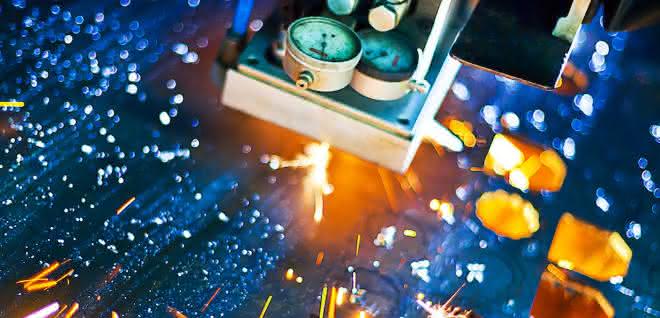
The most widespread forms of artificial intelligence are currently based on learning processes that arise from questions and suggestions for their answers so that people can better meet the challenges of various tasks. Complete automation is only possible for very simple processes that generally represent little added value.
AI also has a certain margin of error. This is because it searches for the best possible result based on algorithms, and this may not be the best possible solution in the individual situation. A human expert is therefore essential to monitor the AI in order to avoid possible errors. But will an algorithm one day have learned so much that humans no longer need to intervene? Perhaps in the distant future, yes. Because even if it is rather unrealistic for complex processes, algorithms are already learning from what we humans do. There will always be new versions, processes and technologies in the future. This means that humans and AI will have to continue to develop together.
In this sense, we will soon see jobs disappearing and jobs being redefined as a result of AI. And as in all previous industrial revolutions, the digital revolution will also create new professions to serve the changing needs - for example, coaches for artificial systems or AI maintenance technicians. Transition phases have always been part of the dynamics of industrial transformation. We are currently going through one of these with the development of Industry 4.0 and hyperconnectivity.
AI algorithms support companies
For sheet metal production, the question is: where and how can AI help us today? IT expert Lantek has developed a software suite that supports companies throughout the entire process chain - from quotation calculation and production to invoicing, warehouse management and customer and business analysis. The software solutions enable companies to gain new insights by using AI algorithms to evaluate all of the data generated in administration and digitally controlled production processes. Here are a few examples:
Optimization of residual sheet metal:
One of the handicaps in the production of sheet metal parts is the amount of scrap produced. With AI, the placement of parts on the sheet metal and the cutting itself can be optimized to make the best possible use of the material and reduce the amount of waste to a minimum.
Anomaly detection:
Let's assume that a workpiece is manufactured in four steps: cutting, punching, painting and welding. If there is a fault in one of these process steps, the program issues an error message. At present, a technician is usually required to rectify the problem. The focus is on using machine learning to one day eliminate the need for human intervention, except in exceptional situations.
Distribution of the workload:
With AI, it is possible to keep track of all the data generated in a production facility. To avoid interruptions in production, it can distribute the workload evenly across all available machines and automatically assign orders to another machine if one machine is down.
Order forecast:
The data history can be used to analyse behavioural patterns in demand, visualize trends and thus anticipate consumption trends. Forecasts can also be made, for example regarding material and personnel requirements.
The goal of every company is to optimize production and make better and faster decisions. With the support of AI, decision-making can be accelerated and simple manual work processes can be automated. In sheet metal production, the aim must therefore be to improve industrial processes by using AI in conjunction with tools such as CAD/CAM, MES or ERP to simplify everyday tasks and become more efficient and productive. Until now, extensive knowledge of processes and programs was necessary to operate these tools; AI can significantly reduce this requirement. The intelligent software can work both locally and in a cloud environment. The cloud offers decisive advantages, such as
- Very high availability of data
- Increased security through easier controllability or more security through highly professional protection mechanisms that are automatically updated according to applicable standards
- smarter decisions: Companies can identify patterns and trends more easily when they link their data in the cloud
- Easier scalability and great flexibility
- Cost optimization instead of dependence on conventional infrastructures
AI optimizes processes
AI helps companies of all sizes to optimize processes and gain an overview of the entire factory or production. They just need to be prepared to embrace it and develop it further. Then AI will increase the efficiency of processes and reduce production costs. We can no longer close our eyes to this reality - which we already have in our hands in the form of mobile devices, in vehicles and in our homes. Digital transformation is a reality and there is no turning back. The huge increase in remote working and increased automation of processes are just two indicators that we need to adapt to new environments and realities. And we have a strong ally in artificial intelligence.
Christoph Lenhard, Head of the German office of Lantek


You might also be interested in
ESTIA aims to strengthen Europe's cloud
New tech alliance for EU sovereignty
Twelve companies, including Dassault Systèmes, are founding the European Sovereign Tech Industry Alliance (ESTIA). The initiative aims to strengthen Europe's technological independence and define requirements for sovereign cloud services. The start...
 read more...
Deutsche Telekom and Nvidia launch one of Europe's largest AI factories
With the Industrial AI Cloud in Munich, Deutsche Telekom and NVIDIA are creating one of the largest AI factories in Europe. Companies can train AI models, carry out simulations and access 10,000 GPUs.
read more...Leveraging data potential with AI and streaming
Huge data treasures are still lying dormant in many manufacturing companies. And yet it is high time that these treasures were unlocked. There is often a lack of resources and capacity to make data usable in real time. Streaming production data can...
read more...More awareness of noise
Dematic offers solutions that are tailored to different cloud environments and reduce environmental impact through reduced material consumption and improved energy efficiency.
read more...Generative AI in the automation environment
The mechanical engineering and automation industry is undergoing profound change. This transformation is being driven by more volatile global trade, geopolitical crises and increasing market pressure, which demands greater agility, technological...
read more...Rigid data structures have had their day
The traditional data center is no longer the center of data. A hybrid cloud storage approach enables manufacturing companies to both meet the current requirements of data-intensive processes and future-proof their infrastructure.
read more...Software as a service in three stages
CIM Database Cloud is a new out-of-the-box solution from Contact for end-to-end digital product development.
read more...How production can benefit from AI
Together with AI technology, IIoT networking makes it possible to better control machine parameters and optimize quality with predictive quality. Downtimes and set-up times can also be further minimized. Cloud platforms also make these technologies...
read more...More expertise for digital engineering
Altair, a computational science and artificial intelligence (AI) company, has acquired OmniV, a technology from Michigan, USA-based software company XLDyn.
read more...