

Hybrid cable
Single-cable solutions for greater efficiency
Hybrid cables are increasingly being used in automation. All cables for power, signals and data for servo drives are combined in one sheath. The Lapp Group has developed two hybrid cables for motor feedback communication for a new digital interface from Hengstler. This interface solution in the field of rotary encoders makes servo motors more efficient, more compact and more future-proof.
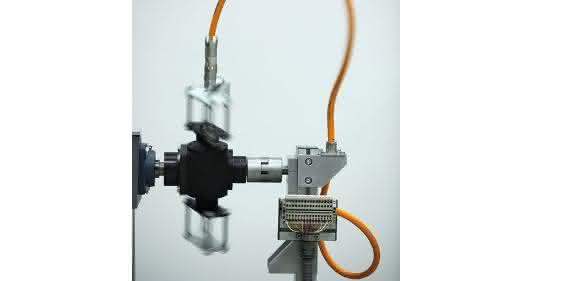
The smart factory can only work if machines and parts operate increasingly independently and communicate with each other via the network. This would not be possible without progressive digitalization and a high degree of flexibility. This is why servo drives have become indispensable in networked and flexible production environments. With the help of digital interfaces for motor-controller communication, important parameters such as position, speed, vibration or temperature can be transmitted. Motor and system manufacturers always focus on issues such as cost and space reduction, simple implementation and maximum performance.
Hengstler, a manufacturer of industrial counting and control components, has now introduced the new Acurolink interface. According to Hengstler, this guarantees a saving of at least 50 percent of the plug-in space, reduced set-up costs and a high level of machine safety. The entire motor feedback communication is realized via two hybrid cables specially developed by the Lapp Group.
Hengstler calls its technology Single Cable Solution. This is a combination of the high-performance Acuro AD37 encoder and the new Acurolink open interface. Hengstler has been involved in the development and production of encoders since 1983. "These many years of experience and the close cooperation with well-known customers during the pilot project phase ensure that the Single Cable Solution has the potential to create a new industry standard," says Adrian Benz, Team Leader Marketing Communication at Hengstler.
Gaining space and losing weight
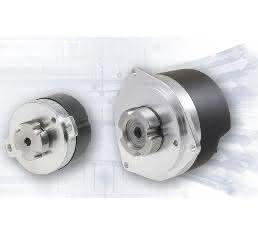
The data protocol of the electrical interface meets the SIL3 requirements according to IEC 61508, Cat. 3 PLe according to EN ISO 13849. The encoder contains both an internal temperature sensor and a separate connection for the motor's winding temperature sensor, making it possible to record this information directly in the encoder. A standardized "Electronic Data Sheet" (EDS) in the encoder stores specific encoder data and can be retrieved at any time. Motor and drive data can be stored in an internal OEM memory in the encoder itself. Acurolink offers great advantages, especially for compact servomotors. The provision of motor power and motor feedback signals via a single-cable solution significantly increases efficiency. The space saving and lower weight are particularly noticeable in larger systems.
Low-capacity cables with a small cross-section
The Lapp Group has developed two hybrid cables precisely matched to the digital interface: The Ölflex Servo FD 7DSL and the Ölflex Servo 7DSL. With this solution, both power and data are transmitted via a common cable. This also applies to the signals from other sensors, such as the temperature sensor, which are integrated into the digital motor feedback protocol. The FD variant is equipped with a highly durable PUR sheath and is therefore ideally suited for use in guide chains. If, on the other hand, the cable is used in fixed installations, the more cost-effective PVC version can be used. Polypropylene (PP) is used throughout as the conductor insulation material. This meets the demand for low-capacity cables and minimizes the problem of interfering leakage currents on the braided shield. In addition, smaller wall thicknesses can be realized with PP than with PVC.
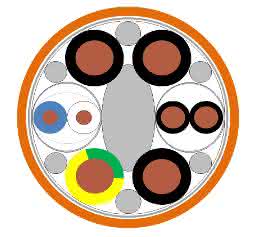
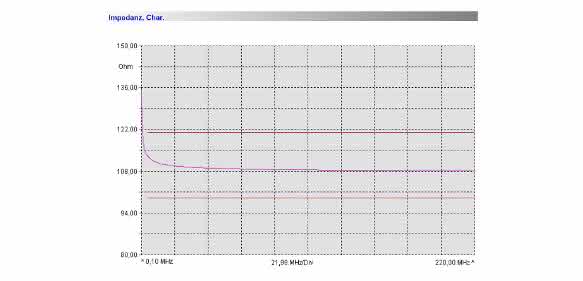
The lower wall thicknesses in the insulation also reduce the outer diameter. Up to 20 percent can be saved with PP compared to PVC. "We can also contribute our expertise to cables for torsion applications and offer types that meet the demanding requirements," says Lucas Kehl, Head of Product Management Cables at Lapp. As data is also transmitted in the hybrid cable, electrical parameters such as characteristic impedance, damping values, but also capacitance, inductance and resistance values as well as propagation times and wave impedances in the defined frequency range are of great importance. For Acurolink, for example, the characteristic impedance is specified as 110 ±10 Ω.
Inexpensive purchase, simple installation
Only one cable is required for power and data, and the separate encoder cable and connector are no longer needed. This reduces the amount of cabling required and results in significant potential savings in terms of materials and costs. The elimination of the encoder cable alone reduces costs by around 10 percent. Another advantage is the simplified installation.
Alternative hybrid solutions based on Industrial Ethernet, for example, or on optical data transmission systems such as POF optical polymer fiber (POF) or plastic-coated glass fiber (PCF) would also be technically possible. Lapp also has extensive know-how in this area. Particularly with regard to electromagnetic compatibility, the use of optical data transmission systems is worth considering, especially as the risk of interference or failure of electronic systems due to electromagnetic influences has increased significantly. am


You might also be interested in
Motors, gearboxes and encoders: Faulhaber expands Ø 16 mm portfolio
Faulhaber is expanding its portfolio with new DC motors from the SXR and GXR family, a 16 mm planetary gearbox and the IEX3 magnetic encoder for compact drive solutions.
 read more...
New drive solutions for industrial automation and robotics
Faulhaber presents drive solutions with the new GXR and SXR motor family, which offer high efficiency and flexibility in combination with powerful gearboxes and encoders. These optimized components open up new possibilities for applications in...
read more...Marco Altherr becomes new Chief Financial Officer
The Supervisory Board of Ziehl-Abegg has appointed Marco Altherr as the company's new Chief Financial Officer (CFO). Altherr will take up his post in May 2025.
read more...Hydrogen storage in metal hydride
With its focus on storage systems for green hydrogen in solid form (metal hydride), GKN Hydrogen presents itself as a pioneer in safety and efficiency for the industry. GKN Hydrogen offers safe storage systems for green hydrogen and focuses on two...
read more...INDUSTRIAL Production Products of the year...
2nd place, Robotics category: EGS Automation
The SUMO automation systems from EGS Automation - economical standard solutions for automating a wide range of processes in plastics and metalworking - took second place in the robotics category in the competition for Product of the Year 2024.
read more...More productivity with Drive Intelligence
The trends in automation are productivity, sustainability and connectivity. Baumüller is launching new products on the market that address these trends, including new tools for smart energy monitoring, condition monitoring in the drive and new...
read more...Intelligence in Motion
At SPS, Koco Motion will be showcasing its expertise in customized drive solutions based on DC and BLDC motors, stepper motors, servo motors, linear drives and controllers.
read more...Nomination Products of the Year 2024
EGS Automation: SUMO automation systems
The SUMO automation systems from EGS Automation, economical standard solutions for automating a wide range of processes in plastics and metalworking, have been nominated in the Robotics category in the competition for Product of the Year 2024.
read more...Transport technology from the modular system
Many transport tasks can be realized with the help of linear technology. Pre-configured solutions are available to simplify the interaction between the linear unit, motor, gearbox and controller. This minimizes the effort required for research and...
read more...