
Automation and Industrial IoT
Contactless signal transmission
SMW-electronics has developed inductive coupling systems to enable the contactless transmission of energy and signals between stationary and moving components in mobile systems. This coupling is wear-free and maintenance-free and replaces conventional transmission using cables and contacts or slip rings.
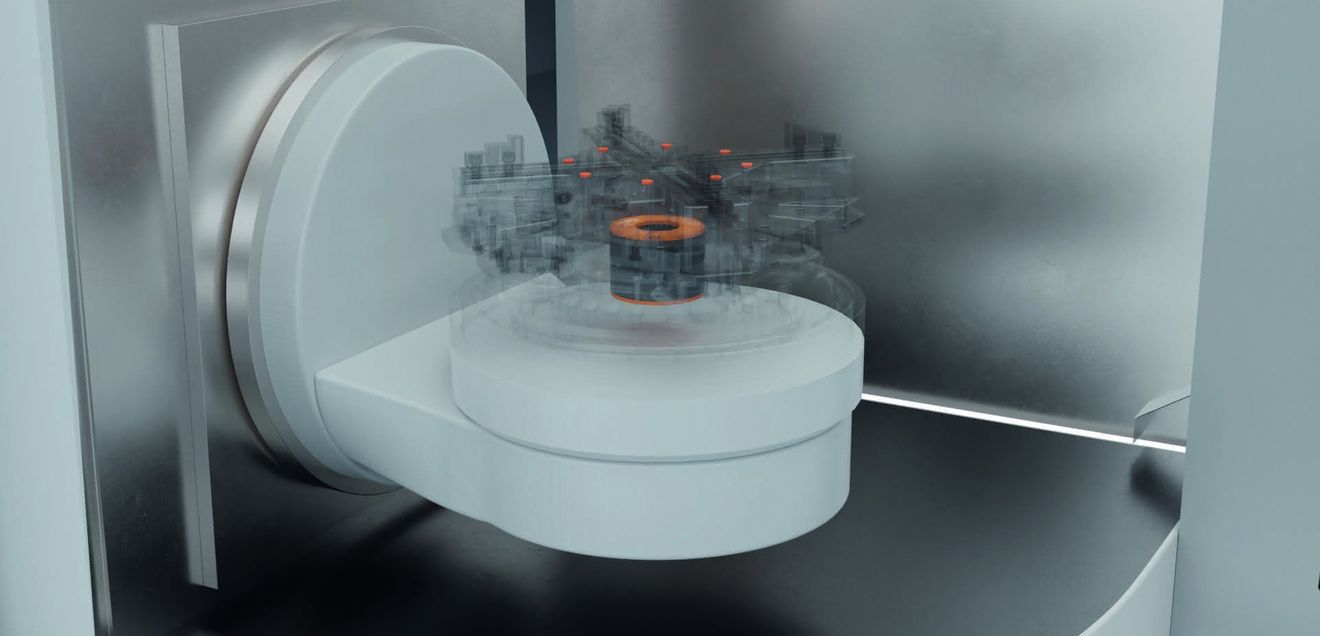
Progressive automation has led to the increasing use of sensors and actuators in rotating or moving system parts. Until now, these systems have used cables, connectors or slip rings to transmit power and signals. However, these components wear out and are susceptible to contamination. This problem is now solved by contactless, inductive coupling systems from SMW-electronics. They are available in different versions, both as radial couplers with and without an internal passage and as cylindrical couplers with a thread. They can be used to connect actuators and sensors in mobile plant components to bus systems and the power supply via an air gap without wear. The couplers are also often an ideal solution for stationary components - for example when partitions made of non-metallic material need to be bridged.
How the inductive couplers work
The IP 67 coupler housing protects the internal electronics and the coil set required for transmission from environmental influences such as water and dust. The electronics of the stationary unit (base) convert the DC voltage into an AC voltage with frequencies between 50 and 200 kilohertz, depending on the coupler. Energy is transferred by converting the AC voltage from the coil set in the stationary part into an alternating magnetic field and radiating it towards the mobile side (remote) via the air gap. On the mobile side, the captured magnetic field is again converted into an electrical voltage by the coil set. An alternating magnetic field with frequencies of 1 to 30 megahertz is also generated for signal transmission. The signal is transmitted by modulation (transmitter side) and demodulation (receiver side) of the sinusoidal fundamental oscillation. Analog couplers transmit the signals within 4 to 5 milliseconds, digital couplers within 1 millisecond. With couplers for Ethernet or IO-Link, the internal throughput time is only around 10 microseconds. Depending on the coupler, air gaps and non-metallic obstacles of 2 to 10 millimetres can be bridged and an angular offset of up to 20 degrees can be compensated.
The potential-free near-field transmission via an air gap results in a great deal of flexibility in the application. For example, offsets between the mobile and stationary sides can be compensated within a tolerance field. The couplers can also be used at high speeds, under harsh environmental conditions or in clean room applications. Couplers for power transmission from one to 1,500 watts are available as standard; systems for higher powers can also be developed for customer-specific applications. The limiting factor here is the available coupling area: the larger it is, the more power can be transmitted. The signals can be transmitted in the form of analog signals (0-10 V / 4-20 mA) or digital signals (PNP) via Ethernet-based fieldbuses, I/O-Link and CAN bus.
Application examples for radial couplers
The radial couplers in disk geometry were developed for machines in which the transmission of energy and signals to a moving machine component or a rotating shaft is required. Examples of applications include machine tools or end-of-arm tooling for robots: the inductive coupler systems allow the clamping force in a chuck to be permanently monitored even during rotation. Endlessly rotating applications can also be easily realized with inductive couplers. The contact-free transmission of energy and signals also has its advantages with a robot gripper: As the electromechanical robot grippers sometimes accelerate so highly dynamically, cables often break after a certain time due to the forces generated. The coupler system eliminates this risk. If a camera is installed on the gripper, the fast signal transmission takes place via Ethernet. Thanks to wear-free transmission, the coupler systems can also be used in clean rooms.
Application examples for cylindrical couplers
The cylindrical inductive couplers support dynamic pairing - the stationary unit can communicate with many different mobile units of the same type. It is also possible for a remote unit to communicate with different base units. Whenever the remote and base are facing each other, they connect to each other within around 100 milliseconds so that power and signals can be transmitted. The couplers are therefore ideal for conveyor systems, for example: In conveyor systems, one base unit works together with many remote units. This solution is ideal for a conveyor with workpiece carriers on which the remote units are mounted. When these workpiece carriers pass the base, they are quickly coupled and the media can be transferred. The cylindrical couplers can also be used in clean rooms.
Shock-resistant cylindrical couplers in IP 67 are also available for robust applications with mobile machines. For example, the inductive couplers can be used for fast and unmanned tool changes, such as attaching different sorting grippers to excavators. To do this, the base is attached to the excavator arm's pick-up and a remote unit is attached to each of the sorting grippers. When changing, the gripper is coupled within 100 milliseconds and reliable communication between the excavator and the attachment starts. The driver does not have to leave the excavator cab for this. Plugs that are prone to wear and dirt are therefore a thing of the past. The signal quality is not affected by the strong vibrations and shocks that occur in construction machinery. If required, the couplers can also be customized.
This article appeared in issue 12/23


You might also be interested in
Portal for data exchange in mechanical...
VDMA and Innovalia develop data rooms
VDMA and Innovalia are jointly developing a data room portal for mechanical and plant engineering. It is intended to facilitate the secure exchange of data and accelerate the use of data-based applications in industry.
 read more...
First Security Guideline available
The IO-Link community has published a new Security Deployment Guideline. This is intended to help users evaluate and implement security measures for the use of IO-Link technology.
read more...5G in the industrial IoT
The Chair of Production Systems at Ruhr-Universität Bochum LPS is researching industrial applications with a local 5G network in the context of Industry 4.0.
read more...Efficient robot monitoring
Microchips are installed almost everywhere - whether in smartphones, washing machines or cars. With increasing digitalization, the demand for semiconductors has been growing rapidly in all areas of the economy for years.
read more...Rockwell implements robot fleet management
Rockwell Automation will work with Total Energies, a global multi-energy company, to implement a robotic fleet management system that will enable autonomous operation of its offshore platforms.
read more...Well connected in harsh everyday life
The highlights at the Fischer Connectors stand were ultra-robust single-pair Ethernet (SPE) and connectivity solutions for USB 3.2 Gen 2.
read more...Weidmüller generates 1.175 billion euros in sales in 2022
The Weidmüller Group, headquartered in Detmold, can look back on a successful 2022. The turnover mark of one billion euros was exceeded for the first time in the current financial year.
read more...Digital twin strengthens sustainability
In the world of Industrial IoT, the term digital twin is on everyone's lips. Dunkermotoren is working intensively on this topic in order to be able to offer its customers added value through its digital twin.
read more...Cloud technology reduces CO2 footprint
Symate's Detact software system for industrial IoT, big data and AI is now also being used at Gerhardi Kunststofftechnik. The surface specialist will use the scalable AI infrastructure in its production to create process transparency from injection...
read more...