

Labeling
Titus marks in every position
marking laser. Following its initial presentation at a number of trade fairs, the vector scan laser marking head from Foba, which is just over 20 centimetres long and weighs around 630 grams, will soon be available on the market.
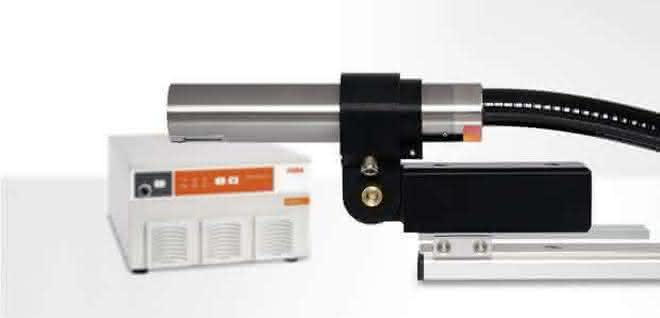
Under the name Titus, the new marking laser of the new 20- or 30-watt fiber laser marking system Y.0200-xs/Y.0300-xs offers new possibilities in terms of flexible line integration, operability and speed. Thanks to its small format and tubular shape, simple mounting using a clamp bracket and an optional supply cable up to ten meters long, the Titus marking head can be easily integrated into various production lines. Its flexibility is also based on an optional straight or 90 degree inclined exit angle of the laser beam as well as the possibility of adapting the marking field size to the application requirements.
According to the manufacturer, up to 90 percent of the time usually required for installation can be saved. The integrated focus finder and pilot laser should also speed up adjustment, focus determination and job set-up.
The new laser marking system was developed in collaboration with and according to the needs of integrators and the automotive industry. "With Titus, we are ahead of the market, because there has never been a marking laser that is so compact, quick to install and easy to operate, even remotely," says Product Manager Philipp Febel.
The device software also offers advantages. All three user interfaces available from Foba can be used to operate the system: In addition to the MarkUS and Draw user interfaces, the new Foba Go remote software, which can be operated from any PC, touch display, tablet or other mobile device, is particularly suitable. All common industrial communication protocols are also compatible.
Maintenance of the system is simplified by the ability to remove or change the marking head in a matter of minutes and by a dust-protected lens. In harsh production conditions, the IP65 or IP69 standard of the marking head also ensures protection against dust and moisture. The low maintenance requirement also results from the low number of wearing parts. as


You might also be interested in
Predictive maintenance in retrofit
Predictive maintenance pays off. This is because early detection of impending failures means that systems can be serviced in a targeted manner before production downtime occurs. But how complex is it to integrate such a maintenance concept into an...
 read more...
Maintenance instead of replacement
The circular economy starts with the machinery
Sustainability in industry starts with machines, says our guest author from Deguma: How maintenance, modernization and the 5R strategy save resources, energy and CO₂.
read more...3D printing for unplanned requirements
The material fails and the machine suddenly stops? Then you need to take the right measures to be able to resume production quickly. Material failure in the form of faulty components or material wear in the frame are a risk for any production.
read more...High demands in terms of safety, application and robustness
Demanding work in the electrical trade and energy supply as well as smooth processes in production require innovative and customized measurement technology that scores points for safety, ease of use and resilience.
read more...Car meets e-bike: riding with lubrication-free polymer bearings
Studies show that the proportion of pedestrian and bicycle traffic is increasing in urban areas. With the JetBike, JetBike GmbH from Braunschweig presents a mixture of e-bike and car and relies on lubrication-free polymer bearings from Igus.
read more...Hydraulic hub for more efficient servicing
Bosch Rexroth presents a digital toolbox for service and maintenance. With a comprehensive range of digital services, the Hydraulic Hub simplifies and accelerates the service and maintenance of hydraulic products and increases machine availability.
read more...Arnold Umformtechnik expands after-sales...
Faster help with VR glasses
Arnold Umformtechnik is expanding the after-sales service for its machines to include digital remote services. The focus is on data security, simple operation and clear processes.
read more...147,000 euros per hour: high costs for German companies due to unplanned downtime
According to the "Value of Reliability" study, 67% of industrial companies in Germany experience unplanned downtime at least once a month. This costs the German economy 147,000 euros per hour. Nevertheless, reactive maintenance concepts are not...
read more...Maintenance starts with a maintenance planner
Legal requirements stipulate that machines and systems must be serviced regularly. The maintenance work serves to ensure occupational safety and economic efficiency.
read more...