

Turbo compressors
Apply pressure so that the air doesn't run out
With new turbo compressors, a chemical company saves around 2 million kWh of energy per year - around 20 percent compared to the energy requirements of the old compressed air supply. TheCO2 footprint has also been significantly reduced. The rotary drum dryers, which efficiently regenerate the desiccant with the heat generated during the compression process, also contribute to this.
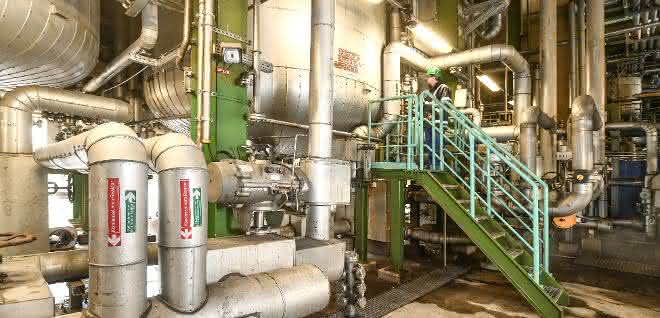
While the chemical reactors at OQ Chemicals in Oberhausen run in outdoor facilities, the offices, control room and compressed air supply are housed in brick buildings. There are also two MAN GHH turbo compressors from 1970 and 1982, which were designed to be redundant so that they could be operated alternately. They were used to generate the compressed air in the plant for half a century. The four drying systems alone would fill a small hall. "Although all of this was still running, it was certainly no longer state of the art," says Process Engineer Denys Volovyk. "That's why we announced the modernization of the compressed air generation as a project."
"On the one hand, the risk of failure was increasing, but on the other, we wanted to make compressed air production more efficient and sustainable," explains Denis Stegemann, who was involved in the project from the outset as an operations assistant in the Energy and Residual Materials Operations department. "By renovating the station, we wanted to ensure the long-term availability of compressed air and build up further reserves for any future additional demand that could arise from new systems." The refurbishment was also intended to cut electricity and steam costs and reduceCO2 emissions. Maintenance costs should also fall. "We have achieved all of these goals with the new compressed air generation system," emphasize Volovyk and Stegemann.
The new compressed air station now consists of three ZH 630+ turbocompressors from Atlas Copco as well as three highly efficient ND 2000+ adsorption dryers. Two compressors are sufficient to supply the entire chemical plant, so that one is always available in redundancy. "Non-availability of the compressed air generation inevitably leads to the failure of all production systems. That's why the supply is redundant, which ensures 100% availability," says Volovyk. This is essential because the chemical processes at OQ Chemicals run around the clock. The company produces oxo intermediates and oxo derivatives. "Our products can be found in many everyday products," says Volovyk. "For example, we supply a product that can be found in safety glass films." Other OQ products are used in the automotive industry or in paints and varnishes. Oxo products are also used in the manufacture of detergents and cleaning agents. "Our customers always expect high quality and purity."
OQ Chemicals places similar demands on the compressed air, and the ZH+ turbocompressors fulfill these in combination with the ND+ dryers. Atlas Copco supplied the oil-free compressors as ready-to-connect, compact complete solutions - each with compressor unit and integrated air intake system, cooler, blow-off valve and silencer, drive motor, complete lubricating oil and control system. Ulrico Jungjohann, operating technician at OQ Chemicals, took care of the connection to the existing piping system.
Control system as an interface to the process control system
As a higher-level control system, the new Optimizer 4.0 from Atlas Copco helps to operate the three turbo compressors efficiently at every load point. It also provides a good overview of the system on site and collects the warning and fault messages from the six units. "The Optimizer is the communication interface for control and visualization in our process control system," explains Sebastian Planz, who is responsible for engineering the electrical, measurement and control technology (EMR). "The measured values are displayed here in the system flow chart and we can, for example, bypass the machines and preselect switch-on priorities." The connection was made via Modbus TCP.
The compressors generate up to 12,500 m³ of compressed air with an operating pressure of 5.7 bar per hour, which is distributed from the central station to three networks: instrument air, conveying air and working air. It supplies OQ's own systems on the site as well as those of site partners. The EMR components require instrument air; the site partner Versalis uses the conveying air to pneumatically transport its plastics in large pipelines, and the working air drives all other work applications. The instrument air must be free of dust (particles), oil and water. "Due to the extensive plant network, we aimed for a low pressure dew point of -40 °C to prevent moisture from condensing in the pipelines, even during winter operation," explains Denis Stegemann.
The adsorption rotary drum dryers use the heat generated during the compression process to regenerate the desiccant. As a result, the ND 2000+ requires very little energy for the drying process and works very economically in specific terms, as the energy required to rotate the drum is low at just 120 W. Thanks to their robust design, the dryers work reliably and always deliver the required high compressed air quality. In addition, they do not 'lose' any compressed air during the process, meaning that 100 percent of the volume flow is available at the outlet. In addition, the design of the LP dryers means that no purge air is required and they do not need a filter - which in turn means only a small pressure drop. "Even in comparison with other heat-regenerating dryers, we save up to 50 percent of the costs over the life cycle with the rotary drum dryer," says Stegemann.
Optimum utilization with high efficiency
"We selected the size of the machines and their control range for OQ so that they are optimally utilized in normal operation at high efficiency levels," explains Andreas Müller, sales engineer at Atlas Copco in Essen. At the same time, the Optimzer 4.0's control algorithm ensures predictive operation and thus ensures that blow-off in partial load operation is reduced to a minimum. "In turnaround mode with low air demand, we can also switch to a mode with just one compressor," adds Denis Stegemann. "This also allows us to efficiently adapt the compressed air generation to the actual air requirements of the plant." The self-sufficient control of the compressed air station by the Optimizer also means a great deal of relief for the operating personnel. "Thanks to their performance range and flexibility, the new turbo compressors allow us to operate in an energy-efficient manner while maintaining a consistently high level of availability," summarizes Denys Volovyk. "We save around 2 million kWh of energy per year, which is around 20 percent compared to the old compressed air supply - or the amount consumed by 400 households. We have also reduced ourCO2 footprint by around 1,450 tons per year with the new compressed air station."
According to Martin Riering, Operations Manager in Energy and Residuals Operations, the targeted performance values were achieved and the company's goals were even exceeded in some cases with this project. "The solution offered by Atlas Copco uses the latest technology in monitoring and control systems and contributes to significantly higher efficiency and considerable energy savings," says Riering. The cooperation with Atlas Copco was very good throughout the entire project, and commissioning during the ongoing process went smoothly without any interruption to the supply. "That was a particular challenge." In addition to the actual project planning and installation phase, Atlas Copco supported the team in Oberhausen during commissioning and the optimization phase. OQ Chemicals recently concluded a two-year maintenance agreement with Atlas Copco.
Thomas Preuß, Journalist


You might also be interested in
Association of the German Turned Parts...
Turned parts industry looks cautiously to the future
Rising order intake, new members, cautious optimism: the members of the Association of the German Turned Parts Industry are confident. At the spring conference in Leipzig, around 150 participants discussed current market developments, strategic...
 read more...
World premieres at the EMO 2025
From September 22 to 26, 2025, Grob will be presenting several innovations at EMO Hannover. The focus of the trade fair appearance will be on the latest 4- and 5-axis universal machining centers and the associated automation solutions.
read more...Efficient complete machining
Index-Werke will be bringing the Index G220 turn-mill center and the Traub TNA400 universal lathe to Intec.
read more...Digitization of process chains
CAM system Hypermill in practice
At EMO 2023, Open Mind will focus on turning, milling and the importance of CAM software and MES in networked production environments.
read more...High-speed spindle in handbag format
Modules for milling and turning
At Weiss, the focus is on the new 1.5 kilogram micro-mill spindle, which rotates at up to 60,000 revolutions per minute.
read more...Handling and workpiece clamping
Networked production starts with the component
Schunk is coming to Hanover with a 360-degree portfolio covering all aspects of machine tools. The focus will be on more sustainable production, connectivity and e-mobility.
read more...Stroll through the city
DMG Mori is inviting visitors to take a stroll through the city at EMO: In a specially constructed DMG Mori City, the machine tool manufacturer is concentrating on its focus topic of Machining Transformation (MX).
read more...Efficiency with digital twins
Digitalization and automation are the way to increase efficiency and flexibility in machining. The Tebis team will be presenting suitable solutions for mechanical engineering at EMO.
read more...The future of machining
Machine tool manufacturer Soraluce will be demonstrating its position in the fields of milling, turning, multitasking and automation solutions at the EMO 2023 trade fair.
read more...