

Hydraulic hoses and pipes
10 rules for hydraulic installation
The failure of high-pressure hydraulic hoses or pipes causes high costs due to loss of productivity, negative environmental influences, collateral damage and poses considerable safety risks.
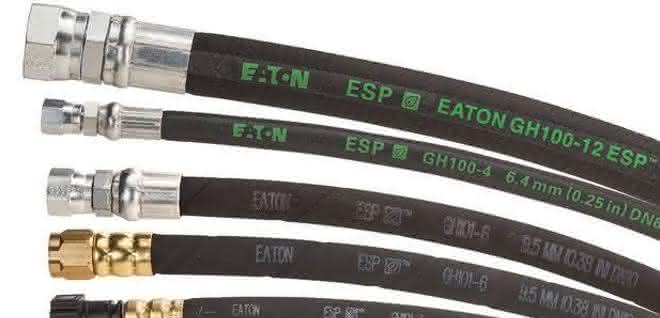
The right installation techniques can significantly reduce the frequency and impact of hydraulic hose failures. Eaton points out 10 important rules to ensure the safety of the installation.
With hydraulically controlled and operated machines, some components cannot be changed as the structure of the machine dictates their position. However, other components can and should be placed where they are easy to connect, easily accessible and service-friendly.
System designers should avoid fluid lines wherever possible and instead use manifolds when connecting components. In most cases, external piping is required. The goal of any designer must be to reduce potential leak points and make maintenance as easy as possible. When designing the base machine, engineers should ensure that there is sufficient space for the routing of hoses and pipes and reduce potential leakage points. It is also important to coordinate the planning of the hydraulic system with other system planning, for example for electrics, lubricants or fuel supply to the machine.
Parallel installation saves costs
Whenever possible, hydraulic lines should run parallel in the machine room and follow its contours. This can be easily achieved with a well thought-out layout and correct clamping. To keep the lines parallel, the positions of the connections to the components and the arrangement of valves, filters, heat exchangers and accumulators must be carefully planned.
Parallel routing often saves costs due to reduced cable lengths and a smaller number of adapters. It also makes the machine easier to service and helps to protect the lines from damage. The components should also be arranged at a sufficient distance to create space for the proper installation of adapters and fittings on connecting hoses and pipes.
System designers must first determine whether hoses, pipes or a combination of both are best suited for a particular application. Hoses and pipes each have specific advantages. Tubes, for example, can be bent to smaller radii and installed in tighter spaces. They are also less sensitive to higher ambient heat and are suitable for hotter liquids than hoses.
On the other hand, pipes can be flattened or damaged by impacts, while hoses are elastic and return to their original shape after absorbing an impact. Pipes can also fatigue when connected to high-frequency vibrating components, while hoses absorb the vibrations. For long lines, tubing can require a series of complicated, low-tolerance bends that complicate installation. The bending properties of hoses, on the other hand, allow them to conform to the desired contour. Hoses can also absorb some momentary pressure surges, resulting in smoother flow characteristics and smoother, quieter operation. When hydraulic rigidity is required, hoses are not suitable due to their tendency to stretch under pressure.
Good design promotes good maintenance
When laying and installing fluid delivery components as part of machine prototyping, fitters should always follow the following ten rules:
1. larger lines first
During installation, the cables with a larger diameter should be laid first, as these are the most difficult to bend and maneuver. Smaller pipes offer more flexibility during installation and are easier to install in confined spaces. Once the large cables have been installed, the smaller ones can be laid to save as much space as possible. This also makes future changes or additions to accessories easier and more economical.
2. correct hose length
The appearance and efficient operation of a system often depend on the correct hose length. Unnecessarily long hose material increases pressure loss and system costs. When calculating the hose length, it is important to bear in mind that the hose can expand by up to two percent or contract by up to four percent.
3. hose bending
A hose system should always be designed so that it can bend but not twist. If a large-diameter high-pressure hose is twisted by 7°, this can significantly shorten its service life, in some cases by up to 90 percent. A high-pressure hose must be routed so that it bends in only one plane. If the installation requires the hose to pass through a compound bend, the hose should be "broken" into two or more sections so that each hose bends in only one plane. A spring guard will prevent the hose from bending beyond the minimum bend radius at the fitting, but it will not prevent the hose from twisting.
4. pivot points
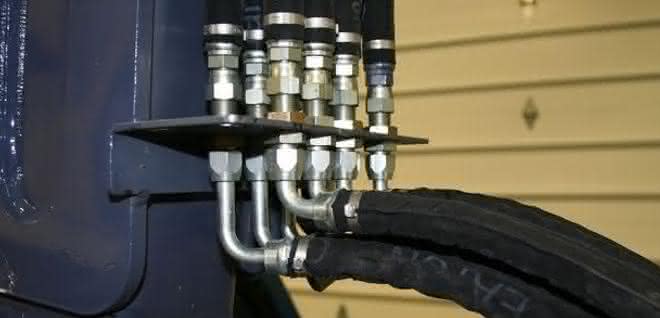
To bend the hose, it is guided through the pivot point around which the component moves. The result is the best and most efficient bending of the hose assembly with the least amount of hose required, as well as keeping the hose within the machine contour. To achieve this, the hose is positioned so that it bends like a hinge. Otherwise, the hose could bend into an S-bend. An S-bend installation leads to excessive hose movement and therefore to a shortened service life. When routing a flexible line through a pivot point, the relative positioning of the end pieces must be taken into account in order to avoid an S-bend. To do this, the movable part is swiveled to its widest point, where the hose undergoes the widest bend. If the fittings are arranged in parallel planes at this point, the hose tends to hinge when the component is moved towards the opposite end of the travel path.
5. alternating movement
Apart from the bending, it is also possible that the hose ends need to be moved. Various construction methods are available for this:
- Hose reels: For use with high-pressure hydraulic hoses, the reels are equipped with high-pressure swivel joints and a spring return for retracting the hose.
- Festooning: The hose is suspended in loops on a steel cable. When one loop point moves away from the other, the loops open and form an almost straight line.
- Rolling: The hose is arranged in an asymmetrical U-shape with hinged guides that hold it. One leg is fixed and longer than the second, which can move back and forth parallel to the first leg.
6. rotary movement
Swivel joints are usually used to enable rotary movements. Swivel joints are mainly used for a continuous 360° movement, while the swivel joint is the better choice for a reverse movement. In applications with hoses, the swivel joint prevents the hose from twisting or bending at the fitting.
7. oil spray steering
Fire protection measures must be taken when laying hydraulic lines near hot, potentially hazardous areas. These prevent, for example, oil from a defective line being sprayed onto a potential ignition source. There are various options available for this:
- Rerouting the line through a tunnel made of steel pipe, a duct or an angle iron
- Install a baffle plate between the lines and the potential ignition source.
- Routing the lines through a large, open hose or sleeve to allow oil to flow out the ends in the event of a line rupture.
- Fire protection sleeves that either fit over the hose or are integrated into the hose cover.
- To protect against a defective hose that could spray hydraulic oil over an ignition source, it can be anchored to the component to which it is hydraulically connected.
8. minimum bending radii
Each hose must be laid taking into account its specific minimum bending radius. Falling below this radius can lead to kinking of the hose and/or additional stress on the interface. This will cause the hose cover to crack more easily or the inner wire reinforcement to fatigue more quickly.
9. prevention of abrasion
Most hydraulic hoses are fitted with a robust cover to protect the hose reinforcement from abrasion or moisture damage. However, constant abrasion at one point can damage the outer cover. This is the most common cause of hydraulic hose field failures. A good fixation and, if necessary, a protective cover can help here. Protective covers can be spiral springs, spiral strip steel, spiral-shaped plastic or nylon cable grommets.
10. tensioning
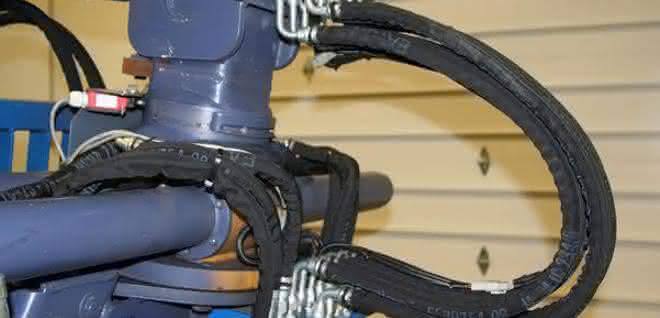
The installation of a cable is only complete when it is properly clamped. Choosing the right clamp is very important and can even be critical for functionality. Conventional sheet metal clamps, for example, will not hold a large high-pressure hose. Good clamps can be inexpensive and still be well suited for high-pressure applications with pulsating lines. For high-pressure lines, possible changes in length of 2 percent increase to 4 percent decrease should be taken into account. If the clamp size is selected correctly, the clamp will hold the hose securely without crushing it. To prevent abrasion of the hose, the inside diameter of the clamp should be approximately 1/32 inch smaller than the outside diameter of the hose.
Good installation extends service life
Good installation techniques are essential for the efficient operation and maximum service life of a hydraulic system. Hydraulic hoses and pipes are fatigue elements with a limited service life. At some point, these wear parts will fail and basic maintenance techniques are not sufficient to adequately prevent failures, either through regular visual inspection or time-based preventive maintenance schedules. The Mean Time to Failure (MTTF) of a component can vary greatly depending on the duration of use, installation, environment and robustness of the product.
Even if the components are replaced regularly every three years, there is no guarantee that the product will last these three years. On the other hand, the corresponding component could last up to six years. This means that it was replaced at a remaining service life of 50 percent. With this performance range, it is difficult to determine the exact interval for replacing the hydraulic hose without either replacing a faultless hose or preventing a defect from occurring.
According to documents from Eaton / am


You might also be interested in
Helu makes its first trade fair appearance under a new brand name
Helu Kabel will be presenting itself as Helu for the first time at Hannover Messe 2026, showcasing system solutions, Heluchain cables and new industrial luminaires.
 read more...
Strategic realignment with brand relaunch
In future, Helukabel will trade as Helu
The Helukabel Group is parting with part of its name: in future, the company will only operate under the Helu brand. With this step, the specialist for electrical connection technology is underlining its strategic development from a classic cable...
read more...Modular plant construction for corrugated board
Insight into the production of corrugators at BHS Corrugated: Automated, modular and equipped with Helukabel components.
read more...Best quality for the steel
Conditions in the steel industry are harsh and inhospitable. The machines used must be able to withstand the demanding environmental conditions in order to deliver the best quality at all times.
read more...If the standard cable is not sufficient
Lapp offers cables for countless applications - but not for all of them. From time to time, the developers have to modify a standard cable or develop a special cable.
read more...Slight decline in sales, strong investments
The Lapp Group has not been spared from the weakening global economy. However, the company only recorded a slight loss in the past 2024 financial year.
read more...Electrical connection technology
Cables and wires for industrial automation
Heukabel offers system solutions for cable routing from a single source. The subsidiary EKD Systems specializes in tailor-made cable drag chains made of steel, stainless steel and plastic, which are used in moving machines and systems as well as in...
read more...Lapp relies on Ultramid from BASF
Mobile charging of electric vehicles
The automotive industry is currently undergoing the biggest transformation in its history. The boom in battery electric vehicles in particular is presenting the industry with major challenges. Lapp, as a supplier of cables and connection...
read more...Cable handling application
At this year's Motek, ArtiMinds Robotics is showcasing a robot-based automation solution for the sensor-assisted assembly of flexible cables in connector housings.
read more...