

Cobot for final aircraft assembly
The collaborative colleague works on the airplane fuselage
Together with Fraunhofer IGP and aircraft manufacturer Airbus, Tox Pressotechnik investigated the question of how final aircraft assembly can be made more productive and ergonomic. To this end, they equipped a collaborative robot with a Tox hand gripper.
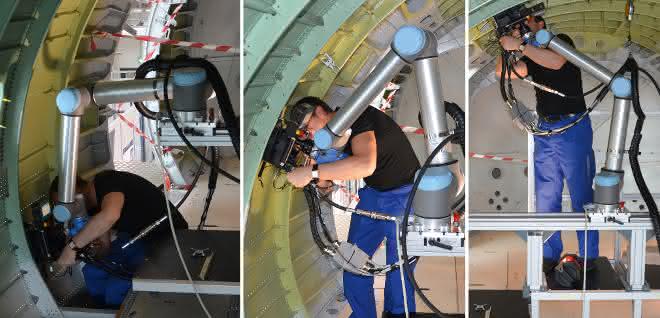
To date, Airbus has produced around 10,000 so-called narrow-body aircraft of the 320 family. The aircraft manufacturer is now relying on the help of new production technologies to make what was previously mainly manual final assembly more efficient.
At present, the longitudinal struts, known as stringers, of individual segments of the fuselage are joined together manually using stringer couplings and conventional solid rivets. In future, however, solid rivets are to be used here. The process promises a considerable reduction in the relevant process steps, the processing time per riveted joint and therefore the assembly time per segment, as well as the strain on the assembly personnel. The self-pierce riveting process is familiar from automotive and vehicle construction and is also used in safety-relevant areas. In order to qualify full self-pierce riveting for aircraft construction and optimize it for robot-assisted application in final aircraft assembly, the companies Airbus Operations, Tox Pressotechnik and the Fraunhofer Institute for Large Structures in Production Engineering (IGP) joined forces in a cooperation project and jointly developed a complete solution.
Joining aircraft segments under difficult conditions
Basically, the task was: How can the required press force be applied quickly and flexibly to the required position with as little physical effort as possible when fully self-pierce riveting large-format segments in final aircraft assembly? The high press forces that occur during solid self-pierce riveting are a particular challenge. The design of the basic holder for the riveting tools and the handling must be correspondingly stable, which leads to a relatively high weight of the self-pierce rivet setting tool.
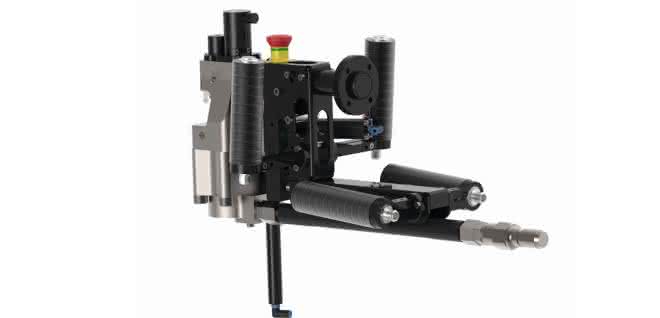
On the hardware side, the jointly developed solution is essentially based on a specially developed and integrated manual tong with control and sensor technology from the Tox modular system, a rivet feeder and a modified collaborative robot system with a maximum load capacity of ten kilograms. Tox Pressotechnik has adapted the Tox manual tongs, which are designed to set up to five different lengths of self-pierce rivets, to the collaborative robot in terms of C-frame design/throat dimensions, hold-down device, rivet feed, punch/die, handles/ergonomics and docking. The Tox X-ES power pack generates the pressing force for the hydraulic cylinder integrated in the full-punch rivet setting tool. The pressure intensifier is connected to the setting tool via a ten-meter-long media line for the pneumatics, hydraulics and electrics, making it extremely flexible in terms of position.
Less force and more efficiency
The collaborative robot is mechanically and control-wise coupled with the setting tool and is guided and positioned via the handles, similar to a balancer. As the very compact stringer tongs, including rivet feed, sheet thickness measurement, rivet control and control elements, weigh just 6.5 kilograms, they can be guided and positioned easily and precisely using the cobot. The stringer tongs are designed for press forces of up to 50 kilonewtons and have a jaw opening of 53 millimetres - measured from the setting axis. It works with a power stroke of eleven millimetres and a fast stroke of 26.5 millimetres. The maximum total stroke is 47 millimetres and the tool opening is 37.5 millimetres. The stroke is triggered at the handles or via the Tox 2 manual control STE, which in turn corresponds with the robot control.
An implemented force-torque sensor (KMS) records the respective forces during manual guidance of the solid rivet setting tool and the robot. The robot translates the low forces during manual guidance into a directly supported movement. This allows the workers to move the solid rivet setting tool intuitively and without physical effort to the specified joint positions.
While Tox Pressotechnik, responsible for the hardware and control system, supplied the full self-pierce rivet setting tool including the rivet feeder and robot as a complete functional system, Fraunhofer IGP developed the robot guide. Together with the programming of the KMS, this contributes to the success of the entire system, as does the efficient joining technology.
The purely production-related advantages include the elimination of pre-processing, simple and reproducible quality-assured setting of the self-pierce rivets, relief of the assembly personnel from physical exertion and high work efficiency. In addition, process data acquisition means greater transparency of the joining processes and effective quality assurance in final aircraft assembly. as


You might also be interested in
Nomination Products of the Year 2024
Schrempp: Intelligent function handles with IO-Link interface
Nominated in the handling, assembly and production logistics category in the competition for the products of the year 2024 are the function handles with integrated signal surface and/or configurable keypad and feedback LEDs with IO-Link interface...
 read more...
Norelem supports VDI Racing Camp
Mastering the challenges of e-mobility
Promoting young talent has been a priority at Norelem for many years: the company supports young talents with components and the necessary know-how and provides schools with illustrative material.
read more...Three-point internal rapid action switch
High-precision internal measurements on drill holes
Feinmess Suhl has expanded its product range with the new 8480 three-point internal rapid probe. The probe has been specially developed for high-precision internal measurement of through and blind bores.
read more...Standardized machine elements
Flexibility is required in mechanical engineering for the rubber industry. Rubicon Gummitechnik und Maschinenbau uses standard and operating parts from Norelem for this purpose.
read more...Carry out cutting work with precision
Schukat now stocks all cutting pliers from the Electronic Super Knips series from the German manufacturer Knipex.
read more...Secure locking
Heinrich Kipp has added a series of snap locks to its range that are designed for flush installation in doors, flaps or drawers.
read more...Industrial vacuum cleaner with a long service life
A powerful vacuum cleaner for coarse, fine, flammable and moist materials is in demand across all industries. Easy handling and a long service life are the most important criteria for regular use.
read more...Enough space for a cool head
What to do when an ergonomic lifting aid is required but the room height is too low for conventional crane systems? Schmalz has a modular flat jib made of aluminum in its product range that is used by Erkodent, a manufacturer of dental thermoforming...
read more...Opening doors without risk of infection
Reichelt Chemietechnik aims to reduce the risk of coronavirus infection in the workplace with its new hygienic door opener.
read more...