
Food and pharmaceutical industry
Hybrid cobot from Yaskawa
The new Motoman HC10DTF expands Yaskawa's portfolio of hybrid cobots with an industry-specific version for the food and pharmaceutical industries.
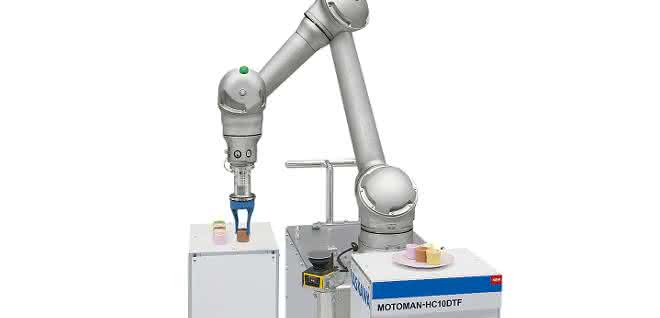
Like the already available HRC-capable HC10DT IP67 and HC20DT IP67 variants, the new development also has a dust and waterproof IP67 protection class. However, the new robot also has a powder-coated surface that allows the use of alkaline and acidic cleaners. It also uses food-grade grease. The Motoman HC10DTF therefore meets the specific cleanliness requirements of the food and pharmaceutical industries in accordance with ISO class 5 and EC GMP class A.
It can therefore be used, for example, for palletizing primary packaged food or for handling samples in laboratories. Employees can be supported in physically demanding tasks in particular, for example when stacking large boxes or other stackable goods. The robot lifts such heavy loads to improve workplace ergonomics and enable employees to perform cognitively demanding tasks.
MRK-capable hybrid robot
Like all models in the Motoman HC series, the new HC10DTF is an HRC-capable hybrid robot. This means that it can also be operated in hybrid mode by connecting external safety technology, such as laser scanners. This allows the Yaskawa cobot to switch between collaborative, speed-reduced and full speed in order to achieve the maximum cycle time depending on the distance to the worker.
The new development ensures the required safety in direct contact with the operator thanks to six integrated torque sensors, which enable flexible interaction between the robot and its environment. They monitor external forces and thus ensure maximum safety during direct human-robot collaboration. In industrial mode, i.e. when there is no human in the workspace, the robot reaches maximum speeds of up to 1 m/s. Such area monitoring can be implemented with external safety sensors, such as laser scanners.
The hybrid mode, i.e. switching between collaboration and industrial mode, ensures maximum efficiency with a minimum footprint. This is particularly advantageous for integration into existing systems where space is at a premium and the use of fences would be unthinkable, such as for end-of-line tapping.


You might also be interested in
Hamburg Regional Court issues preliminary injunction against Elite Robots Germany
In the copyright dispute between Teradyne Robotics and Elite Robots Germany, the Hamburg Regional Court has issued an interim injunction. The distribution of the software and products concerned is prohibited, and there is also a comprehensive...
 read more...
Schunk founds tech spin-off for humanoid robot hands
Schunk is bundling its activities in humanoid robotics by founding its own spin-off at the beginning of January. The aim of the new company is to develop modular humanoid robot hands for industrial applications.
read more...Partnership for humanoid robotics
Schaeffler and Neura Robotics jointly develop humanoids
Schaeffler and Neura Robotics will work together in the future to develop and supply key components for humanoid robots. The systems will also be integrated into Schaeffler's global production network.
read more...Yaskawa at the Automatica 2025
AI meets robotics
At this year's Automatica, everything at Yaskawa revolves around AI-based robotics solutions for the smart factory and beyond. As a trade fair highlight, the manufacturer is presenting its new Motoman Next product concept.
read more...Kassow Robots at the Automatica
7-axle vehicle in action
At Automatica, Kassow Robots will be presenting a wide range of industrial applications for production and logistics tasks that provide new impetus for efficiency and flexibility in industrial automation.
read more...Robotics and automation in six exhibition halls
From June 24 to 27, 2025, Automatica, the trade fair for intelligent automation and robotics, will bring industry and research together in six exhibition halls. Preparations are in full swing.
read more...Interview with Jörg Rommelfanger
Robotics in 25 years
The annual IFR report shows that the number of industrial robots is steadily increasing worldwide. They have already played an important role in ABB's portfolio for decades. In an interview with INDUSTRIAL Production, Jörg Rommelfanger, Head of...
read more...Reliable end effector for cobots
Collaborative robots are now widely used for a wide range of handling tasks. SMC offers three versions of the RMH pneumatic gripper for this purpose; it is compatible with cobots from a total of twelve companies.
read more...7-axis cobots with controller in robot base
With the Edge Edition, Kassow Robots has launched the world's first 7-axis cobots with a controller integrated into the robot base.
read more...