

MRK applications
From robot to cobot
With the TX2 generation of robots, Stäubli offers six-axis robots that can be used both as standard robots and as cobots. This concept provides flexibility and qualifies the machines for use in the automotive and supplier industry.
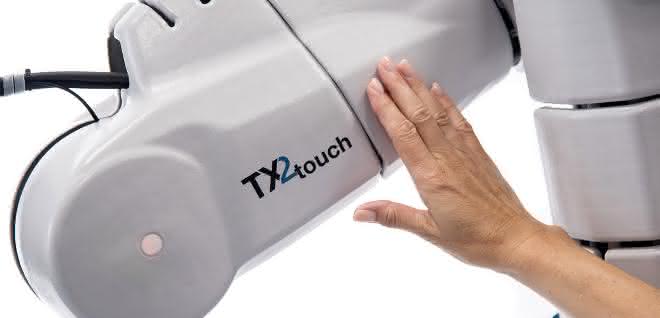
Stäubli Robotics Division Manager Peter Pühringer sums up what lies behind this pioneering concept: "We deliberately did not want to develop lightweight robots with limitations in terms of payload and speed for pure HRC applications. Instead, the aim was to make our standard robots fit for interaction with humans while retaining their full performance capabilities. And with the use of the latest safety technology, we have succeeded."
But first things first: At first glance, the three new model series TX2-40, TX2-60 and TX2-90 look like "normal" industrial robots. The six-axis robots, which cover the payload range from two to 15 kilograms with reaches of 515 to 1,450 millimetres, are very compact and are therefore suitable for use in confined spaces. And, of course, the new machines are lighter, stiffer and more powerful, making them even more dynamic and precise and, thanks to a variety of measures, also more energy-efficient.
Safety technology makes all the difference
However, the crucial difference to conventional industrial robots lies in the safety technology. Groundbreaking safety functions have been successfully integrated here. And it is precisely this safety package that enables the manufacturer to open a new chapter in human-machine cooperation with the world's fastest Safe Robots.
The six-axis units have their own digital safety encoder per axis and an integrated safety board. All safety functions are TÜV-certified and meet the strict requirements of the SIL3-/PLe category. To ensure maximum safety, every movement of the robot is monitored by sensors. All of the robot's coordinates, speed and acceleration are recorded in real time. For the TX2 series, Stäubli relies on configurable, safe I/O modules and real-time Ethernet fieldbus systems that guarantee maximum safety and compatibility. These functions enable the highly dynamic robots to work together with humans.
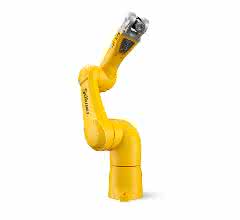
From robot to cobot with Air-Skin
The automotive industry in particular is increasingly seeing applications in which direct interaction between man and machine without a safety fence is a prerequisite for innovative production concepts. "In order to be able to operate these applications, the robots must comply with the applicable safety regulations for the highest HRC level. To this end, we are modifying the TX2 standard robots. The most obvious change is the new air skin, which turns the six-axis robot into a cobot under the name TX2touch," says Pühringer.
This touch-sensitive skin, which complies with safety category 3 PLe, stops the robot immediately in the event of a collision. The new air skin consists of several pads that can be replaced individually if damaged. The design with air cushions under the skin ensures that the robot does not overheat and can be operated at high speed without limiting its service life.
The reaction time of the skin is just ten milliseconds, which means a speed increase of 40 percent compared to safety sensors with a reaction time of 80 milliseconds. The new skin is also available with a thickness of 20 millimeters, which literally provides a larger safety cushion and therefore allows driving at higher safespeeds.
According to the manufacturer, this skin makes the TX2touch the fastest and safest cobot on the market. "Unlike most lightweight robots, the stop function is PLe-compliant. This makes the robot perfect for all applications with direct human-machine interaction," promises Pühringer.
With all the innovations in the area of safety, Stäubli is relying on the tried and tested on the mechanical side: the new six-axis robots have the typical closed structure with protection class IP65, the wrist is even IP67 and therefore waterproof. The TX2 series is therefore predestined for use in demanding cleanroom conditions as well as for applications in harsh environments such as parts cleaning. All six-axis robots of the TX2 generation have an optional vertical cable feed-through on the robot base and can be mounted on the floor, wall or ceiling. Ralf Högel/as


You might also be interested in
Helu makes its first trade fair appearance under a new brand name
Helu Kabel will be presenting itself as Helu for the first time at Hannover Messe 2026, showcasing system solutions, Heluchain cables and new industrial luminaires.
 read more...
Strategic realignment with brand relaunch
In future, Helukabel will trade as Helu
The Helukabel Group is parting with part of its name: in future, the company will only operate under the Helu brand. With this step, the specialist for electrical connection technology is underlining its strategic development from a classic cable...
read more...Modular plant construction for corrugated board
Insight into the production of corrugators at BHS Corrugated: Automated, modular and equipped with Helukabel components.
read more...Best quality for the steel
Conditions in the steel industry are harsh and inhospitable. The machines used must be able to withstand the demanding environmental conditions in order to deliver the best quality at all times.
read more...If the standard cable is not sufficient
Lapp offers cables for countless applications - but not for all of them. From time to time, the developers have to modify a standard cable or develop a special cable.
read more...Slight decline in sales, strong investments
The Lapp Group has not been spared from the weakening global economy. However, the company only recorded a slight loss in the past 2024 financial year.
read more...Electrical connection technology
Cables and wires for industrial automation
Heukabel offers system solutions for cable routing from a single source. The subsidiary EKD Systems specializes in tailor-made cable drag chains made of steel, stainless steel and plastic, which are used in moving machines and systems as well as in...
read more...Lapp relies on Ultramid from BASF
Mobile charging of electric vehicles
The automotive industry is currently undergoing the biggest transformation in its history. The boom in battery electric vehicles in particular is presenting the industry with major challenges. Lapp, as a supplier of cables and connection...
read more...Cable handling application
At this year's Motek, ArtiMinds Robotics is showcasing a robot-based automation solution for the sensor-assisted assembly of flexible cables in connector housings.
read more...