

Force-torque sensors
The end of dullness
Sense of touch for industrial robots. Optoforce has developed a way of giving industrial robots a sense of touch with six-axis force-torque sensors.

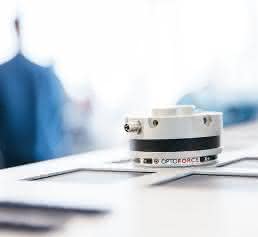
They are connected between the robot arm and the end effector, after which the robot can handle sensitive materials or uneven workpieces sensitively.
"Handmade" - for many years a seal of quality for products made by hand to a high standard. While art collectors offer top prices for such unique pieces, deviations from the norm are at best tolerated in industrial production. At worst, they lead to production errors that are expensive and extremely annoying for all parties involved. The acute economic damage in such cases can be quantified - the long-term damage, once customer trust and reputation have been lost, quickly takes on an existential dimension.
Whether it's "reaching into boxes", packaging, sanding or assembly tasks: In many industrial production areas, however, companies still rely on the sensitivity of their employees and good old-fashioned manual work. Even when heavy metal workpieces or even hazardous materials have to be moved for hours on end, automation of such tasks was previously unthinkable. This is because industrial robots were too blunt to process sensitive materials, react to uneven workpieces or even operate in disorderly production environments. The high risk of production errors was out of all economic proportion to the acquisition costs of a robot.
Large corporations reacted to this situation by relocating simple production steps to low-wage countries, while small companies with high labor costs and the quality mishmash typical of manual labor hardly stood a chance on the global market. Although costs remained low, uniform production quality was out of the question: fatal in the face of increasingly fierce competition on the market.
This problem can be solved in the future: with feeling. To be more precise: a sense of touch. The six-axis force-torque sensors Hex-E and Hex-H from Optoforce give industrial robots the sensitivity they need to handle delicate materials or uneven workpieces in just a few minutes. This enables consistently high production quality to be achieved even when automating precision tasks.
The haptic sensors are connected between the robot arm and the end effector and start working after a few simple steps (around 15 minutes): A robust layer of elastic plastic measures the forces acting along the XYZ axis. In addition to the specific new automation possibilities, the sense of touch in robots can also represent a strategic advantage for companies: Touch sensors measure around 1,000 process data per second. This enables them to prompt the robot to react in real time in the event of an acute need, for example in the case of an irregularly processed workpiece. In this way, they avoid a specific production error, which in the worst case could bring production to a standstill or even reach the customer, thus jeopardizing the company's reputation and customer trust.
The long-term strategic benefits of such measurements should not be underestimated either. Targeted evaluation of process data allows disruptive factors in production, such as irregularly processed workpieces, to be strategically identified and eliminated in the long term. The increase in process reliability can not only be measured in concrete savings in quality control and crisis management, but also have a strategic impact in the form of more satisfied customers and a better company reputation in terms of adherence to deadlines and quality. Whether this value can be quantified is up to each entrepreneur to decide. But there is no question that it is decisive for the future of a company. as


You might also be interested in
Intelligent brownfield networking
Many industrial companies are struggling with established plant structures and proprietary interfaces. Stefan Klaus' presentation will show in a practical way how brownfield environments can be efficiently networked with open technologies and made...
 read more...
Factory-X in practice
How can set-up processes in highly variant production be automated efficiently? Markus Benndorff from soffico shows how Factory-X, industrial data rooms and modular architectures create new possibilities for flexible production concepts.
read more...Mechanical engineering | Case study
Cordless in brush production
The machine manufacturer Wöhler Bohemia is integrating wireless HMI panels from Keba into its brush production systems. The background to this is the need for flexibility, robotics integration and new market strategies.
read more...International product approvals as a strategic competitive advantage in the global market
Which certificates are valid worldwide? Christian Latte, Head of Technical Compliance and Approval Officer at Hummel AG, explains this in an interview. He provides insights into product approvals and explains why early approval strategies shorten...
read more...Foundry modernizes plant park with continuous wire belt shot blasting system
The Spanish foundry Funosa is modernizing its equipment fleet with an RDGE 1250 wire belt continuous shot blasting machine from Rösler. Focus: sand removal from heavy iron castings, energy efficiency, ease of maintenance and ESG strategy.
read more...How bridging steps, stairs and catwalks are changing processes in production and logistics
At Logimat 2026, Munk Günzburger Steigtechnik will be showcasing modular bridging steps, stairs, platform and walkway systems for production, warehousing and logistics. With online configurators, distances can be efficiently shortened, processes...
read more...Drilling cycles optimized
A new replaceable head drill from Walter can reduce machining time in series production thanks to its patented interface and screwless design.
read more...Production, metalworking, robots
Precise 5-axis machining
The new Kern Fortis HD five-axis machining center will provide manufacturing companies with high precision requirements with a new machine from 2026.
read more...Agentless remote access to industrial plants
TeamViewer is expanding its Tensor enterprise platform to include "Agentless Access", enabling secure remote access to industrial systems without the need for local software installation.
read more...