

Automated guided vehicles
What does the future of transport robotics look like?
Automated guided vehicles. The market for transport robots is booming. Two trends can be identified: The number of platform manufacturers will continue to increase, with many of them already relying on cooperation with integrators. Secondly, transport robots are developing into self-learning system networks.
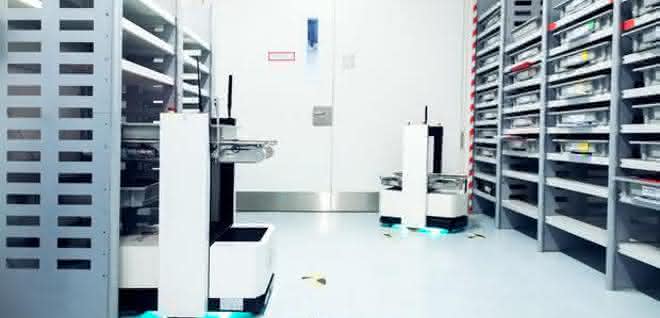
The market for automated guided vehicles (AGVs) or autonomous transport robots is booming. Just a few years ago, it was mainly listed companies that were investing in the business. Today, there are thousands of companies that want to make their production more efficient with intelligent robot solutions. This development can be explained by the fact that transport robotics is an integral part of Industry 4.0. It is about delivering the right material to the right machine at the right time and in the right quality. No industry is exempt from this. Automation using transport robots can be considered wherever transportation takes place.
Platform manufacturers versus integrators
In recent years, the number of platform manufacturers for transport robots on the market has also increased. However, it should be noted that the platform itself will not be the decisive factor in the future. Rather, it will be about how to bring together heterogeneous robot fleets from different providers in an industrial context that can collaborate with each other. InSystems Automation's customers are therefore not primarily buying a transport robot, but a holistic material flow concept for their production. Experience has shown that no two factories are the same. The local conditions and requirements with regard to loads, transfer stations and conveyor technology are always different. Platform manufacturers such as Omron, Stöcklin and Asti are now working with integrators such as InSystems Automation to integrate their vehicles into the specific production environment and existing software structure.
Holistic material flow concept
The Swiss technology company Dyconex provides an example of a complex application. With over 50 years of experience, Dyconex is a leading global supplier of highly complex flexible, rigid-flex and rigid HDI/microvia PCB and chip substrate solutions for all applications where miniaturization, increased functionality, quality and reliability play a role. The printed circuit boards are manufactured under clean room conditions and the production processes are spread over three floors.
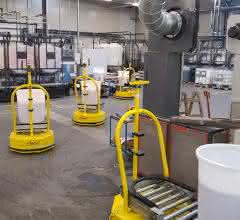
The transportation of PCBs, some of which are highly sensitive, was previously carried out manually by employees, who had to leave their workstations to do so, which was time-consuming. Employees often had to wait for the elevator and change their work clothes between the different cleanroom zones due to high cleanliness standards. InSystems Automation developed a material flow solution for Dyconex that fully integrates into the company's demanding environment. The autonomously navigating transport robots move across the floors, independently call the elevator system and communicate with the automatic doors. The vehicles make it easier to meet the high internal cleanliness standards than is possible for people wearing textile clothing.
Swarm-intelligent transport robots and the importance of AI
In addition to the trend towards holistic material flow concepts, another observation can be made for the future of transport robotics: Transport robots are developing into self-learning, self-optimizing system networks that use cooperative intelligence to perform complex tasks such as providing material to machines and workstations autonomously without separate fleet management. InSystems Automation is researching the foundations for this in the joint project "CrESt". The aim is to develop swarm-intelligent transport robots with team spirit that behave like a soccer team, agreeing and coordinating with each other with regard to decisions to be made, without separate fleet management. The robots collaborate with each other and have cooperative intelligence. Similar to soccer, each robot acts as part of a team and adheres to the strategies and rules of the game that have been agreed with it.
Whether crates, pallets or barrels, future transport robots will decide among themselves which vehicle is best suited to take on a transport job. Various key performance indicators (KPIs) such as battery and maintenance status, degree of wear, route and travel time, as well as the individual capabilities of each robot, are monitored. On the other hand, the fleet optimizes itself according to so-called system group targets or global targets. These can be, for example, that transport orders should be processed as quickly as possible or necessary or with as little wear as possible.
The cooperative intelligence now consists of the fleet developing strategies as to how it can ideally achieve the goals set for it without disregarding its own individual goals (for example, the battery level must not fall below a certain value).
Parallel to the developments mentioned above, work is being carried out on the use of artificial intelligence methods. In future, transport robots will not only react independently to physical obstacles. They will also be able to detect fluctuations, irregularities and special situations in the production process. If there is an increased need for transportation during a shift change (transportation peak), the transport robot fleet will react accordingly. On the one hand, it can ensure that the vehicle batteries are sufficiently charged before such events occur. On the other hand, it can arrange for the transport robots to be ready in advance at the points where increased demand is expected.
S. Dannat/as


You might also be interested in
Predictive maintenance in retrofit
Predictive maintenance pays off. This is because early detection of impending failures means that systems can be serviced in a targeted manner before production downtime occurs. But how complex is it to integrate such a maintenance concept into an...
 read more...
Maintenance instead of replacement
The circular economy starts with the machinery
Sustainability in industry starts with machines, says our guest author from Deguma: How maintenance, modernization and the 5R strategy save resources, energy and CO₂.
read more...3D printing for unplanned requirements
The material fails and the machine suddenly stops? Then you need to take the right measures to be able to resume production quickly. Material failure in the form of faulty components or material wear in the frame are a risk for any production.
read more...High demands in terms of safety, application and robustness
Demanding work in the electrical trade and energy supply as well as smooth processes in production require innovative and customized measurement technology that scores points for safety, ease of use and resilience.
read more...Car meets e-bike: riding with lubrication-free polymer bearings
Studies show that the proportion of pedestrian and bicycle traffic is increasing in urban areas. With the JetBike, JetBike GmbH from Braunschweig presents a mixture of e-bike and car and relies on lubrication-free polymer bearings from Igus.
read more...Hydraulic hub for more efficient servicing
Bosch Rexroth presents a digital toolbox for service and maintenance. With a comprehensive range of digital services, the Hydraulic Hub simplifies and accelerates the service and maintenance of hydraulic products and increases machine availability.
read more...Arnold Umformtechnik expands after-sales...
Faster help with VR glasses
Arnold Umformtechnik is expanding the after-sales service for its machines to include digital remote services. The focus is on data security, simple operation and clear processes.
read more...147,000 euros per hour: high costs for German companies due to unplanned downtime
According to the "Value of Reliability" study, 67% of industrial companies in Germany experience unplanned downtime at least once a month. This costs the German economy 147,000 euros per hour. Nevertheless, reactive maintenance concepts are not...
read more...Maintenance starts with a maintenance planner
Legal requirements stipulate that machines and systems must be serviced regularly. The maintenance work serves to ensure occupational safety and economic efficiency.
read more...