

Clamping technology
Save set-up time
Heinrich Kipp offers several clamping systems that are compatible with each other. One example of this is the Uni-Lock five-axis modular system combined with the Uni-Lock zero-point clamping system. This enables highly efficient machine utilization.
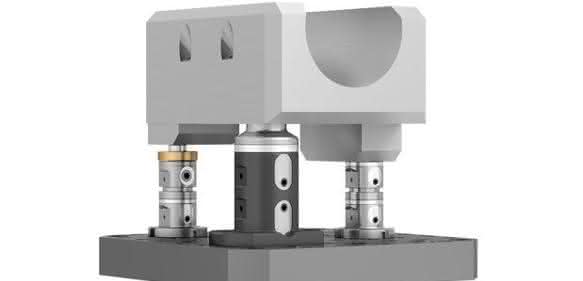
The machine table is equipped with the zero-point clamping system; other tilting clamping systems can then be changed quickly. The attached five-axis modular system is suitable for five-sided machining of complex workpieces of small and medium sizes. Workpieces can either be clamped on the five-axis modular system or directly on the zero-point clamping system. Unproductive non-productive times, such as reclamping or aligning the workpiece, are completely eliminated. The repeat accuracy of both systems is in the range of 0.005 millimetres. The central element is the clamping pin, which is used universally for all clamping systems. Thanks to the large selection of bolts, almost any workpiece can be clamped. The clamping pins are positively locked to the clamping element.
The five-axis modular system is available in system sizes 80 and 50 millimetres thanks to the extension. Both sizes can be combined with each other in one clamping, which opens up further possibilities for workpiece fastening. The advantage of the 50 mm system is that it is ideal for five-sided machining of small workpieces without interfering edges; the clamping force here is up to ten kilonewtons. pb


You might also be interested in
Machining without reclamping
Together with Lauscher Präzisionstechnik and the company Spreitzer, the IFW at Leibniz Universität Hannover is researching a new, flexible clamping system for additively manufactured components with complex geometries.
 read more...
Handling and workpiece clamping
Networked production starts with the component
Schunk is coming to Hanover with a 360-degree portfolio covering all aspects of machine tools. The focus will be on more sustainable production, connectivity and e-mobility.
read more...Vacuum clamping technology for wood
Schmalz launches new VA-CL catalog
Schmalz's new VA-CL catalog provides an overview of all solutions for clamping wood with a vacuum. QR codes also make the ordering process easier: a scan takes interested parties directly to the desired product in the online store.
read more...Zero-defect production thanks to clamping technology
Many production companies are faced with a dilemma: they can often only survive with zero-defect production that uses less energy and is more cost-efficient. This can be achieved with intelligent clamping technology, which has evolved into a machine...
read more...Clamping system for a new milling machine
Investments in machinery often lead to further purchases - as is the case at Joma-Maschinenbau, whose modern production facility has recently been supplemented by a 5-axis milling machine.
read more...Elements and systems for digitization
Workpiece clamping technology with sensor technology for efficient production is the focus of Roemheld at AMB. The clamping technology specialist offers workpiece clamping elements and systems for the digitalization, automation and flexibilization...
read more...Modular gripper
The Tünkers OneScrew System, TOS for short, is a modular gripper system developed by the automation specialist from Ratingen.
read more...Clamping system allows short set-up times
New zero-point clamping systems with numerous features ensure short set-up times, high clamping forces and repeat accuracy. The high-end version offers additional features and numerous monitoring options.
read more...Partner for tools
While searching for reliable solid carbide tools, a machining service provider and manufacturer of clamping fixtures came across Mapal tools. As a result, a reliable partnership has developed.
read more...