

Magnetic materials
A question of the right technology
Magnetic sheet and magnetic rubber semi-finished products from Schallenkammer are suitable for the production of technical molded parts with detachable adhesive and holding functions. The supplier and development partner uses various manufacturing and finishing processes for this purpose.
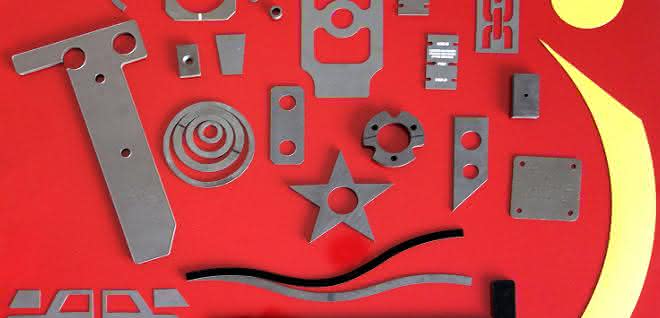
The magnetic technology specialist Schallenkammer now supplies many device and apparatus manufacturers with technical vendor parts made of magnetic materials. The Graviflex 200 and 190 magnetic foils and the 150 and 180 magnetic rubber types from its range of semi-finished products are the main products used by the company in the manufacture of customer-specific components and structural elements with detachable holding and retention functions.
In numerous different manufacturing and coating processes, these semi-finished products are shaped with high precision, finished ready for use and surface-finished. Schallenkammer's new production hall, which was built around four years ago, is home to modern CNC cutters and punching machines, highly flexible laminating and digital printing systems and fast-rotating cutting systems for the production of customer-specific rolls with different running lengths and widths from five millimetres.
Heat-resistant magnetic elements
Graviflex magnetic foil 200 is usually used for the production of technical molded parts when three properties are primarily required: Permanent magnetic adhesion on both sides, an average adhesive force of up to 130 g/cm2and permanent temperature resistance of up to 120 degrees Celsius - up to 200 degrees Celius may be applied for short periods. As this magnetic foil is also very easy to process mechanically, it is suitable for the production of 2D series parts using CNC cutting and punching technology. "On behalf of various customers, we use it to produce heat-resistant magnetic elements and strips with a thickness of one millimeter for use in mechanical engineering and surface technology - for example, custom-made paint covers," reports company boss Peter Böhler.
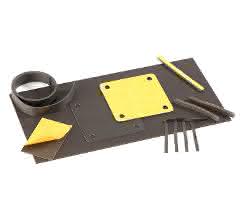
As it adheres magnetically on both sides, Graviflex magnetic foil 200 can also be used for bonding applications. Furthermore, this magnetic foil is also suitable for the production of double-sided color-coated and, if necessary, additionally printed components and molded parts with a self-adhesive coating. In these cases, Schallenkammer combines various mechanical shaping processes with laminating and printing technology.
Components with high adhesive force
Schallenkammer often manufactures flexible stamped and cut parts in a wide variety of shapes as well as sheets or strips to customer specifications from the Graviflex MF 190 film, which is permanently magnetic on one side and proves to be a material solution for components that have to apply exceptionally high magnetic adhesive forces in a temperature range of minus 40 to 100 degrees Celsius. Depending on its thickness, Graviflex MF 190 offers adhesive forces of up to 850 g/cm2. The molded parts, tapes or sheets made from it can be between 0.8 and six millimeters thick. If required, they can be provided with a self-adhesive coating or a surface-friendly lamination.
Tough elastic and magnetic
The magnetic rubber 150 or 180 from the Schallenkammer portfolio comes into play as soon as elastomeric properties are required in addition to magnetic adhesive force in the production of technical molded parts. They consist of a flexible, rubber-like plastic with embedded strontium ferrite powder and are suitable for the production of tough-elastic, compliant or shock- and vibration-damping components.
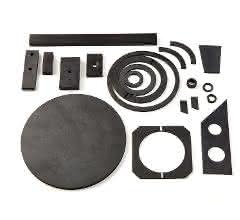
In Schallenkammer's production lines, it is often used to produce molded parts such as rings, fasteners or non-contact contactors. Strips, strips or circular blanks with a high magnetic holding force can also be punched and cut precisely and without splintering. The vendor parts made from magnetic rubber 150 or 180 are resistant to weathering and ageing and insensitive to ozone, water vapor and diluted acids and alkalis.
The magnetic rubber 150 or 180 is generally suitable for the production of components that can withstand continuous temperatures of up to 100 degrees Celsius and short-term temperature peaks of up to 150 degrees Celsius. The length of the plate or strip-shaped elements can reach up to 1,040 millimeters; their thickness can vary from 1.5 to eight millimeters. The company also processes these semi-finished products in two material variants. Type A magnetic rubber has magnetization aligned axially across the height (thickness) and is suitable for blanks with widths of up to 140 millimetres. Magnetic rubber type C, on the other hand, has a one-sided multipole surface magnetization and is available for blanks with widths of up to 440 millimetres.
As with the magnetic foils in the Graviflex series, Schallenkammer also offers the option of coating the surfaces of the magnetic rubber components made from it in color or with felt for surface protection, or even with a self-adhesive coating. "Type C magnetic rubber can also be used to reversibly connect metal parts. For example, a metal support bracket can be attached to a ferrous surface - such as the housing of a machine - without drilling or screwing. The support bracket is held in place by a plate made of magnetic rubber, which forms a so-called ferrous return through the connection with the metal. In concrete terms, this means, for example: With a steel sheet one millimeter thick and a rubber thickness of two millimeters, the adhesive force of the component doubles from 75 g/cm2 to 155 g/cm2due to the iron backing," explains company boss Peter Böhler. as


You might also be interested in
Cutting solutions in 2D and 3D
Microstep showed 2D and 3D cutting solutions in action on sheet metal, tubes, profiles and container bases, including bevel cutting with plasma or waterjet and dynamic fiber laser cutting, as well as drilling, milling and marking demonstrations.
 read more...
Precision machining of bores
Paul Horn is presenting an innovative extension for the Supermini system in the field of ultra-fine machining at EMO 2023. The system has been supplemented by a variant with an ultra-fine ground cutting surface.
read more...Deep drill holes optimized with PCD
When the Schlote Group built a new plant in Harzgerode in 2017, production was geared towards series production of a single component right from the start.
read more...Production goes digital
EMO, the world's leading trade fair for production technology, invites the industry to Hanover from September 18 to 23.
read more...Vibration-free groove turning process
Adjustable damped boring bar
Paul Horn is exhibiting innovations and product enhancements at the EMO in Hanover. Among other things, the company is exhibiting a boring bar that can be adjusted to the vibration amplitudes that occur.
read more...Efficiency with digital twins
Digitalization and automation are the way to increase efficiency and flexibility in machining. The Tebis team will be presenting suitable solutions for mechanical engineering at EMO.
read more...Many highlights in Leipzig
Ceratizit will be presenting the highlights from its portfolio at Intec. In addition to the latest tools for milling, turning and drilling, automation solutions will also be a top topic at the tool manufacturer's stand.
read more...How smart robot simulation works
More intelligent, more efficient, easier to operate - robots are developing rapidly. Among other things, great care is required when setting them up and operating them in order to avoid cost-intensive downtimes. Robot simulation tools are...
read more...Milling, turning and grinding center
Milling, turning, grinding and gear cutting on one and the same machine - in a single clamping operation: Soraluce's multitasking machines are the answer to technically complex workpieces with tight tolerances that require various machining...
read more...