

25 years of Lantek Germany
Anniversary at the pioneer of digitalization in sheet metal production
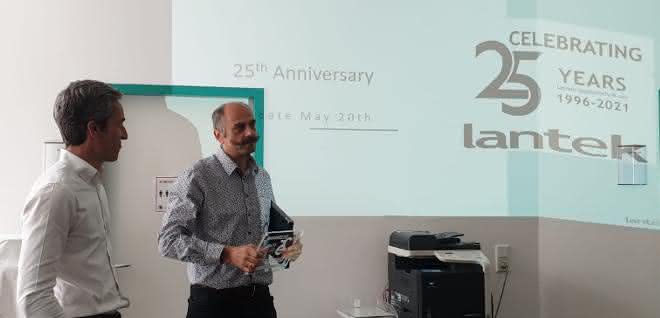
Lantek Germany celebrates its 25th anniversary. The company is one of the pioneers in the digitalization of sheet metal production. It was already thinking about networking when many factories did not even have a PC.
June 1996: Spanish software specialist Lantek opens its office in Germany at a time that can be described as "prehistoric" from a digital perspective. Worldwide, software applications in industry and everyday life are still in their infancy. Digitalization is still a foreign concept in sheet metal production. Windows 95, the first graphical user interface for PCs, was launched just one year ago. The first smartphone came onto the market 11 years later. And it was only another four years later - 15 years after the opening of the German Lantek office - that the German government coined the term "Industry 4.0" at the Hannover Messe 2011. Today, it stands for the networking of machines and processes worldwide with the help of information and communication technology.
Drivers of Industry 4.0 in sheet metal production
"Industry 4.0 is tailor-made for us," says Christoph Lenhard, Lantek 's first employee in Germany and head of the German office. "Lantek is the driver of Industry 4.0 in sheet metal production." With its machine manufacturer-independent software portfolio, Lantek supports companies of all sizes in the metal and sheet metal processing industry on their individual path to digitalization.
Christoph Lenhard is the face of Lantek in Germany. Hardly anyone in the German-speaking world knows as much about software for sheet metal processing as he does. He remembers the beginnings of the Darmstadt office, at the time the second outside Spain after France: "Back then, people started programming the CNC on the PC and no longer on the machine." One of the first customers was Messer Cutting Systems in Groß-Umstadt, not far from Darmstadt. "They were looking for screen-supported Windows-based software for their beam-guided cutting machines - and Lantek was one of the first to offer this. Their machines are still running with our software today."
Lenhard studied mechanical engineering, speaks Spanish and had the task of opening up the German market for Lantek - and communicating the approach to the industry: Software can work independently of machine manufacturers, giving users the greatest possible freedom when developing their machine parks. Lenhard relied on the machine manufacturers as OEM partners: He established the Lantek brand in Germany, Austria and Switzerland through their systems equipped with Lantek CAD/CAM software. Today, the German office has 15 employees and supports around 900 customers - from contract manufacturers to international corporations. The great market potential that Lantek saw in Germany in 1996 has been confirmed: In the internal ranking, the German office occupies 3rd place. Worldwide, Lantek now has more than 220 employees in 20 offices in 14 countries, serving more than 25,700 customers in over 100 countries.
Intelligent software decides on the machines
The CAD/CAM beginnings have now evolved into a comprehensive portfolio of software modules for networked sheet metal processing. This represents a standardized platform solution against landscapes of software islands, which are often unable to communicate with each other, mean additional work for many companies and stand in the way of a comprehensive overview. The software portfolio covers all processes in the plant - from automated quotation creation and production control, including external work outside the plant, to invoicing, warehousing and business processes. However, a company does not have to say goodbye to the tried and tested: The experts simply integrate existing software systems into the new complete environment via interfaces.
Long gone are the days when the machine decided over the software. "Today, intelligent software decides which machines it communicates with. It allows each component to find its own way through production," explains Lenhard. Entering data multiple times is a thing of the past - and companies no longer need to set up and maintain their own cost-intensive networks to keep up with the digital age: cloud-based applications and virtual desktop solutions free them from the burden of having to finance, provide and maintain the necessary infrastructure on site, including sufficient computing power.
OEM partners are still among Lantek's most important customers and multipliers. The strategic partnership agreed in spring with the German machine tool manufacturer Trumpf does nothing to change this. "Lantek will remain an independent brand," emphasizes Lenhard. "And our development offices will also remain separate. However, our customers will benefit from each other's expertise - for even better and more future-proof solutions. That's the really good news this year for sheet metal production."


You might also be interested in
ESTIA aims to strengthen Europe's cloud
New tech alliance for EU sovereignty
Twelve companies, including Dassault Systèmes, are founding the European Sovereign Tech Industry Alliance (ESTIA). The initiative aims to strengthen Europe's technological independence and define requirements for sovereign cloud services. The start...
 read more...
Deutsche Telekom and Nvidia launch one of Europe's largest AI factories
With the Industrial AI Cloud in Munich, Deutsche Telekom and NVIDIA are creating one of the largest AI factories in Europe. Companies can train AI models, carry out simulations and access 10,000 GPUs.
read more...Leveraging data potential with AI and streaming
Huge data treasures are still lying dormant in many manufacturing companies. And yet it is high time that these treasures were unlocked. There is often a lack of resources and capacity to make data usable in real time. Streaming production data can...
read more...More awareness of noise
Dematic offers solutions that are tailored to different cloud environments and reduce environmental impact through reduced material consumption and improved energy efficiency.
read more...Generative AI in the automation environment
The mechanical engineering and automation industry is undergoing profound change. This transformation is being driven by more volatile global trade, geopolitical crises and increasing market pressure, which demands greater agility, technological...
read more...Rigid data structures have had their day
The traditional data center is no longer the center of data. A hybrid cloud storage approach enables manufacturing companies to both meet the current requirements of data-intensive processes and future-proof their infrastructure.
read more...Software as a service in three stages
CIM Database Cloud is a new out-of-the-box solution from Contact for end-to-end digital product development.
read more...How production can benefit from AI
Together with AI technology, IIoT networking makes it possible to better control machine parameters and optimize quality with predictive quality. Downtimes and set-up times can also be further minimized. Cloud platforms also make these technologies...
read more...More expertise for digital engineering
Altair, a computational science and artificial intelligence (AI) company, has acquired OmniV, a technology from Michigan, USA-based software company XLDyn.
read more...