

Artificial intelligence in Germany
Microsoft invests 3.2 billion euros in AI infrastructure
Microsoft has announced the largest investment in its 40-year history in Germany to accelerate the possibilities and benefits of artificial intelligence (AI) in the country. The company will expand its data centers for cloud and AI applications and train more than 1.2 million people in digital skills by the end of 2025.
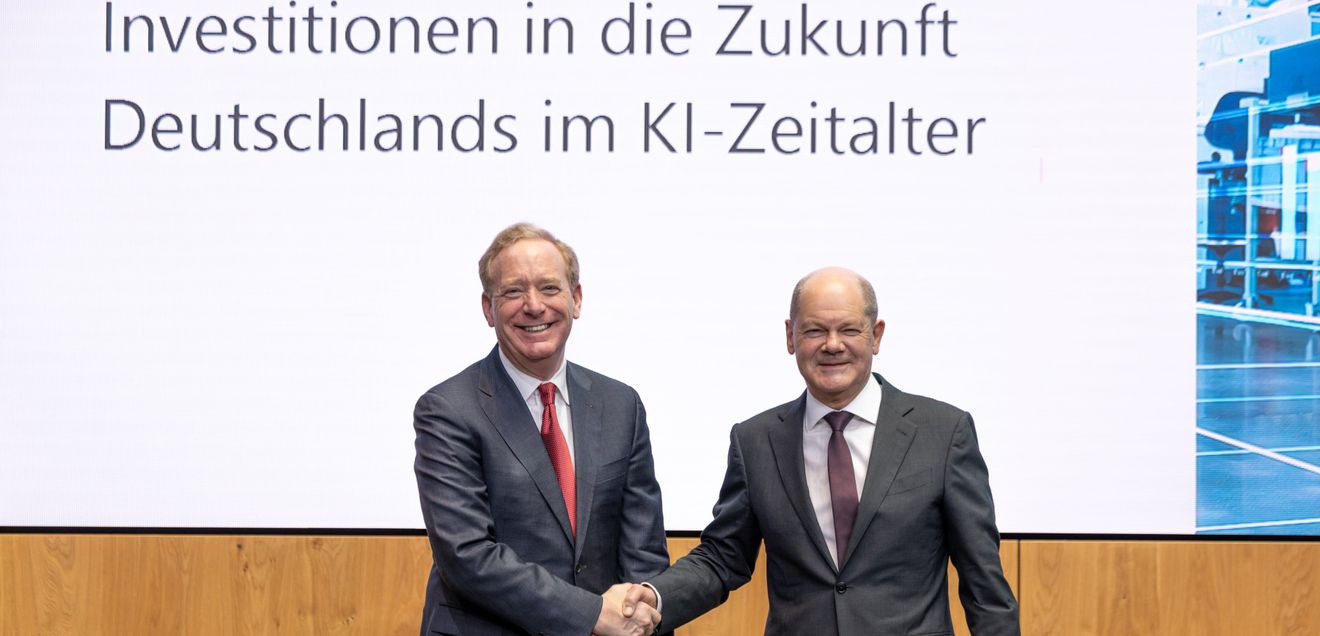
Over the next two years, Microsoft will invest 3.2 billion euros in the expansion of its cloud and AI infrastructure across Germany. The expansion of its cloud region in Frankfurt am Main and the newly planned infrastructure in North Rhine-Westphalia (NRW) will more than double capacity. This significant increase in digital capacity will help Germany to meet the growing demand for AI-specific computing power and cloud solutions. It will also serve to train and apply new AI models and services offered by Microsoft and a variety of other companies on the Microsoft Azure platform.
German economy to benefit from AI.
"We want to enable the German economy to benefit from AI to continue to build on its global leadership in competitiveness," says Brad Smith, Vice Chair and President of Microsoft. "We see a growing demand for AI applications in key industries such as manufacturing, automotive, financial services, pharmaceuticals, life sciences and medical technology. As economic change fundamentally transforms these industries, it is important to equip companies in Germany with world-leading technology."
Federal Chancellor Olaf Scholz says: "Microsoft's billion-euro investment in Germany announced today is very good news for Germany as a business location. Microsoft is thus promoting the necessary structural change in the Rhenish mining area, advancing the computing infrastructure in our country and strengthening the German ecosystem around artificial intelligence. Such projects show how attractive the location and the trust of investors in Germany is."
Strong signal and contribution to structural change
The Minister President of North Rhine-Westphalia, Hendrik Wüst, explains: "Microsoft's investment is a strong signal for Germany and a great contribution to structural change in the Rhenish mining area. Above all, however, it once again confirms the attractiveness of North Rhine-Westphalia as a business location. With this billion-euro decision, Microsoft is making a significant contribution to sustainably driving forward the transformation of our economy. The fact that a global player is making such an investment in North Rhine-Westphalia is a sign of confidence and the result of concrete location policy. Microsoft will find an ideal location in the Rhenish mining district and thus massively advance the digital infrastructure for North Rhine-Westphalia and the whole of Germany."
Microsoft's advanced IT infrastructure and AI platform services enable companies, from small start-ups to large corporations, to develop, deploy and use AI models and applications as proprietary solutions or open source. It also makes Microsoft's own AI-powered services such as Microsoft 365 and Microsoft Dynamics more widely and locally available to German customers.
Processes for responsible AI and sustainability
Microsoft will operate its AI services and infrastructure in accordance with industry-leading practices for responsible AI and sustainability. The company has established a Responsible AI standard for its own AI platforms and services, as well as an AI Assurance Program to share best practices and promote responsible AI practices. Microsoft's commitment to sustainability includes achieving 100% global use of renewable energy for the company's operations, including its data centers, by 2025. This initiative reflects a shared commitment to environmental sustainability and a more energy-efficient future. Microsoft's vision is for cloud computing to be ubiquitous, accessible and responsible in Germany in the future. The company offers cloud services that are not only powerful, but also reliable and meet the highest standards for data protection and privacy.
Numerous German companies and start-ups are already using advanced AI functions. Siemens has developed the Siemens Industrial Copilot with Azure OpenAI Service for complex tasks such as writing and optimizing code for machines and troubleshooting. Boehringer Ingelheim added Azure OpenAI Service to its iQNow AI platform to improve the efficiency and quality of its knowledge management. Bayer uses Microsoft M365 Copilot to speed up daily workflows, for example by automatically summarizing emails and attachments or creating initial drafts of documents. Microsoft Copilot is also being experimented with in other areas, such as product development. Commerzbank is working on redesigning its customer experience by developing an AI banking avatar with Microsoft Azure AI.
"Today's announcement ensures that as a fast-growing AI company born in the cloud in Germany, we will have access to the very cloud and AI infrastructure we need to grow our business and compete successfully on a global scale," says Malte Kosub, CEO and co-founder of Parloa. The company is a leading example of the new generation of German AI technology companies. Its solution is based on Microsoft Azure AI technologies and enables new types of call centers that can provide personalized customer service day and night by relying on human-like voice interactions through AI.
Focus on teaching digital skills
Microsoft is combining its infrastructure investments with an increased focus on teaching digital skills to more than 1.2 million people in Germany by the end of 2025. Together with the partner ecosystem, new training programs will be launched that focus on building AI skills, developing technical AI capabilities, supporting AI transformation in companies and promoting the safe and responsible development of artificial intelligence. This includes the first professional certificate for generative AI.
Through partnerships with a professional network of Microsoft-certified training service providers, industry partners, universities, non-profit organizations, government institutions and associations, Microsoft actively trains people in various fields. For example, a cooperation with the Confederation of German Employers' Associations (BDA) and the "IT Fitness" initiative, which Microsoft developed together with the Förderverein für Jugend und Sozialarbeit e.V. (fjs), offer free and beginner-friendly learning experiences in the areas of AI, cybersecurity and green digital skills in Germany - with the aim of reaching more than 550,000 people. Another example is the Microsoft initiative "BoostYourSkills" in collaboration with companies such as Schaeffler and DHL Group. It aims to help young people make a successful start to their careers in an environment where digital skills are becoming increasingly important. Microsoft also supports the ReDI School of Digital Integration, which helps refugees and marginalized groups to find a job in the German IT industry.


You might also be interested in
Industrial policy | Commentary
Industrial Accelerator Act (IAA): Associations criticize "Buy Europe" strategy
The Industrial Accelerator Act (IAA) is intended to accelerate European industry. Business associations fear additional bureaucracy instead of real acceleration and are calling for fewer regulations and more strategy.
 read more...
What the VCI and VDMA associations say about the free trade agreement
The EU-Mercosur free trade agreement opens up new markets for German companies. Chemical and mechanical engineering associations see growing export opportunities and are calling for the dismantling of trade barriers - an important step for Europe's...
read more...Management change in the KraussMaffei Group
KraussMaffei will start with a new management structure from January 2026: Alex Li will become CEO, Chi Zhang will return as Chairman of the Supervisory Board and Michael Hofmann will take over as CFO. All details on the management changes.
read more...Setting the course for Germany's technological future
The Federal Cabinet adopted the microelectronics strategy today. Germany wants to become a leader in microelectronics. The Federal Government's new strategy: bundling topics such as research, skilled workers and production in order to strengthen...
read more...Technologies for the energy transition
Federal Minister for Economic Affairs Robert Habeck traveled to the Hannover Messe with a full schedule. Highlights included the "Renewable Dialogue - North Sea Energy Hub" conference and the traditional tour of the trade fair, this time with a...
read more...Epson comes back to Düsseldorf
After twenty years in Meerbusch, the German branch of the Japanese technology group Epson is moving its headquarters back to Düsseldorf.
read more...Industrial trade fairs Intec, Z and GrindTec
Innovative, powerful, international
The last edition of the Leipzig industrial trade fairs two years ago could only be held virtually due to the pandemic. The long-awaited comeback of Intec and Z will take place at Leipziger Messe from March 7 to 10, 2023.
read more...Lightweight construction at Formnext 2022
New materials and digital services for the AM industry
In cooperation with Hessen Trade & Invest and the Bremen Economic Development Corporation, Leichtbau BW once again organized a joint stand at Formnext to present innovations from Baden-Württemberg, Hesse and Bremen.
read more...Automation trade fair in Chemnitz
On September 28 and 29, 2022, it will once again be all about automation at Messe Chemnitz.
read more...