

100 years of the Ring Group
Global player from Pirmasens remains firmly in family hands
The Ring Group turns 100 years old. Jennifer Ring is the fourth generation to join the management of the mechanical engineering and contract perforation specialist in its anniversary year.
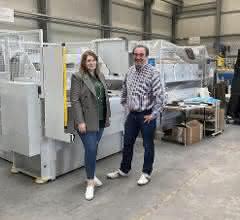
At home in Pirmasens in the western Palatinate and represented by its eight subsidiaries in seven countries on three continents: "We are where our customers are," says Jennifer Ring, describing the Ring Group's successful strategy of global presence. Last year, she took the step into management at the specialist for mechanical engineering and contract perforation as planned. Since then, the 32-year-old has been responsible for the fourth generation of the family, together with her father Andreas Ring and her uncle Matthias Ring. The company's 100th anniversary (1921-2021) dates back to the same year, although due to the restrictions imposed by the pandemic, the celebrations will not take place until a few months later in the summer of 2022.
As with many other companies in the region, the roots of this traditional business lie in the shoe manufacturing industry. In the mid-1980s, the owners recognized the impending relocation of wage-intensive production from the former shoe metropolis of Pirmasens to low-wage countries in good time and opted for diversification. Today, a good 70 percent of the company's mostly long-standing customers are automotive suppliers, as well as tanneries, textile factories, paper manufacturers and, as before, shoe producers. With its 350 employees worldwide, 250 of whom work at the German headquarters in Pirmasens and a smaller branch in Bühl in Baden alone, the Ring Group generates annual sales in the double-digit million euro range.
Customer-oriented delivery from a single source
One hundred years on the market, an independent family business with a solid foundation and a focus on healthy growth: One of the success factors is to always focus on the needs of the customer. This applies in particular to mechanical engineering, where perforating, punching, embossing, tanning and shoe machines are not only planned, developed, designed and delivered by the Ring Group. The one-stop service also includes the supply of tools as well as service, maintenance and training worldwide. Contract perforation is comparatively comprehensive, for example for leather seats, steering wheels, dashboards and headliners. The service package ranges from consulting and design development to sampling and delivery in a wide variety of batch sizes. "Ultimately, however, quality is always the deciding factor," emphasizes Jennifer Ring and describes 'Made in Germany' as a seal of quality that is still recognized worldwide and stands for the highest quality and precision, especially in mechanical engineering: "The high quality and durability of our machines is regularly demonstrated when we take back systems that have been in use by our customers for a very long time for reconditioning and resale."
Rooted in the region and connected to its people
Particularly in the context of 'Made in Germany', she sees the Pirmasens site as being a fixture; a current investment, the large new production hall currently being built at the headquarters, is evidence of this. Last but not least, it is also about the close ties to the region and its people and the continuation of a Pirmasens family tradition that began with company founder Franz Hatzenbühler, has continued for over 100 years and is set to continue in the future.
In terms of employee recruitment, the Managing Director responsible for commercial matters sees the location in the Western Palatinate as neither an advantage nor a disadvantage. However, she sees the advantages of being able to reach the important hub for international flights in Frankfurt am Main relatively quickly, but also being able to get from A to B every day via short and congestion-free routes. Kaiserslautern, Saarbrücken and the Rhine-Main region, for example, would be easy to reach - only the connection to the east via the not yet fully developed B10 to the economic areas of the Rhine and Neckar would leave something to be desired.
"Not being constantly annoyed in traffic jams and thus saving valuable time is just as much a part of the quality of life as living where others from urban centers go to spend their vacations," Jennifer Ring points out. She is alluding to the adjacent Palatinate Forest Nature Park with its natural recreational opportunities such as hiking, cycling and mountain biking and much more. "In addition, the cost of living in the region is extremely affordable." The good cooperation with the city administration is also one of the benefits highlighted, as is the relationship with the city leadership, which "is on hand whenever it is needed". Jennifer Ring is only critical of some of the bureaucratic hurdles in new construction projects - knowing full well that the administration's room for maneuver is limited by law. Her aim is to ensure the continuation of the family business into the fifth generation. Sooner or later, she could also receive support from her younger sister and her three cousins, who are also younger.
"The Ring Group is one of the German flagship companies that harmonize family structures and cross-generational tradition with the performance and reach of a modern global player," explains Markus Zwick, Lord Mayor of the city of Pirmasens. "As a city community, it is invaluable for us to have such nuclei of economic prosperity in our midst. I am thinking here of the large number of qualified jobs, but also of the apprenticeships on offer with six training profiles for technical and commercial areas. Quite apart from this, the Ring Group carries the name and reputation of our city all over the world through its extensive network."


You might also be interested in
Predictive maintenance in retrofit
Predictive maintenance pays off. This is because early detection of impending failures means that systems can be serviced in a targeted manner before production downtime occurs. But how complex is it to integrate such a maintenance concept into an...
 read more...
Maintenance instead of replacement
The circular economy starts with the machinery
Sustainability in industry starts with machines, says our guest author from Deguma: How maintenance, modernization and the 5R strategy save resources, energy and CO₂.
read more...3D printing for unplanned requirements
The material fails and the machine suddenly stops? Then you need to take the right measures to be able to resume production quickly. Material failure in the form of faulty components or material wear in the frame are a risk for any production.
read more...High demands in terms of safety, application and robustness
Demanding work in the electrical trade and energy supply as well as smooth processes in production require innovative and customized measurement technology that scores points for safety, ease of use and resilience.
read more...Car meets e-bike: riding with lubrication-free polymer bearings
Studies show that the proportion of pedestrian and bicycle traffic is increasing in urban areas. With the JetBike, JetBike GmbH from Braunschweig presents a mixture of e-bike and car and relies on lubrication-free polymer bearings from Igus.
read more...Hydraulic hub for more efficient servicing
Bosch Rexroth presents a digital toolbox for service and maintenance. With a comprehensive range of digital services, the Hydraulic Hub simplifies and accelerates the service and maintenance of hydraulic products and increases machine availability.
read more...Arnold Umformtechnik expands after-sales...
Faster help with VR glasses
Arnold Umformtechnik is expanding the after-sales service for its machines to include digital remote services. The focus is on data security, simple operation and clear processes.
read more...147,000 euros per hour: high costs for German companies due to unplanned downtime
According to the "Value of Reliability" study, 67% of industrial companies in Germany experience unplanned downtime at least once a month. This costs the German economy 147,000 euros per hour. Nevertheless, reactive maintenance concepts are not...
read more...Maintenance starts with a maintenance planner
Legal requirements stipulate that machines and systems must be serviced regularly. The maintenance work serves to ensure occupational safety and economic efficiency.
read more...