

Monitoring solutions in the drivetrain
Process monitoring for greater efficiency
Mayr Antriebstechnik shows how intelligent, talking brakes and clutches can be used for process monitoring. They not only help to reduce or even completely avoid faults and downtimes, but also enable demand-based maintenance and automated remote maintenance.
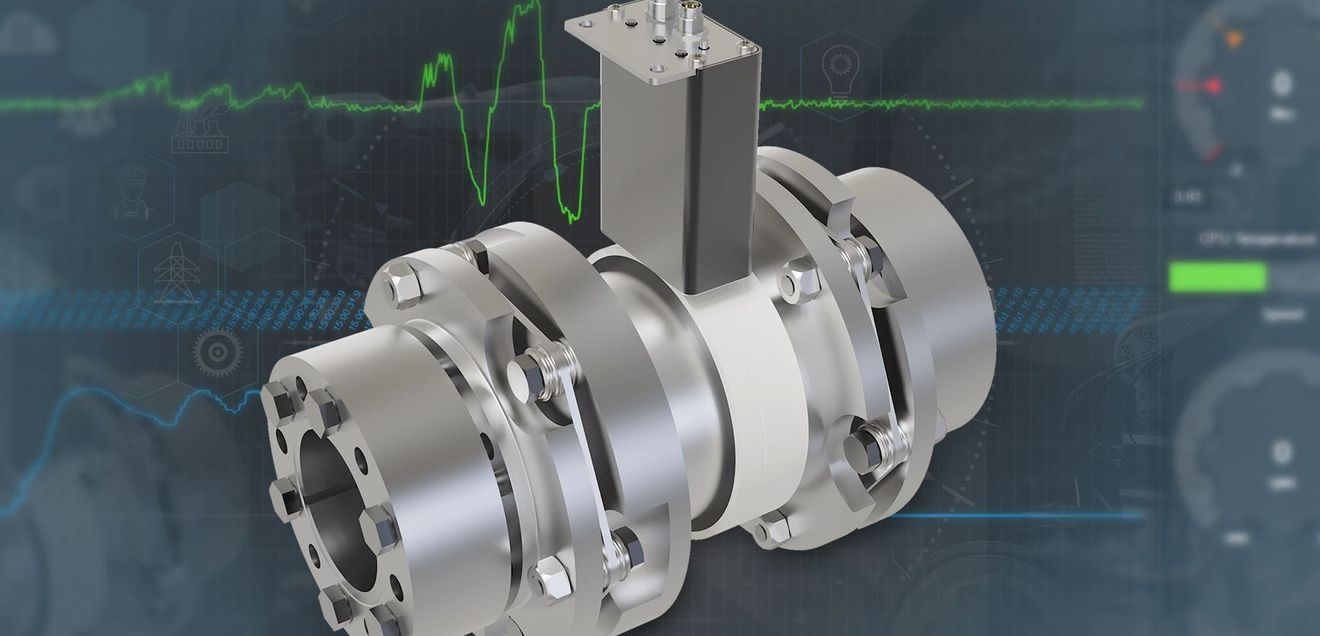
Mayr Antriebstechnik shows how intelligent, talking brakes and clutches can be cleverly used for process monitoring. They not only help to reduce or even completely avoid faults and downtimes, but also enable demand-based maintenance and automated remote maintenance. Users want to be informed about torques in the drive train, but this only works if there is enough space for implementation. The Roba-drive-checker is now a new component in the proven modular system of the Roba-DS backlash-free disk pack clutch. The core elements are the multi-gateway and the Roba-drive-checker sleeve. As all connection options of the Roba-DS steel multi-plate clutch are available, this process monitoring system can be integrated into many existing applications, including in the field of robotics.
Safety brakes: Information directly from the component
Mayr Antriebstechnik also offers smart solutions for safety brakes. The brakes are capable of communicating without additional sensors and provide information directly from the component. Mayr safety brakes are monitored using the retrofittable Roba-brake-checker module, which is connected to the brake's power supply. The module uses an advanced analysis of current and voltage to detect the movement of the armature plate and knows the status of the brake. In addition to monitoring the switching status and critical coil temperature, the Roba-brake-checker also performs preventive function monitoring for wear, function reserve and faults.
In an extended version, the module is equipped with an additional circuit board with a customer-specific interface. This can be used to supply data on switching time, current, voltage, resistance, power and relative pick-up current. This means that curves can also be evaluated, anomalies in the process can be quickly identified and conclusions can be drawn from complex correlations. Integration into remote maintenance systems is also possible.
Hall 6, Stand B57


You might also be interested in
Triton Partners takes over Flender
Global investment firm Carlyle has signed an agreement to sell Flender, a provider of mechanical drive technology, to Triton Fund 6, advised by Triton. The terms of the transaction were not disclosed and is expected to close in the fourth quarter of...
 read more...
New roller conveyor cover from Hema
Rolls faster & lasts longer
Hema brings speed to roller blinds: With the expansion of the product family for roller conveyor covers, the specialist for machine and equipment protection has improved travel speed by 30 percent.
read more...Family-owned company invests 28 million euros in Nuremberg site
Anyone talking about German industry at the moment is often talking about uncertainty: a weak economy, high costs, global upheavals. A different story is being told in Nuremberg.
read more...Why stator and rotor laminations are becoming a performance factor
Why the future of robotics depends not only on software, but also on high-precision stator and rotor laminations inside the motor.
read more...New drives and image processing for networked production
B&R, the Machine Automation Division of ABB, will be presenting new solutions for machine and plant engineering at the all about automation trade fair in Wels. The focus will be on drive technology and industrial image processing.
read more...Around 9 percent increase in incoming orders
In the 2025 financial year, Bosch Rexroth generated sales of around 6.5 billion euros. The company thus succeeded in maintaining its business at the previous year's level despite the persistently difficult environment. Order intake recorded...
read more...Increased demand for control and drive...
Sieb & Meyer expands production capacities in Lüneburg
Sieb & Meyer AG is expanding its production space in Lüneburg by 1,800 m² in response to continued high demand in the wake of strong sales growth in the 2025 financial year and increasing investment in AI infrastructure.
read more...Hanover Fair starts
Topics such as digitalization and sustainable production will shape Hannover Messe 2026, and a number of prizes will also be awarded during the trade fair.
read more...Warehouse automation and drive technology
Automated storage systems place high demands on the drives in horizontal and vertical conveyor technology.
read more...