

Electric drives
New device family for active energy management
The new PxtFX, PxtEX and PxtRX devices from Michael Koch are designed to open up new possibilities for the active management of energy from electric drives.
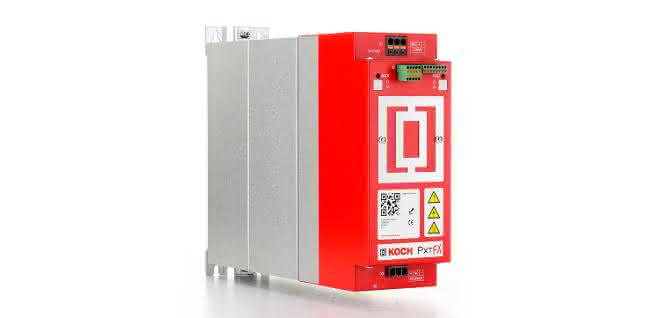
The modular device family was actually supposed to be presented to the public at the Hannover Messe at the end of April. The applications are numerous, but they are all based on storing surplus or required electrical energy temporarily, largely independent of the grid. The choice of storage media also depends on the application, with Koch using special aluminum electrolytic capacitors for short and very frequent cycles, double-layer capacitor modules for higher energies and less frequent cycles and batteries for infrequent cycles. The connecting element between the drive and storage is the active energy management device or system. Koch has been active on the market with such devices since fall 2010. The new product family with the meaningful name Pxt, which can also be pronounced "P times t" (equals energy), is now reaching a new dimension with greater functionality.
PxtFX for frequent, short cycles
Two active devices called PxtFX and PxtRX are complemented by the PxtEX, the modular storage unit with one or more aluminum electrolytic capacitors. The applications are diverse, the devices provide benefits through a single feature or through the combination of two or more features. The first feature that comes to mind is the recuperation of the machine's braking energy, which increases energy efficiency. In its smallest configuration, the PxtFX can save up to 1.2 kilowatt hours of energy per operating hour in one-second cycles. In terms of the application itself, savings of up to 40 percent can be achieved with the active energy management system based on the PxtFX.
However, other benefits often play a greater role than increasing energy efficiency, such as the compensation of so-called brownouts, the safe and defined standstill during blackouts, the possible acceleration of production processes with output increases of up to 50 percent, the reduction of grid load peaks or even the operation of the electric drive independently of the power grid.
With a current load capacity of 20 amps continuous and 40 amps peak for around one minute compared to the storage unit, which may have a maximum voltage of 450 volts DC, the PxtFX can generate up to 18 kilowatts of power. The device can be equipped ex works with a storage volume of two or four kilowatt seconds. Automatic detection of the brake transistor switch-on voltage threshold is built into the device as standard, which enables the device to work with all commercially available frequency inverters and servo controllers in a plug & play manner. The extensive safety features of the PxtFX protect against reverse polarity of the DC link connections, against the connection of loaded memories and against overloading the system on both the memory and DC link sides. Koch considers internal fuses to be standard. New features on the PxtFX include the SD memory card, an external 24-volt supply, status indicators via LEDs, boot loading and reset options and six digital I/Os. This is supplemented by output functionalities via a USB module.
PxtEX expands the storage volume
If the storage volume of the PxtFX is not sufficient, the PxtEX device comes into play. A single PxtEX can store two, four or six kilowatt seconds of energy with its aluminum electrolytic capacitors specially developed for the application spectrum of active energy management systems. Simply connected to the PxtFX via cables with reverse polarity protected plugs, the memory expansion directly benefits the system. The individual storage units are internally fused and also indicate their charge status visually via a flashing LED. A safe discharge resistor is also integrated into the PxtEX as standard, which provides direct and rapid support in bringing the overall system to a voltage level that is safe for people. However, Koch systems are generally low-maintenance.
PxtRX for higher loads
While the PxtFX device is specially designed for use in applications with repeat cycles of milliseconds to a few seconds and must be able to do this well over 100 million times over its service life, its bigger brother PxtRX is predestined for applications in conjunction with higher energy density storage devices, such as double-layer capacitors or batteries. The PxtRX is designed for a current load capacity of 30 amperes continuous and 60 amperes peak for around one minute. In conjunction with a high storage voltage of up to 800 volts DC, the device is able to generate an output of almost 50 kilowatts.
If this power is not sufficient for the application, several PxtRX devices, as well as the PxtFX devices, can be connected in parallel. Depending on the application, this can result in active energy management systems that fill large control cabinets. Koch offers ready-to-connect complete systems in control cabinets under the type designation KTS. These include active energy management systems from the Pxt family, application-specific storage units, the appropriate fuses, cabling and, depending on the storage units used, passive or active discharging devices. One feature in particular helps the PxtRX in such KTS control cabinet solutions: it works without any problems even with power lengths of up to 20 meters to the DC link.
Digital rating plate makes work easier for many
What all appliances have in common is the digital rating plate. When the QR code of an appliance is scanned using an app for Android or iOS smartphones or tablets, not only the technical data of the specific appliance and its specific design are displayed, but also inspection and test reports as well as the associated documents such as the installation and operating instructions. This means that all users of the device can access the individual documents and information for the device in the Pxt family from any location and on any paper. In addition, management options are available that allow a machine manufacturer, for example, to assign devices with their respective properties to a machine or system. as


You might also be interested in
Helu makes its first trade fair appearance under a new brand name
Helu Kabel will be presenting itself as Helu for the first time at Hannover Messe 2026, showcasing system solutions, Heluchain cables and new industrial luminaires.
 read more...
Strategic realignment with brand relaunch
In future, Helukabel will trade as Helu
The Helukabel Group is parting with part of its name: in future, the company will only operate under the Helu brand. With this step, the specialist for electrical connection technology is underlining its strategic development from a classic cable...
read more...Modular plant construction for corrugated board
Insight into the production of corrugators at BHS Corrugated: Automated, modular and equipped with Helukabel components.
read more...Best quality for the steel
Conditions in the steel industry are harsh and inhospitable. The machines used must be able to withstand the demanding environmental conditions in order to deliver the best quality at all times.
read more...If the standard cable is not sufficient
Lapp offers cables for countless applications - but not for all of them. From time to time, the developers have to modify a standard cable or develop a special cable.
read more...Slight decline in sales, strong investments
The Lapp Group has not been spared from the weakening global economy. However, the company only recorded a slight loss in the past 2024 financial year.
read more...Electrical connection technology
Cables and wires for industrial automation
Heukabel offers system solutions for cable routing from a single source. The subsidiary EKD Systems specializes in tailor-made cable drag chains made of steel, stainless steel and plastic, which are used in moving machines and systems as well as in...
read more...Lapp relies on Ultramid from BASF
Mobile charging of electric vehicles
The automotive industry is currently undergoing the biggest transformation in its history. The boom in battery electric vehicles in particular is presenting the industry with major challenges. Lapp, as a supplier of cables and connection...
read more...Cable handling application
At this year's Motek, ArtiMinds Robotics is showcasing a robot-based automation solution for the sensor-assisted assembly of flexible cables in connector housings.
read more...