

Under the skin of Mars
Maxon makes motor fit for NASA's InSight mission
On November 26, the robotic probe InSight is due to land on Mars, carry out various measurements and provide insights into Mars and the formation of the Earth. To do this, a measuring probe will be driven five meters into the Martian soil.
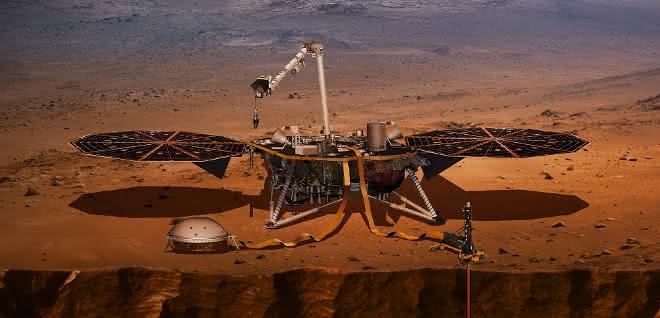
DC motors from Maxon Motor are also on board. The engineers at the Obwalden-based drive specialist had to pull out all the stops to make their motor fit for the task. The mission is being carried out by NASA's Jet Propulsion Laboratory (JPL).
Five meters deep into the Martian soil
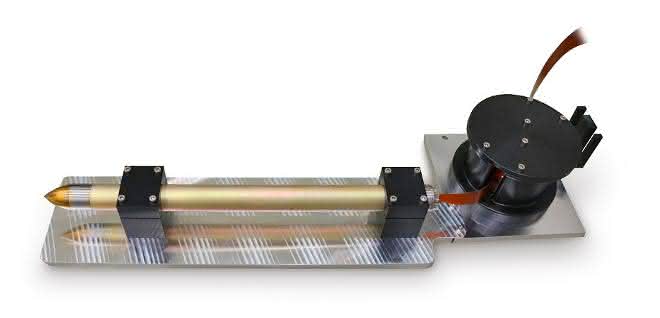
A compact motor-gearbox combination with a diameter of 22 millimetres is used in the HP3 measuring device, which was developed by the German space agency DLR and is intended to determine the temperature profile of the planet. Specifically, the maxon drive is located in a bolt, which the developers call a "mole". This bolt independently penetrates five meters deep into the ground by tensioning a spring with each rotation of the motor, which then discharges with great force and triggers a downward impact. In this way, the "mole" gradually works its way down into the ground - over a period of several weeks. As it does so, it drags along a cable equipped with sensors which, among other things, will help the researchers to determine the thermal state of the Martian interior and draw conclusions about its formation. As Mars is a rocky planet like Earth, the scientific results can also provide new insights for our own planet.
Special solution for more than 400 g
Mars is per se an unfriendly place for technology. Nevertheless, more than a hundred Maxon drives have already proven their worth on the Red Planet. For the current InSight mission, however, the Swiss engineers have been faced with even more challenges. To effectively drive the bolt into the ground, the DC motor has to withstand forces of over 400 g - more than 100,000 times. It took several variations and failed tests before the right solution was found: a standard DCX 22 motor, which was heavily modified with additional welding rings, welded bearings and specially shortened brushes. The GP 22 HD gearbox used, on the other hand, only received Mars-specific lubrication.
The InSight probe is powered by two solar panels for the duration of its mission. JPL has used designs from the successful Phoenix mission to save costs. To extend the solar panels, a maxon DC motor is used that was developed some time ago: an RE 25. This type of motor is also found in NASA's Opportunity rover, which has been active on Mars for more than 14 years.
This means that two generations of Maxon drives come together in the InSight robotic probe and together contribute to the success of the mission.


You might also be interested in
Helu makes its first trade fair appearance under a new brand name
Helu Kabel will be presenting itself as Helu for the first time at Hannover Messe 2026, showcasing system solutions, Heluchain cables and new industrial luminaires.
 read more...
Strategic realignment with brand relaunch
In future, Helukabel will trade as Helu
The Helukabel Group is parting with part of its name: in future, the company will only operate under the Helu brand. With this step, the specialist for electrical connection technology is underlining its strategic development from a classic cable...
read more...Modular plant construction for corrugated board
Insight into the production of corrugators at BHS Corrugated: Automated, modular and equipped with Helukabel components.
read more...Best quality for the steel
Conditions in the steel industry are harsh and inhospitable. The machines used must be able to withstand the demanding environmental conditions in order to deliver the best quality at all times.
read more...If the standard cable is not sufficient
Lapp offers cables for countless applications - but not for all of them. From time to time, the developers have to modify a standard cable or develop a special cable.
read more...Slight decline in sales, strong investments
The Lapp Group has not been spared from the weakening global economy. However, the company only recorded a slight loss in the past 2024 financial year.
read more...Electrical connection technology
Cables and wires for industrial automation
Heukabel offers system solutions for cable routing from a single source. The subsidiary EKD Systems specializes in tailor-made cable drag chains made of steel, stainless steel and plastic, which are used in moving machines and systems as well as in...
read more...Lapp relies on Ultramid from BASF
Mobile charging of electric vehicles
The automotive industry is currently undergoing the biggest transformation in its history. The boom in battery electric vehicles in particular is presenting the industry with major challenges. Lapp, as a supplier of cables and connection...
read more...Cable handling application
At this year's Motek, ArtiMinds Robotics is showcasing a robot-based automation solution for the sensor-assisted assembly of flexible cables in connector housings.
read more...