

From steam engine to HyperPodX
120 years of Continental drive belts
Continental has significantly shaped the history of the drive belt and thus the progress of the industry. The registration of the Continental brand for drive belts dates back to 1899. It all began with a simple V-belt. Since then, the company has been developing and producing belts that provide drive in almost every industry.
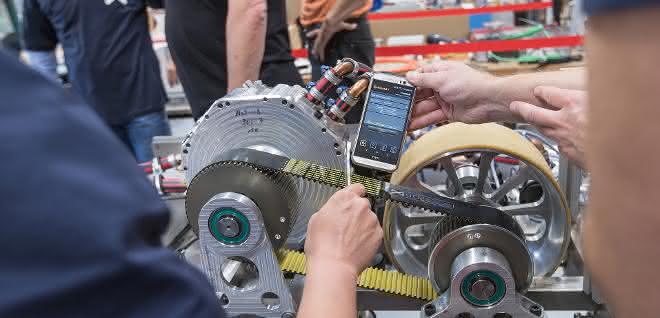
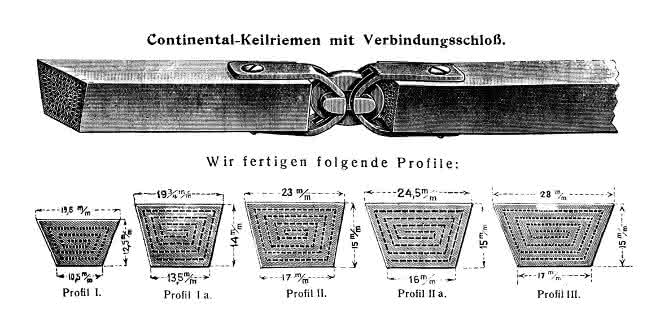
150 years ago, steam engines powered looms and spinning wheels. The energy was transmitted by leather belts. At the beginning of the 20th century, the V-belt with connecting lock, which was produced by Continental from a rubber compound, set new standards for the transmission of rotary motion. Its predecessor, the flat belt, could only transmit around a third of the power with the same width. The belts had to be able to transmit more and more power and be as space-saving, robust and easy to use as possible.
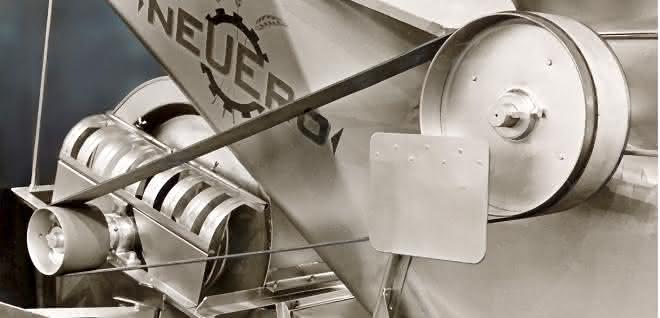
In the 1950s, the company produced polyurethane timing belts. With a steel cord tension member, they were even more efficient and could maintain a more constant belt tension. With their teeth, they were form-fit and precise. Higher rotational speeds and smaller installation spaces were therefore possible.
In the 80s, V-belts could be manufactured without a fabric cover. This made them even narrower and more powerful at the same time. A type of toothing improved their ability to bend. Timing belts underwent a similar development.
Today, the focus has shifted to improving materials and combining them: fiber-reinforced mixtures, EPDM, aramid tensile cords and, later, carbon. The latter stretches only minimally even under high tensile loads. The company now has more than 18,000 dimensions and designs in its portfolio. Last but not least, Continental 's belts provide valuable support for Hyperloop technology, which experts see as a revolutionary approach to mobility. Students at the Emden/Leer University of Applied Sciences and the University of Oldenburg, for example, used a Synchrochain Carbon from Continental for a Hyperloop project. With the Synchroforce Carbon, Continental also launched its first oil-resistant rubber timing belt on the market.
The latest development is belts with integrated sensors for condition monitoring.


You might also be interested in
Continental unterstützt Hyperloop-Technologie
Für das Projekt „HyperPodX“ haben Studierende der Hochschule Emden/Leer und der Universität Oldenburg im Rahmen eines Wettbewerbs des amerikanischen Unternehmens SpaceX einen Hyperloop entwickelt. Den Antrieb übernimmt ein Hochleistungsriemen von...
 read more...
Contitech: Lagerungselemente schützen selbstfahrende Transportanlagen
Continental bietet Lagerungselemente an, die selbstfahrende Einheiten in der Intralogistik vor Stößen und Schwingungen durch Unebenheiten wie Schwellen oder leichte Höhenunterschiede schützen.
read more...From sensor to intelligent system
Sensors, measurement technology and artificial intelligence are merging to form intelligent systems. From June 9 to 11, 2026, Sensor+Test in Nuremberg will showcase the most important trends in a changing industry.
read more...Dr. Volker Frey becomes CTO
On May 1, 2026, there were personnel changes in the top management of the ifm group of companies. Dr. Volker Frey succeeds Benno Kathan as CTO, who has retired.
read more...Sales growth in a turbulent market environment
Thanks to innovations and a focus on strategic industrial markets, Sick was able to moderately increase its sales in the 2025 financial year. In a turbulent market environment, the company was able to maintain its position and gain market share with...
read more...Precise sensor technology for mobile machines
Compact singleturn Hall-effect encoder with IP65
The Megatron MP1612 is a wear-free Hall effect single-turn encoder with 12-bit resolution, IP65 metal housing and extremely compact design (Ø12 mm, depth 11.5 mm). Ideal for joysticks, AGVs and agricultural machinery.
read more...New impetus for ifm sales
Two new positions were filled at ifm at the start of 2026: Markus Wolf becomes Managing Director Sales Germany, Sven Quant takes over the position of Central Managing Director in the Process Sensors division within the ifm Group.
read more...Werner von Siemens Fellows 2025
Five research talents honored
Five outstanding research talents have been honored as Werner von Siemens Fellows 2025. The Werner von Siemens Ring Foundation recognizes researchers whose work has made an exceptional contribution to the advancement of science and technology in...
read more...Biodegradable label makes transportation conditions traceable
Researchers are developing a smart, compostable label that measures temperature and humidity and detects when limit values are exceeded.
read more...