

Autonomous systems and networked controls
Intelligent planning makes it easier to get started with automation
In today's manufacturing processes, machines and systems are becoming increasingly autonomous, intelligent and powerful. This applies above all to the end devices and tools used, which are necessary for process tasks.
Sensors, push-buttons or handling systems and the corresponding control systems. They can work more autonomously and be decentralized. Where previously a central control system was required for the individual components, these components now perform many functions themselves. This shifts the intelligence from the control level to the machine level. A classic system architecture is not always suitable for ensuring efficient processes. Instead, new architectures are required.
Typical system architectures for automation systems consist of a lower level - the machine level - with the executing end devices, for example handling systems, which carry out specific material flow or production tasks. Higher-level controllers at the control level, such as programmable logic controllers (PLCs) or industrial PCs, logically link the underlying systems. PLCs are autonomous control modules that do not require the use of computers, but can also be combined with other IT systems. There are also software solutions that perform these tasks. Industrial PCs that are integrated into the network of machines and systems are used to run the software. In linear technology applications, the higher-level controller takes over the control of individual steps to complete a transport task. Sensors such as light barriers, temperature sensors, limit switches and actuators, for example lifting or adjustment systems, from different manufacturers are often linked together.
System architectures are changing
While the subordinate systems in classic system architectures were usually not very powerful, the picture has now changed considerably: The machine level is becoming more intelligent and is therefore often integrated into a device together with the control level. As the end devices from the former machine level therefore increasingly have their own control systems, they can perform precise tasks in production and logistics. For example, sensors in manufacturing processes are able to position themselves. Intelligent end devices can also be used in area gantries based on linear technology. Depending on the application and intelligence of a machine, different system architectures are therefore possible.
PLC compared to the control system without PLC connection
PLCs are ideal when changes to the workflow need to be implemented quickly, as they have standardized interfaces and can be easily combined with other IT systems. In this way, they open up further areas of digitalization in the sense of Industry 4.0. Once control programs have been created, they can be copied and used as often as required. The PLC can be accessed from different locations - remote maintenance is therefore possible without any problems. Rapid error analysis and reliable operation are additional advantages of the PLC.
In contrast, autonomous systems with their own controller without a PLC connection are ideal if tasks with less complexity are to be performed or a higher-level process controller is not required. This considerably reduces and simplifies the effort required to set up the system. There is no need to create a separate IT infrastructure to connect different systems. This enables step-by-step planning and expansion of production systems and makes it easier for small and medium-sized companies in particular to get started with automation. Investments can be implemented gradually and adapted to a company's performance. It is also possible to combine both systems. In this way, autonomous systems can be used specifically in conjunction with networked systems.
Applications in conjunction with linear technology
In linear technology in particular, there are many examples of how efficiency in production and logistics can be increased with relatively little programming effort. Stand-alone linear technology solutions are ideal for simple tasks such as lifting, lowering or positioning workpieces and tools. A PLC connection is not necessary in this case. For this purpose, slides are moved along a linear axis or cantilever axes with fixed slides are used. Automated linear units are perfect for moving tools from one point to the next and positioning them precisely, for example.
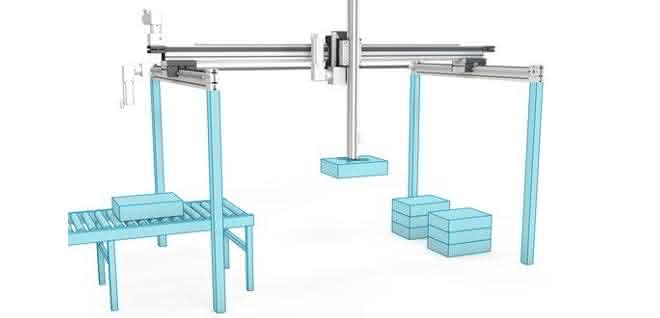
Even heavy loads, such as robots or production systems, can be moved automatically in this way. Cantilever axes use the carrier profile of the linear unit to exert force on a workpiece or to precisely position a tool. They can be used for material and load tests, among other things. One application example that requires a connection between intelligent end devices and a PLC is the control of 2D and 3D gantries. In this case, the end devices are positioned along a surface or in a room. Typical areas of application are pick-and-place tasks in production and logistics as well as the feeding of products, for example when filling liquids. Surface gantries can be used to guide print heads, nozzles, scanners and sensors. Spatial gantries are used, for example, when materials need to be stacked or sorted. For this purpose, cantilever axes are equipped with grippers or suction cups that move the material in a space.
One system for many applications
Item offers a flexible basis for process automation with its customized complete system. This consists of a linear unit, motor, drive and controller as well as comprehensive software support for planning and commissioning. "With the Item linear motion unit, we deliver a perfect system that supports classic and modern system architectures and therefore covers many applications in linear technology," says Uwe Schmitz, Product Manager Machine Automation at Item Industrietechnik GmbH. "Transport tasks can be performed without a higher-level controller; however, a connection to a PLC via fieldbus or I/O ports is also possible."
Numerous pre-assembled linear units with different drive and guide technologies are available for the implementation of classic automation tasks and are ideally matched to each other. The Item MotionDesigner only requires a few details to perfectly match all components when configuring the linear unit. The software takes into account the static, dynamic and thermal loads of all components and calculates the optimum solution from thousands of possible combinations. Item MotionSoft is then used to easily configure and commission the automation solution. The commissioning software and the intelligent Item control system automatically measure the linear unit to determine the optimum settings.
Simple programming and perfect integration
The central task of the Item controllers is the optimum control of the Item servo motors at all times. The programmable servo controllers combine many functions in a compact housing. Complete travel profiles can be saved and executed in the controller. Signals can be read in and evaluated directly, for example via I/O ports. "Users can carry out programming using the Item MotionSoft software," explains Uwe Schmitz. "This allows them to set important parameters such as speed and acceleration and define the travel program."
Once the path program has been stored in the control system, it executes it independently. A PLC is therefore not required to move to positions or carry out simple processes. The Item controllers support all common fieldbus systems and have interfaces to higher-level controllers. This means that the linear units can also be integrated into complex processes as modules. Working in conjunction with a PLC is therefore also possible if more complex tasks need to be implemented.


You might also be interested in
More than 900 exhibitors already registered
Around six months before the start of the trade fair, more than 900 companies have registered for SPS 2026 in Nuremberg. The trade fair focuses on industrial AI, cyber security and digital transformation.
 read more...
Virtual PLCs in practice: How vPLCs make production systems more flexible and scalable
The increasing networking of IT and OT is fundamentally changing industrial automation. The IT/OT Integration Summit shows how modern technologies can make production environments more efficient, flexible and future-proof. The event will focus on...
read more...Sales growth in a turbulent market environment
Thanks to innovations and a focus on strategic industrial markets, Sick was able to moderately increase its sales in the 2025 financial year. In a turbulent market environment, the company was able to maintain its position and gain market share with...
read more...Siemens presents new AI agent
Siemens is launching 'Eigen Engineering Agent', an AI for automation technology. The solution is integrated into the TIA Portal, has been tested with over 100 companies and is designed to significantly accelerate engineering processes.
read more...Schaeffler keeps sales almost stable
Schaeffler generated revenue of EUR 23.5 billion in 2025 and increased EBIT before special items to EUR 936 million. At 266 million euros, free cash flow was significantly above the prior year and forecast. Net income remained negative due to high...
read more...Advancing artificial intelligence together
Helukabel is stepping up its activities in the field of artificial intelligence and is now a member of the IPAI. The innovation and collaboration platform for companies, research facilities, institutions and administration has set itself the goal of...
read more...New impetus for ifm sales
Two new positions were filled at ifm at the start of 2026: Markus Wolf becomes Managing Director Sales Germany, Sven Quant takes over the position of Central Managing Director in the Process Sensors division within the ifm Group.
read more...Digital twin meets product passport
Future-proof end-to-end solution at SPS 2025
At SPS, conplement and R. STAHL will present how the digital twin works end-to-end along the entire value chain: from creation and provision to productive use.
read more...Changes in the management of Endress+Hauser
Endress+Hauser strengthens its management team: Mirko Lehmann, Katja Windt and Helena Svensson take on central management roles. What is changing in technology, production and personnel.
read more...