

Transportation system
In the right position at the right time
A manufacturer relies on the PosyArt transfer system from IEF-Werner to apply laser marking to plastic paint trays after production. It conveys the components on workpiece carriers to the stations.
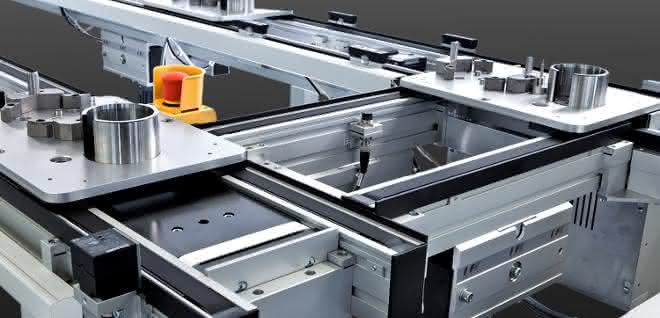
Scratches in the paintwork? Fingerprints or dirt such as dust particles on the surface? This can quickly lead to complaints, especially with high-quality plastic parts such as decorative trims for the automotive industry. Manufacturers therefore often rely on so-called plastic paint trays. These allow them to transport components after injection molding and paint them directly without having to pick them up or put them down anywhere. A southern German plastics processor was commissioned to produce these trays. In order to subsequently mark the series parts with a logo and a consecutive number for traceability, the processor was looking for a transport system that would automatically and, above all, precisely feed the trays to the laser marking system. A solution was also required that would link the individual process steps - including the upstream processing stations.
"The company approached us with these requirements," recalls Oliver Koch, an employee in the Systems Sales department at IEF-Werner. The automation specialist supplied the PosyArt assembly, transfer and testing system and adapted it to the new customer's specifications. The modular and, thanks to the use of welding frames, stable structure of the IEF solution now enables simple and economical marking of the components. Thanks to the numerous standard components, virtually all transfer, assembly and logistics tasks can be solved - from straight transfer lines between the various automatic stations or manual workstations to branched transfer systems.
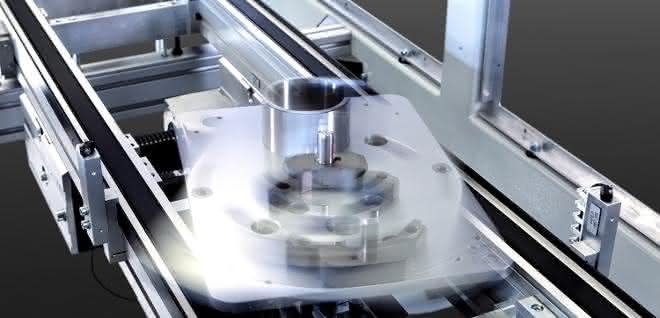
The main components such as belts, drives, switches and stop elements are very durable. The dovetail geometry on the long sides of the profiles allows sensitive, stepless positioning of all PosyArt assemblies. The belt is also antistatic. Circumferential flat belts are used in this case. Thanks to the use of pre-assembled belts, the user can easily replace them in the system in the event of wear without the need for time-consuming gluing. The height of the sections can be varied using the standard frames.
Reliable transport system
"We have equipped the system with 400 x 400 millimeter workpiece carriers (WT), each weighing six kilograms, and the corresponding holders," explains Oliver Koch. At the seven manual workstations, employees place the trays one after the other in the correct position on the WT. Lateral positioning, centering stations and a turning unit are used to bring them into the correct position for further processing.
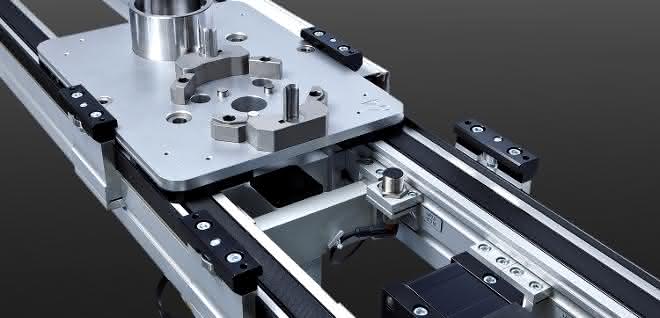
In the centering unit, for example, the trays are placed in the middle and then fixed three-dimensionally with an accuracy of plus/minus 0.05 millimetres. The laser system can later mark the components with a high degree of repeat accuracy. A turntable, which turns the workpiece carriers by 180 degrees, is used to change direction on the line. The loaded WT travels to the various processing stations at a speed of 21 meters per minute. These include a unit that cleans the surface to be marked, one that blows off the component, two laser stations that apply the marking precisely to the correct part and an optical sensor that checks the position of the marking.
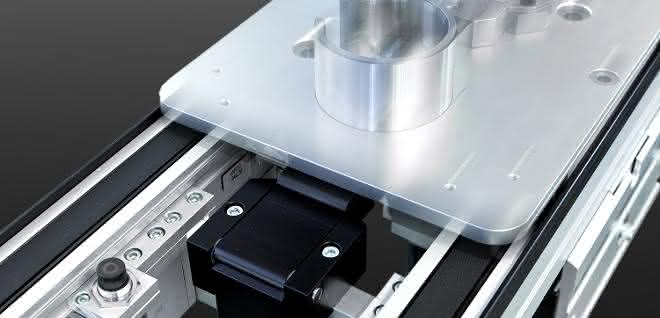
A stopper stops the loaded WT in front of each station while the conveyor belt is running. "We have arranged these in the middle," explains Oliver Koch. "This prevents the workpiece carriers from jamming in the guide rails. The stoppers used in this application are pneumatically operated and are equipped with integrated workpiece carrier damping. They are triggered as soon as sensors detect the workpiece carrier on the belt."
Completely documented
In addition to the hardware, IEF-Werner supplied the complete control technology including the TransLogic performance solution. This processes information from the workpiece carriers as well as the individual stations. "The carriers are prepared for the integration of RFID chips as standard," explains Oliver Koch. "Production-relevant information such as processing statuses or test parameters can therefore be read out via read heads, the system statuses displayed, orders managed and production processes monitored." The control station solution also supports system maintenance. Production data can be archived and evaluated via CSV file. TransLogic is based on a Siemens S7 1500 and therefore offers all interfaces to the various system components. The connection is made via Profinet.
The IEF-Werner team supported the plastics processor in project planning and finding solutions - as well as in aftersales. "If a component needs to be replaced, these are also available separately at any time," says Oliver Koch. "We always have important wear parts in stock and therefore immediately available." Users can replace them themselves in just a few simple steps. For example, the drive belts of the points can be replaced within a minute by lifting out the lifting unit or changing the entire slide-in unit. as


You might also be interested in
Robotics and autonomous order picking
Locus Robotics acquires Nexera Robotics and expands autonomous warehouse logistics
Locus Robotics takes over Nexera Robotics and may have taken a decisive step towards truly universal warehouse automation. A new gripping technology should now make possible what was previously considered difficult to automate.
 read more...
How bridging steps, stairs and catwalks are changing processes in production and logistics
At Logimat 2026, Munk Günzburger Steigtechnik will be showcasing modular bridging steps, stairs, platform and walkway systems for production, warehousing and logistics. With online configurators, distances can be efficiently shortened, processes...
read more...Highly automated warehouse for...
SSI Schaefer implements highly automated warehouse for CERP in France
SSI Schaefer and CERP are building a highly automated logistics center for pharmaceutical logistics in Wissous with shuttle storage, A-Frame, robotics and WAMAS software.
read more...Start of construction for new production hall
Mayr Antriebstechnik invests in its home base and internationally
Mayr Antriebstechnik strengthens location and international logistics: Construction of a new hall in Mauerstetten - parallel expansion of the plant in Poland as a logistics hub.
read more...Conveyor systems that adapt
Modern conveyor systems must reliably transport different product sizes, shapes and materials. The new modular product system from Kipp offers flexible, modular solutions for this: Adjustable side guides ensure precise alignment and gentle...
read more...Focus on sustainability and AI at the trade fair
With more than 120,000 square meters of exhibition space, LogiMAT 2025 will once again occupy all ten halls of the Stuttgart exhibition grounds. From March 11 to 13, global players, medium-sized companies and start-ups will provide an overview of...
read more...Workstation system for shipping and logistics
With Sintro Packing, Karl is launching a workstation system that is designed to meet the specific requirements of shipping and logistics. It is characterized by modular adaptability and ergonomic efficiency.
read more...Deutsche Messe announces Robotics Award
On the occasion of Hannover Messe 2025, Deutsche Messe is once again presenting the Robotics Award after a break of several years. Prizes will be awarded for robot-supported automation and logistics solutions. Companies and institutions from Germany...
read more...Micro motors as the driving force behind intralogistics
Suitable transport structures in intralogistics are a prerequisite in all industries in order to withstand competitive pressure in the future. The basis for this is comprehensive automation, which would be inconceivable without an armada of powerful...
read more...