

Fully automatic assembly
Installing cables automatically in the vehicle
A process for the automated assembly of wiring harnesses in motor vehicles is to be developed in a joint project. Image processing and robots play an important role in this complex process.
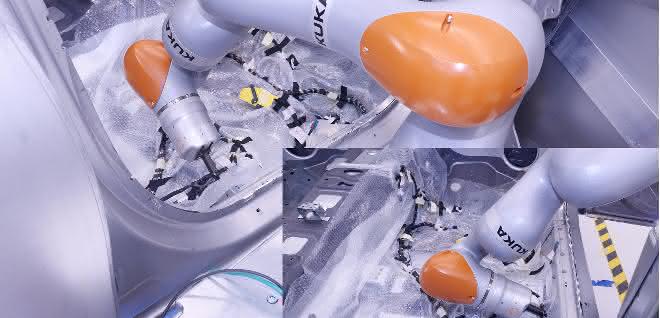
Wire harness production and assembly is still characterized by a large number of manual processes. A sub-project of the Innovation Initiative Wire Harness (IILS) of Arena2036 is therefore dedicated to the investigation of the realization of an automated assembly of the wire harness in the vehicle. Due to the large number of variants and the associated complexity of the wire harness, the aim must be to achieve the most flexible approaches to automation possible. To this end, BMW, Mercedes-Benz, Kuka, Rosenberger and the Institute for Control Engineering of Machine Tools and Production Facilities (ISW) are joining forces to assemble a reference wiring harness fully automatically in a vehicle body using a robot specializing in sensitive assembly work and a newly developed camera concept. The Arena2036 research campus is a partnership between science and industry funded by the Federal Ministry of Education and Research (BMBF) to develop and test concepts for tomorrow's automotive production.
Exploring technical possibilities
The aim of the sub-project is to evaluate the technical possibilities and limitations of automated assembly of the wiring harness. Based on the knowledge gained, it is possible to derive design guidelines and standards. These can be taken into account in the development process for new generations of wiring harnesses, thereby simplifying automated wiring harness assembly in the vehicle. An initial concept using delivery of the wiring harness on a carrier film instead of the usual packing bag offers advantages in terms of automated assembly. Thanks to the carrier medium, the wire harness has a defined starting position, which makes subsequent handling by a robot much easier.
Furthermore, the carrier film prevents ambiguous conditions, such as overlapping branches, and thus makes it possible to visually record the overall condition of the wire harness. The knowledge gained from this sub-project is also relevant for the entire value chain of the wire harness, as interfaces for automation could already be used in wire harness production. With the help of a demonstrator, requirements for an automatable wire harness are to be derived and evaluated. In the specific case of automated wire harness assembly under investigation, the challenge is to reliably identify and grip fastening elements for the wire harness and connectors attached to the wire harness.
A solution for localizing and tracking cables has already been researched at the ISW. This solution is now being extended to branched wire harnesses in this sub-project, paving the way for automated wire harness assembly through process-guided tracking of the wire harness.
Rough localization of a wire harness
A multi-body simulation is used for the rough localization of the wire harness, which recognizes the wire harness with the help of a stereo camera. For this purpose, the point cloud calculated using a stereo matching algorithm is first segmented and suitably filtered in order to distinguish the wire harness from its surroundings. The wire harness is then tracked using a model-based localization approach in order to have gripping information from the image data available at all times. A special feature here is that no additional optical markers are attached to the cable harness.
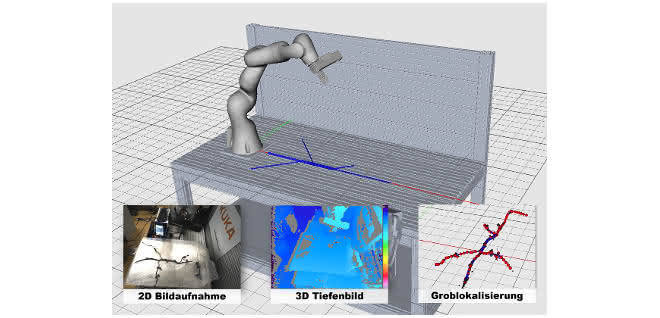
By localizing the wiring harness during the process, it is possible to read out the rough position of the clips at any time. These clips are needed to fix the wiring harness at defined points in the body. With the help of the rough localization, it should then be possible to drive a Kuka LBR iiwa 14 R820 with a camera mounted on the end effector over a clip in order to detect the clips specially designed for automation on the wire harness with a subsequent fine localization.
Fine localization of the wire harness
The clips are then recognized, gripped and placed by the camera mounted on the end effector. As this process was previously carried out manually, the clips must be adapted accordingly for automated handling. The important thing here is that the test bench makes it possible to practically validate different clip designs for automated assembly.
Thanks to the two-stage localization concept, the rough positions of the clips in the room are known at all times during the montage, which means that the search area for the necessary fine localization can be greatly reduced. Since no orientation of the clips can be identified by the purely rough localization, the fine localization must be added using a significantly smaller image area. In addition, the position of the camera for fine localization at the end effector is very helpful in compensating for uncertainties caused by the robot kinematics, as it can calculate the grip position relative to the end effector.
Test on the demonstrator
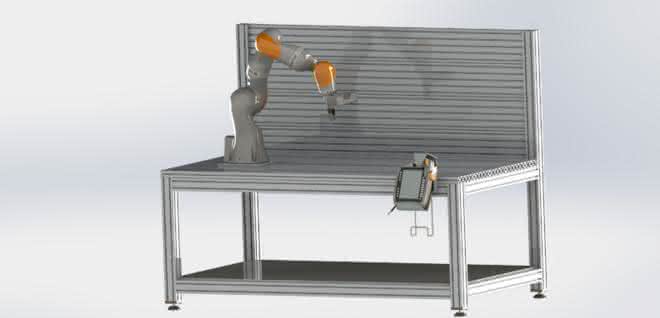
In order to master the complexity of such automation, it is necessary to consider the entire value chain. The project draws on a very large, experienced and mixed consortium. Thanks to the different perspectives from the individual stages of the value chain, measures can be taken that are in line with the entire value chain. Together, it is possible to lay the foundations for the automated assembly of a wiring harness in a vehicle. Current findings from research and industry will be used to build the demonstrator in summer 2021. After the described application scenario of assembly in the vehicle has been evaluated, the demonstrator will also be used to analyze manual activities in the value chain. These can be checked for automation with the help of the demonstrator. It would be conceivable, for example, to look at production on the building board, which is still characterized by a high degree of manual work today. Program sequences can be derived directly from a digital image, the digital twin, in order to plan the individual handling steps efficiently and with foresight. In addition, automation enables consistent information on the wire harness to be stored and evaluated in order to identify and reduce errors in the long term and ensure traceability.
Manuel Zürn, Markus Wnuk, Dr.-Ing. Armin Lechler, Institute for Control Engineering (ISW), University of Stuttgart; Christian Steiler, BMW Group; Matthias Paukner, Kuka Systems; Jerome Trommnau, Bernd Weiß, Dr.-Ing. Niklas Minsch, Mercedes-Benz; Manfred Mittermeier, Rosenberger Hochfrequenztechnik; Georg Schnauffer, Arena2036; Uwe Hessler, Kromberg & Schubert; Roland Pollner, Dräxlmeier


You might also be interested in
VDE study on electrical engineering
More retirements than graduations
According to a VDE analysis, more than 30,000 electrical engineers will retire by 2029 without enough graduates to replace them. This is due to falling student numbers and high drop-out rates.
 read more...
Giving lightweight construction a profile
Pultrusion: A process that forms fibers under tension
Pultrusion is developing from a niche process into a key process for lightweight construction and sustainable fiber composite structures. The Fraunhofer IWU shows applications from energy to mobility.
read more...Green hydrogen directly from the sun and water
A start-up project at the Karlsruhe Institute of Technology (KIT) aims to fundamentally simplify the production of green hydrogen: Mass-produced photoreactor panels are to be used to produce hydrogen directly from sunlight and water - without...
read more...Fraunhofer shows industrial future between AI, data and new materials
At Hannover Messe 2026, the Fraunhofer-Gesellschaft will be presenting solutions for a resilient industry: from AI and data rooms to hydrogen technologies and material and recycling innovations.
read more...The bottleneck is in the system
Is the transformation of the industry failing due to "German Angst"?
A recent ISF study examines what is slowing down change in German industrial companies. According to the results of the study, the causes of innovation bottlenecks often lie in internal structures and a lack of strategic orientation.
read more...Why a data-secure Germany needs joint implementation
Is 2026 a key year for a data-secure and networked Germany? Michael Fritz from the Fraunhofer Cluster CCIT explains why the coming year will be crucial for secure data spaces, common technical standards and Germany's digital future.
read more...Biodegradable label makes transportation conditions traceable
Researchers are developing a smart, compostable label that measures temperature and humidity and detects when limit values are exceeded.
read more...AI support for the circular economy
An assistance system developed at Fraunhofer IPK is used to identify, sort and assess the quality of disused household appliances, thus contributing to recycling and waste avoidance with the help of artificial intelligence.
read more...VDW Research Institute honors industrial projects
At EMO Hannover 2025, the VDW Research Institute will be honoring projects for increasing the efficiency of forging hammers and safe protective devices for grinding machines. Practical research for Industry 4.0, occupational safety and automation
read more...