
Stratasys and Siemens Healthineers
New findings on the quality of anatomical 3D prints
Stratasys and Siemens Healthineers have presented a research paper investigating the accuracy of 3D printed patient-specific medical models. The results show the potential of this technology for medical imaging and diagnostics.
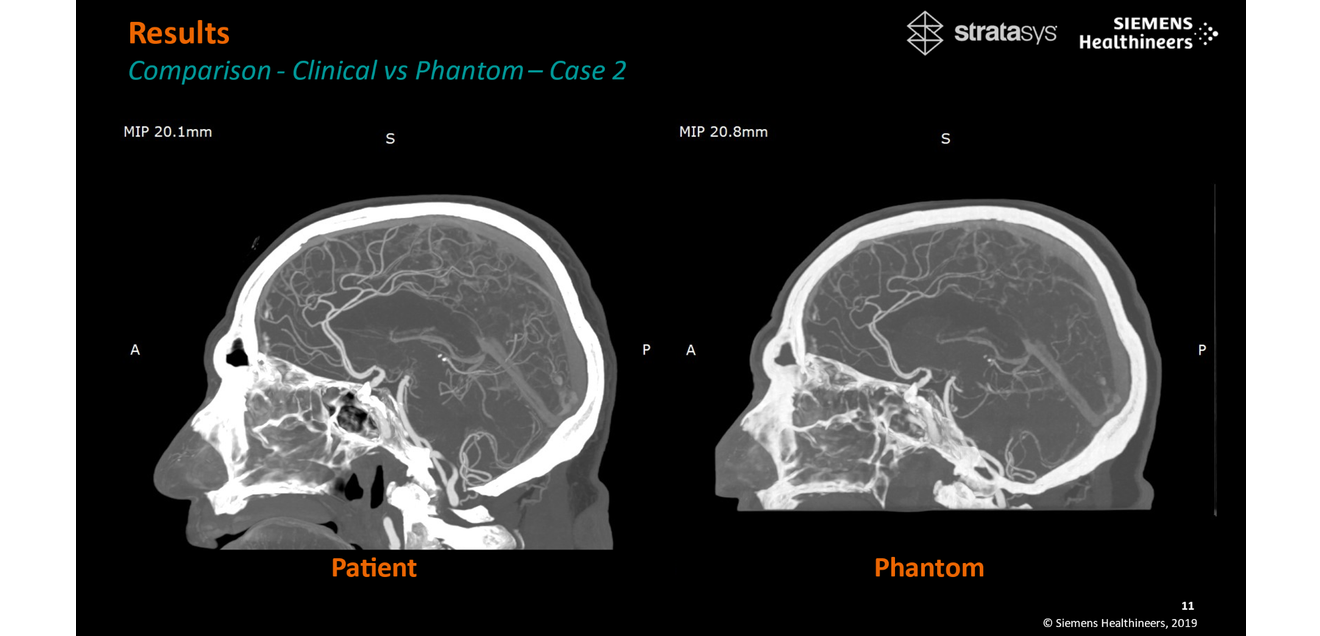
Stratasys and Siemens Healthineers have unveiled the results of a joint research effort that demonstrates the accuracy of Stratasys' 3D printed medical models to replicate human anatomy. This collaboration combines Stratasys' Radiomatrix materials and Digital Anatomy technology with Siemens Healthineers' algorithms to improve the quality of anatomical models. These are intended to replace the phantom models previously used for planning and training before operations.
The research results show that patient-specific 3D-printed models are not only cost-efficient and precise. They also enable the development of new CT scan algorithms and contribute to improving diagnostic accuracy. The use of these models in radiology allows a realistic reproduction of anatomical structures and pathologies.
Jesús Fernández Léon, Head of Computed Tomography Product & Clinical Marketing at Siemens Healthineers, emphasized the importance of this innovation for computed tomography. The combination of 3D printing solutions and digital anatomy technology not only improves the evaluation and verification of modern CT systems, but also sets new standards in medical imaging.
The results of the study were presented at the annual meeting of the Radiological Society of North America (RSNA). The joint research aims to further advance innovation in medical imaging. By integrating advanced digital anatomy technology and materials, patient-specific phantoms with high anatomical precision and realistic radiopacity are created. These models provide a more accurate representation of clinical imaging results than conventional phantoms and meet the high demands of radiology for consistency and reliability.
In addition, these phantoms offer the advantage that repeatable data sets can be generated on the same anatomy. This eliminates ethical and variability issues associated with human scans or the use of cadavers. They also facilitate the validation of AI-based software solutions, accelerate the development of new imaging algorithms and promote innovation in the field of materials science.
The use of this technology in hospitals and imaging centers can help to optimize the calibration and performance of CT scanners. This would lead to more precise diagnoses and better patient outcomes. At the same time, it opens up new opportunities for education, training and research in radiology.
Erez Ben Zvi, Vice President of Healthcare at Stratasys, sees the collaboration with Siemens Healthineers as a significant step forward for the medical community. This partnership could not only increase imaging accuracy and make training more efficient, but also reduce dependence on cadaver donors.
The RSNA presentation also highlighted the deviations between real and printed models. In critical areas such as gray matter and veins, the deviation was only one Hounsfield unit (HU), which sets new standards for CT imaging research.


You might also be interested in
AI automation specialist reorganizes...
Generation change at Insiders Technologies
After almost 30 years at the helm, Werner Weiss is handing over the management of Insiders Technologies. Andree Albrecht takes over the management after a transition phase.
 read more...
Intelligent brownfield networking
Many industrial companies are struggling with established plant structures and proprietary interfaces. Stefan Klaus' presentation will show in a practical way how brownfield environments can be efficiently networked with open technologies and made...
read more...Factory-X in practice
How can set-up processes in highly variant production be automated efficiently? Markus Benndorff from soffico shows how Factory-X, industrial data rooms and modular architectures create new possibilities for flexible production concepts.
read more...Quality controls in production
Robots check car floor pans fully automatically
How can complex components in automotive production be inspected fully automatically and in real time with the help of machine vision and robotics? The case study shows how floor pans are measured and inspected fully automatically.
read more...Measurement software with integrated calibration wizard
The WinControl measurement software from Ahlborn is designed for the acquisition and processing of measurement data with Almemo measuring devices and offers functions for complex calibration tasks. A graphical user interface and context-sensitive...
read more...New platform facilitates chip design
Siemens opens access to EDA software in Europe
Siemens is cooperating with the Chips JU within the framework of EuroCDP and is facilitating access to modern EDA software for chip design, development and innovation for European companies. The aim is to strengthen start-ups, SMEs and research...
read more...AI and virtual twins for the industry
Dassault Systèmes confirms annual forecast after solid start to 2026
The French software group Dassault Systèmes has made a solid start to 2026 and is continuing to focus on artificial intelligence, cloud applications and virtual twins as growth drivers in its industrial business.
read more...Use data consistently and uniformly
New connectors and an app solution for the IIoT framework from PLCnext Technology make it easier to collect data from controllers, sensors and field devices - especially in existing systems.
read more...How companies can prevent cyberattacks
Instead of using traditional malware, attackers use legitimate programs and system tools within their victims' IT environments. Malicious behavior can hardly be distinguished from normal user behavior. For companies, this means that security...
read more...