

Rotating multi-metal 3D printing
Students accelerate the production of rocket parts
Students at the Swiss Federal Institute of Technology in Zurich (ETH) have developed a laser melting machine that prints round components in a circle and can process several metals simultaneously. The system significantly reduces production time and opens up new possibilities for aerospace and industry. ETH has applied for a patent for the machine.
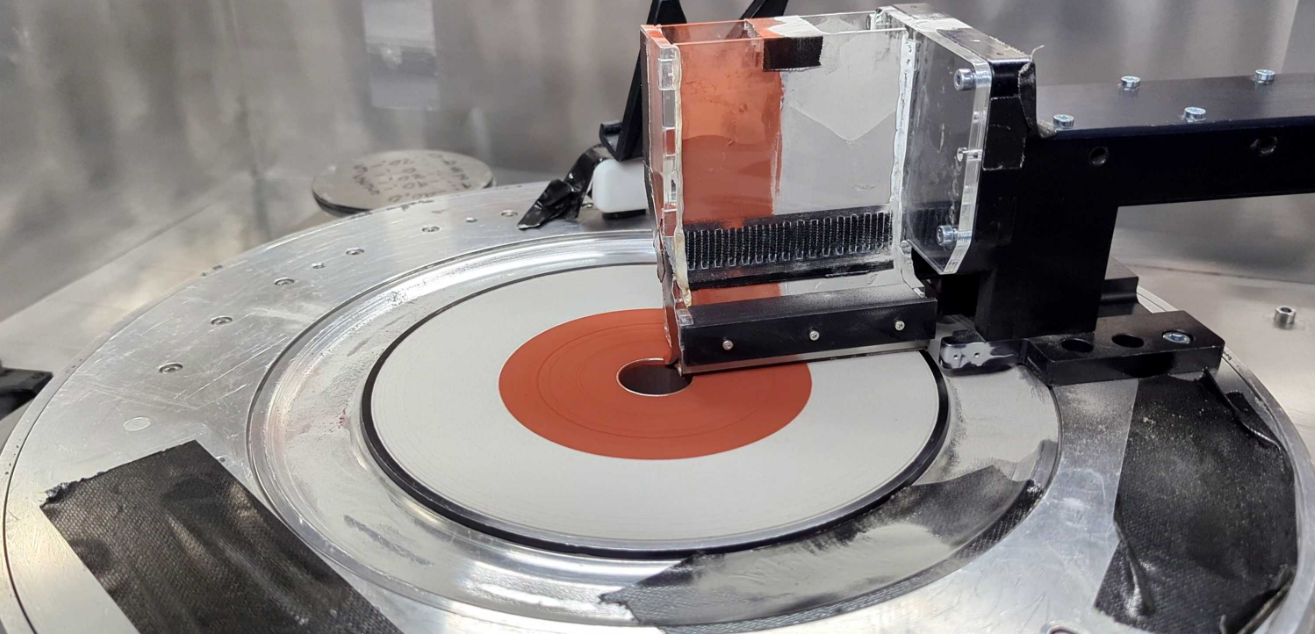
Faster 3D printing
Thanks to a rotating platform, the new 3D metal printing machine can apply and fuse material powder in a single step. It therefore works faster than conventional devices. The system can process two different metals in a single pass, saving work steps and using only as much material as is actually needed.
A prototype was created in just nine months and offers potential for applications in aerospace, aviation and drive technology - wherever lightweight, cylindrical objects are required. Almost all modern rocket engines now use 3D printing because it allows structure and function to be combined with particular precision, thereby increasing performance.
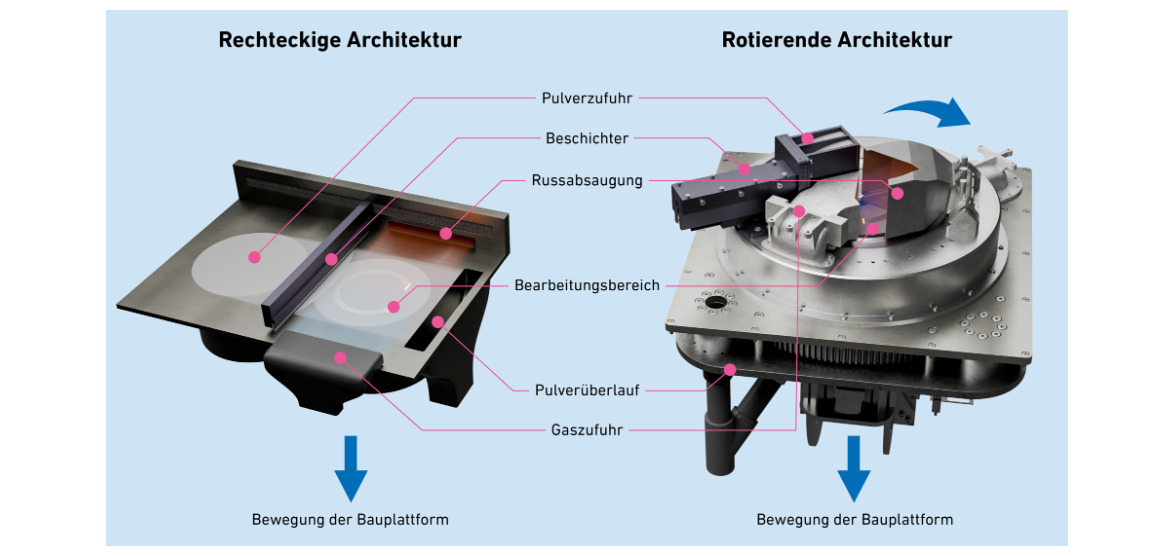
The students have now built what ETH Zurich reports to be the fastest multi-material metal printer: The new laser melting machine rotates powder and gas nozzles simultaneously during printing. This allows it to process several metals in a single pass without pauses. The machine could fundamentally change the 3D printing of metal parts by significantly reducing production time and costs.
Project Rapture: students develop the machine
The six-person team of Bachelor students in their fifth and sixth semesters developed the new machine as part of the Rapture focus project at the Laboratory for New Manufacturing Technologies under the direction of ETH professor Markus Bambach and scientist Michael Tucker. In just nine months, the students turned the idea into concrete plans, built and tested it.
The machine is particularly suitable for applications in the aerospace industry where cylindrical components are required, such as rocket nozzles or turbines. However, it is also interesting for general mechanical engineering.
Creating access to advanced 3D technology
Project manager Michael Tucker explains that the project arose from a very specific challenge: Aris, the "Swiss Academic Space Initiative", is developing its own rockets and needs special nozzles for liquid propellants. The student team is pursuing the goal of reaching the Kármán line in the coming years - the internationally recognized boundary to space at an altitude of 100 kilometers, above which the atmosphere is too thin to allow aircraft to fly without special propulsion.
In order for rocket nozzles to withstand the extreme heat and high pressure during a long launch, they should ideally be made of several metals. For example, the inside of a nozzle could be made of thermally conductive copper with integrated cooling channels, while the outside is made of a heat-resistant nickel alloy.
"For smaller players like the student rocket team, this kind of multi-metal technology was previously too complex and too expensive," says Tucker.
3D printing in rotation
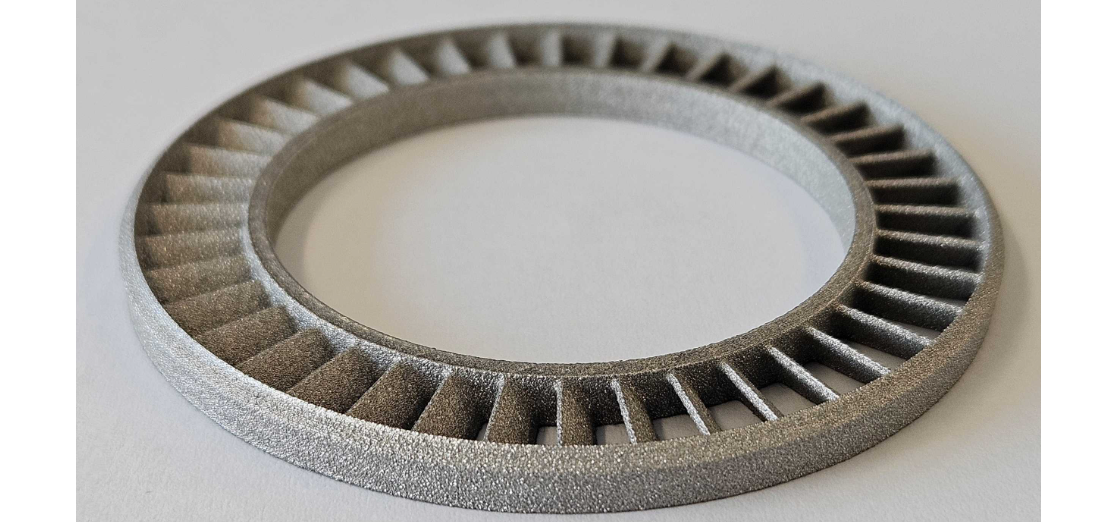
The core of the new machine is a rotating platform that enables a fast printing process. Unlike conventional rectangular laser melting systems, where a new layer of powder has to be applied after each fused layer, Rapture's machine works continuously thanks to the rotating platform: the machine can apply powder and have it fused by the laser at the same time. This significantly increases productivity. The production time for cylindrical components is reduced to less than a third.
Rocket nozzles, rotating engines and numerous aerospace components are ideal for this process, says Tucker. They typically have a large diameter but very thin walls. Although the machine can also produce non-axisymmetric parts or entire arrays of components, the rotating process is particularly efficient for ring-shaped geometries.
Two metals in one pass
The rotating machine can process two different metals simultaneously in a single pass. Conventional systems require several steps and significantly more metal powder. As mixed powder is difficult to separate and reuse, it is usually lost as waste. The new process only applies the material where it is actually needed on the component, thus saving material.
The machine blows a special gas over the area where the powder melts to stabilize the process. Nitrogen prevents the component from oxidizing during printing. Soot, spatter and other by-products are removed via a fume cupboard.
"We initially underestimated how much this gas flow device affects the quality of the product," says Tucker. "Today we know that it is crucial."
Thanks to the rotating architecture of the newly developed machine, the gas flows at the processing point can be controlled much more precisely than with conventional systems.
3D custom work instead of standard components
The students had to overcome several technical hurdles when developing the innovative laser melting machine. One of these was to precisely synchronize the laser beam with the rotation of the gas supply and the powder supply. Many of the components required for the machine were not commercially available, so the team designed them themselves. These included a rotating connection for the gas supply system and a system that automatically refills the powder during operation.
Despite this, the student team managed to build a machine that looks almost industrial-grade. For Tucker, this was one of the highlights of the focus project: "For a team of students to develop and build a functional machine in nine months is extraordinary."
Potential for space travel and e-mobility
In addition to specific applications for Aris and the aerospace industry in general, the team also sees potential applications in other areas, such as aircraft or gas turbines and electric motors, where ring-shaped geometries are typical.
Due to its novelty and great economic potential, ETH has applied for a patent for the rotating multi-metal laser melting technology. It has now also been nominated for the ETH Spark Award.
The components produced so far with the prototype have a diameter of up to 20 centimetres. The research team is now working on scaling up the process to higher speeds and larger diameters. To this end, the researchers are currently looking for industrial partners who would like to work with them to further develop and apply the technology.
Publication:
Bambach, M., & Tucker, M. R. (2025). Design and analyses of powder deposition, gas flow, and productivity for a rotary laser powder bed fusion system. CIRP Annals, 74(1), 315-319. DOI:10.1016/j.cirp.2025.04.005
Source: Swiss Federal Institute of Technology Zurich, Deborah Kyburz


You might also be interested in
Stratasys takes over MarkForged
Stratasys is acquiring MarkForged from Nano Dimension for USD 42.5 million, thereby expanding its portfolio in the field of fiber-reinforced composites. The acquisition also strengthens the company's software and materials expertise in industrial 3D...
 read more...
Timo Göbel, Head of BMW Additive Manufacturing
"Clearly on course for broad industrialization"
The BMW Group's Additive Manufacturing Campus (AMC) is setting the course for the next stage of industrialization. Under the leadership of Timo Göbel, additive manufacturing is being further integrated into all stages of the vehicle life cycle. In...
read more...Real-time control to make recycling materials economical
The Fraunhofer IAPT is researching AI-based closed-loop processes for industrial 3D printing with recycled plastics. The aim is to achieve less waste, greater process stability and profitable printer farms.
read more...Forum Solutions 4AMIndustry shows ways into industrial application
Additive manufacturing has developed dynamically in recent years and has long outgrown its status as a purely innovative technology in many industries. Nevertheless, companies still face the challenge of integrating AM into their production...
read more...Alliance aims to drive forward industrial 3D printing
Machine components, electrostatically shielded transport containers, large components for the automotive, rail and aviation industries or specific medical products straight from the printer - the potential applications of additive manufacturing are...
read more...Stratasys simplifies post-processing for 3D printing
Stratasys has launched a partner program for post-processing solutions to facilitate the creation of end-to-end AM workflows. The first partner is PostProcess Technologies, whose automated systems for FDM, PolyJet, SLA and P3 can now be purchased...
read more...Formnext 2026 puts UK and key industries in the spotlight
Formnext 2026 will focus on the United Kingdom as the official partner country. At the same time, the leading trade fair for additive manufacturing is further expanding its involvement in key user industries, including orthopaedics, aerospace and...
read more...Machines, automation and production technologies
From March 17-20, 2026, Grob is hosting an in-house exhibition for trade visitors in the field of production technology. Over 40 machines from universal machining centers, machining technology, electromobility and additive manufacturing will be on...
read more...AM has arrived in the industry
Formnext 2025, which took place in Frankfurt am Main from November 18 to 21, showed just how dynamically additive manufacturing is developing. With numerous innovations and pioneering developments, the trade fair not only presented new solutions,...
read more...