

Digital transformation
Automated conveyor technology
The increasing automation of logistics processes in production and intralogistics is and will remain a decisive competitive factor for companies and a guarantee of their resilience. Automated guided vehicles (AGVs) combined with stationary conveyor technology and automated warehouse solutions help to increase efficiency and also offer an easy and resource-efficient entry into the digital transformation thanks to improved process transparency (data and process mining).
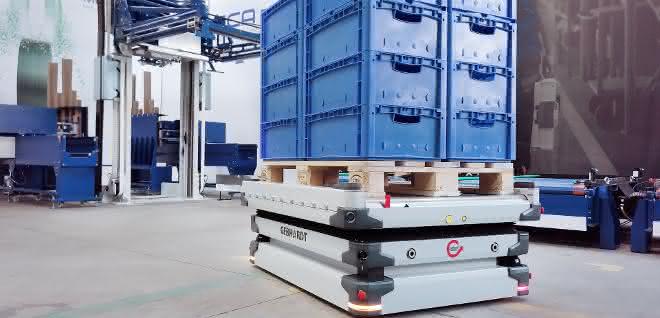
With the use of AGVs, the focus is essentially on the target variables of increased flexibility, improved adaptability, increased achievable logistics performance and system availability (condition monitoring & predictive maintenance). In addition to these features, the reduction of cost-intensive tied-up production and logistics space and the creation of additional transport routes through multiple use without increasing the floor space are further optimization measures. Waste, as defined by LEAN principles, can be reduced to a minimum through the use of integrated logistics concepts in conjunction with AGVs.
The Gebhardt Karis AGV complements the solution space of stationary conveyor systems for warehouses and production, breaks up rigid logistics chains and brings the necessary flexibility to the flow of goods. The AGV thus lays the foundations for modern and efficient material flows in volatile times of Industry 4.0, pandemics, fluctuating sales volumes and raw material shortages. Karis thus creates a versatile and future-proof solution that can be easily and scalably adapted to changing environmental conditions.
Scalable and powerful
Whether production or logistics, area or station supply - different circumstances require different solutions. Thanks to its modularity and building block approach, the Karis portfolio can be individually configured and therefore used flexibly. The Karis functionality includes autonomous, demand-driven task and order distribution as well as decentralized, infrastructure-independent material supply within logistics or on the assembly line - even over long distances. Alone or in mixed use, the Karis AGV integrates seamlessly into corporate, production and merchandise management control systems. In addition, the diverse transport applications ensure closer, more efficient and more reliable timing of the individual areas.
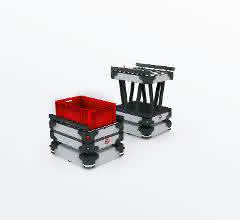
With its three basic designs in conjunction with various freely configurable options for load pick-up and load handling, all versions for transporting containers, trays, cardboard boxes and other load carriers weighing up to 1,500 kg are already covered as standard. Furthermore, the vertical range of manufacture even enables the realization of special load handling devices, so that no wish remains unfulfilled. With a footprint of 575 x 700 mm for the smallest and 900 x 1,300 mm for the largest design, as well as a maximum speed of 1.8 m/s and a maximum optional lift of the loading level of up to 250 mm, almost all transport tasks can be realized precisely and manoeuvrable. A fixed carrier plate (passive) or a driven load handling attachment (LAM), such as a roller conveyor (active), can be used for load handling.
Safe and efficient
The Karis is equipped with highly integrated safety functions: State-of-the-art sensor technology prevents collisions with people or obstacles and offers maximum safety throughout the entire working area. Travel movements are permanently monitored. The vehicles stop automatically and reliably in front of obstacles. The distributed safety architecture allows adaptations to new load carriers and environmental conditions. A 360° protective field with laser scanners permanently scans the surroundings without blind spots. This equipment enables operation in both directions at the same speed. The vehicle communicates with the master computer via WLAN or 5G and uses the integrated optical navigation to reach the specified positions with an accuracy of up to +/- 10 mm.
Individually combinable software modules adapted to the application, which cover functions from the categories of traffic management for point-specific traffic control and energy management for controlling energy consumption, ensure the high efficiency and availability of the fleet. On this basis and for maximum processing efficiency, the order management module interacts with various logistics strategies to process the pending transport orders - regardless of the type of vehicle and across all systems. Together with the Gebhardt StoreWare, the modules combine to form the necessary strategies within a software topology that the operator needs for an efficiently functioning warehouse ecosystem. An essential element on the way to the Smart Factory.
End-of-line solutions integrated
The collaboration between Gebhardt and Mosca, a company that has been successful in the field of strapping technology and securing transported goods for over 50 years, showed that the use of mobile autonomous systems can rethink the optimal linking of end-of-line solutions, for example. In the jointly developed solution, the Karis system ensures the best possible connection of Mosca's stationary strapping machines to the flow of goods. The result is an uninterrupted and seamless material flow across stationary and flexible intralogistics components. "For us, stationary and flexible components are not in contradiction to each other, but perfectly coordinated with each other, they are the means to realize an uninterrupted, flexible and scalable material flow," explains Jan Schlichting, Head of Sales Mobile Robots and AGVs at Gebhardt.
Optimum supply for production
A globally active company in the field of powertrain solutions with 800 employees in five countries also relies on the Gebhardt Karis. By integrating the AGV, the customer realizes demand-oriented and flexible supply and disposal of decentralized production and manufacturing systems with tools for metalworking in machine tools. The basis for the new process was a complete re-modeling and transformation of the actual state into an agile and autonomous target state based on the FTS Karis.
Previously carried out manually and with long walking distances, the process was characterized above all by a high susceptibility to errors and an enormous amount of time. These times are now over and waste has been eliminated. The new solution reduces manual effort and bridges long distances within production, freeing up personnel and space that can be put to better use elsewhere. In addition, process efficiency and transparency are increased, which has a positive impact on more targeted store floor management.


You might also be interested in
5G in the industrial IoT
The Chair of Production Systems at Ruhr-Universität Bochum LPS is researching industrial applications with a local 5G network in the context of Industry 4.0.
 read more...
Implement milling tasks economically
Milling covers a wide range of applications - from the machining of large free-form surfaces in the aviation industry and in the manufacture of wind turbines to the milling of cavities and highly automated mass production.
read more...Mitsubishi Electric invests in the future
Further production building in Owariasahi City
Due to the growing importance of the Japanese region of Owarisahi in Aichi, Mitsubishi Electric Corporation is increasing its planned investments and announcing the construction of a second production building.
read more...Industrial Connectivity Lab opens
Siemens customers test wireless technologies
Siemens has opened a new test lab for industrial connectivity technologies at its Erlangen site. Embedded in the Siemens Technology Center on the Erlangen campus, the Industrial Connectivity Lab offers 300 square meters of space for testing...
read more...A sustainable foundation for the industry
The networks are growing together - this refers to the ongoing merging of IT and OT. Christian Korff, Managing Director Global Accounts and Member of the Management Board, Cisco Germany, explains the challenges and levers involved.
read more...It started with a timer for X-ray machines
In 2023, the automation expert Omron can look back on 90 years of innovative company history, in which many technological boundaries have been crossed and milestones set.
read more...Flexible component transport in production
Stein Automation presents the Stein 400 workpiece carrier system for parts weighing up to 80 kilograms and the C5G logistics control system.
read more...Extended image processing options
High-performance multispectral line scan camera with 5GigE
The new Linea2 4k Multispectral 5GigE camera takes machine vision systems to the next level with its performance and value, offering a 5GigE interface with five times the bandwidth of the Linea GigE camera.
read more...Digital transformation and edge computing
Kyndryl, the spin-off company of IBM IT Infrastructure Services, was represented at the Hannover Messe with several partners, such as Nokia, Google and VMware.
read more...