

Wipes
Use of consumables: avoid domino effects
The demands on industry are high: production processes are becoming ever more complex and customer requirements ever more stringent. At the same time, costs need to be reduced. Kimberly-Clark Professional draws attention to a detail that tends to go unnoticed: optimization through the correct use of consumables - such as wipes or dispensers. They can not only increase the quality of production, but also reduce the risk of defects, reworking and unplanned costs.
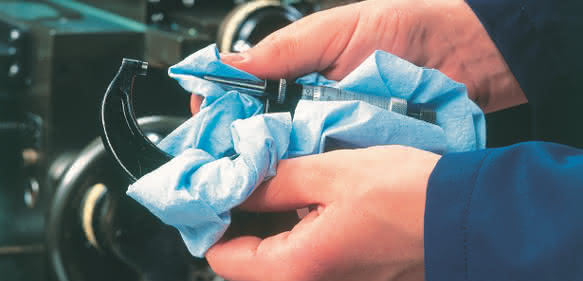
Even small details, such as the correct use of consumables, are essential for optimizing the production environment. If these are used according to the needs and requirements of the company, this has an impact on the number of consumables used or the working time required for a specific task, among other things. The amount of complementary solutions used, such as chemicals, paints or varnishes, can also be minimized in this way.
Purpose-optimized wipe prevents domino effect
Choosing the right wipe plays a key role when it comes to achieving increased productivity, higher cleaning efficiency, consistent quality and reduced consumption of cleaning materials. A wipe that is not optimized for its purpose can have far-reaching consequences in the daily production process. For example, when cleaning machines, conveyor belts or rough surfaces, it is important to clean them free of lint and residue. In the worst case, foreign bodies in machines and systems can lead to safety risks, downtimes and production losses. If the wipe does not meet the individual cleaning tasks, the consumption of the wipes is also significantly higher. If liquids have to be wiped up or heavy soiling removed, absorbent cloths with a textile-like structure are recommended. "Our WypAll X80 Plus wipes absorb more dirt per wipe than textile cleaning cloths, large rolls or other similar products. The result is less wastage of cloths and a reduced amount of waste," explains Nadine Woll, Marketing Manager at Kimberly-Clark Professional.
Save time and walking distances
Even if manufacturing specialists select their consumables carefully, they often fail to consider how they are actually used. As a result, the quantity, use or delivery method is not properly aligned with the actual need. For example, if industrial consumables are not provided at the point of use, waste is created through movement. If an employee spends just ten minutes per shift fetching consumables, this adds up to several thousand hours per year for 30 employees per shift. With flexible and mobile systems, this type of waste can be easily eliminated. "For example, we offer the mobile and closed WypAll wipe dispenser for our quarter-folded WypAll wipes for high cleaning requirements. Users benefit from various placement options. This means the wipes are always to hand. The dispenser is also economical to use and protects the contents from contamination," reports Nadine Woll. In addition to provision, the form in which materials are dispensed is also important in the production process. For example, when tearing off a wipe from an unperforated roll, it is easier for lint to accumulate. This can have serious consequences, especially in the food industry. Pre-cut products solve this problem while ensuring controlled consumption and preventing waste. Companies also benefit from a reduction in their disposal costs.
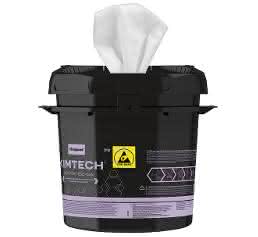
If solvents and chemicals are provided in open buckets, waste increases due to evaporation, which also represents a potential hazard for employees. In addition, there is a higher risk of spilling or splashing the agents. Similarly, when wiping cloths, paper towels or cleaning rags are immersed in solvent containers, too much liquid is often absorbed, which is no longer released by the cloths. To counteract the increased consumption of chemicals, the use of pre-soaked wiping cloths is recommended. With the Kimtech Wettask bucket from Kimberly-Clark Professional, users should be able to reduce their solvent consumption by at least 20 percent. The flexible provision of the refillable and airtight system at the respective place of use is a further advantage to enable employees to travel short distances.
"On the basis of plant inspections, we determine where hidden inefficiencies are concealed. This involves examining how products are used as part of a complex production and value chain. With the insights gained, Kimberly-Clark Professional delivers the right solutions that meet the specific requirements of the environment and processes. It is important to localize the problems precisely, achieve improvements and avoid domino effects," says Nadine Woll. cs


You might also be interested in
Plagiarius 2024 negative prize
On January 26, 2024, the Plagiarius campaign awarded its dreaded "Plagiarius" negative prize for the 48th time to manufacturers and retailers of particularly brazen counterfeits and fakes.
 read more...
Ivalua honors winners of the Generative AI...
AI-supported "add-ons" for buyers within 48 hours
Ivalua, provider of cloud-based spend management solutions, announced the winners and innovations of the first Generative AI Innovation Cup. The competition took place in December 2023. It was open to all Ivalua partners and employees - more than...
read more...Efaflex celebrates 50 years of high-speed...
The emphasis is on "fast"
Since day one, Efaflex has wanted to use new technologies as early as possible and drive progress in the industry. This year, the family business is celebrating its 50th anniversary under the motto "Fast Forward".
read more...Security of supply even during power outages
In the winter of 2022, Germany was worried about energy shortages. The drugstore retailer dm did not paint any horror scenarios, but nevertheless saw the possibility of controlled, temporary, regional power cuts (brownouts).
read more...Safety technology in mechanical engineering
Modules with new functions
Euchner's product highlights at EMO 2023 include the communication-capable solenoid interlocks.
read more...Transforming the paper industry towards climate neutrality
Together with partners from industry and research, Voith is developing a project for the optimization of energy and material flows in paper production. The aim of the research project is to develop a digital framework that enables effective process...
read more...Up to 95 percent less flue gas thanks to direct extraction
The requirements for occupational safety measures and safety technology are also constantly increasing in welding technology. The Technical Rules for Hazardous Substances (TRGS) stipulate that welding fumes and harmful substances must be extracted...
read more...Competitive advantages with large machines
Whether 3D-printed components for machines and systems, prototypes or aids for design: additive manufacturing is almost indispensable for modern companies in mechanical and plant engineering and automation if they want to play in the premier league.
read more...Transport technology from the modular system
Many transport tasks can be realized with the help of linear technology. Pre-configured solutions are available to simplify the interaction between the linear unit, motor, gearbox and controller. This minimizes the effort required for research and...
read more...