

Display
The sustainable lighting of industrial companies - implications for founders, entrepreneurs and co.
Many entrepreneurs ignore the many positive effects of efficient lighting and may lose money as a result. We explain why this is the case and what options exist for modernizing light sources in industry without investing huge sums of money.
Special features of lighting in the industrial sector
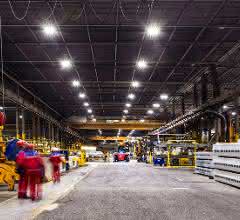
The highly complex, partly automated production processes in industry require special attention. Illuminating production halls and warehouses is essential to ensure that they function cost-effectively and productively.
The capital of any company is first and foremost its employees. They need to be challenged and encouraged. When it comes to increasing performance and productivity, the role of lighting is underestimated. Light is responsible for a large number of processes in the body. It influences well-being, health and the ability to work. Consequently, it is also possible to increase productivity by optimizing lighting conditions. For example, if better lighting results in fewer accidents, employees are less likely to fall ill. The regulatory costs for such scenarios are also reduced. Sickness cover, new hires and the replacement of non-functioning parts within the production line become obsolete.
Scientific studies clearly show a causal relationship between illuminance and the number of accidents at work in companies. In view of the fact that 80 percent of all information is perceived by the organ of sight, this is hardly surprising. According to this, increasing illuminance has the effect of increasing productivity to a certain extent.
Furthermore, replacing outdated lighting offers enormous energy-saving potential. Cost reductions of up to 70 percent can be achieved. However, the legal standards and sometimes outdated DIN standards that need to be observed can cause difficulties.
When it comes to setting up lighting systems, it is almost impossible to give standardized advice: Every business is unique. Individual concepts are necessary. In general, it can be said that older employees with declining visual performance need more support than younger colleagues. At this age, only half the illuminance is required compared to older employees. However, visual acuity begins to decline from the age of 35.
Examples from practice
Depending on the industry, different requirements need to be met that require individual solutions. This is illustrated below using examples from the logistics and electrical industries.
Logistics
The lighting in warehouses is often inadequate. Valid safety standards are not followed. The result is an accumulation of accidents at work. In the spacious halls, a broken luminaire is not immediately noticeable. This results in dark corners and obstacles are overlooked. The risk of accidents also increases due to the reflections of objects that can dazzle employees. Looking upwards, for example when sorting goods with a forklift truck, is particularly risky. This is caused by bright lights that obscure the view. In addition, the height of the warehouses makes it difficult for conventional luminaires to distribute the light evenly across the areas. The constant operation of the luminaires is a particular burden on energy consumption. Intelligent lighting management ensures that light is only available where it is needed. Sensors detect the presence of employees and switch the light on when it is really needed.
Electrical industry
The activities in the electrical industry are extremely diverse. It is therefore advisable to illuminate the individual work areas separately. Fine work such as the assembly of very small parts requires concentration and efficiency. Inadequate lighting results in employee fatigue and consequently leads to errors. This is particularly tragic in the case of cost-intensive materials and components. In this respect, the human eye is dependent on pleasant lighting. Light with a high blue component promotes concentration and reduces symptoms of fatigue.
In addition, glare-free lighting is mandatory. The reduction of shadows and flicker-free light have top priority. Clean room luminaires must also be used, as the manufacturing process, such as the production of microchips, does not tolerate any contamination.
Overall, optimum lighting serves to enable the combination of manual work and automated processes without errors.
Relevance of the sustainability of lighting systems
Climate protection and sustainability have long since ceased to be exclusively marginal issues. Rather, they are global challenges that are at the center of the discourse in society as a whole. Reducing electricity consumption inevitably cuts the company's costs and reduces its emissions.
This development is being realized through the use of modern LED lights and the conversion to intelligent lighting systems. It is foreseeable that in the future, the lighting of a business will play an important role in the planned revision of the Energy Saving Ordinance. In the future, lighting will presumably be assessed as a technical building system, which means that the energy requirements of lighting will no longer be offset against other technologies such as heating or air conditioning. It is therefore important to use technical innovations to save costs.
There are also plans to significantly shorten the specified maintenance cycles. The background to this measure is the avoidance of inoperable lights and systems and the associated reduction in electrical waste.
Advantages of renting lighting systems
Deutsche Lichtmiete supports industrial companies in the sustainable conversion to modern LED technology as part of the rental of lighting systems. The company is driven by the desire to protect the climate, which is why it uses luminaires with the longest possible service life of up to 100,000 hours and recycles damaged components by type. In addition to aligning its corporate philosophy with its ecological footprint, Deutsche Lichtmiete is committed to the Sustainable Development Goals of the United Nations.
Renting lighting systems prevents unnecessary capital commitment. This means that no initial investment is required for retrofitting. There are no opportunity costs. Financial resources can be used to strengthen the market position. Furthermore, monthly energy costs can be planned months in advance. In addition, costs are reduced due to a lower number of accidents and the replacement of dilapidated technology. These measures result in a reduction in electricity consumption andCO2 emissions. This is important, as sustainability and the ecological footprint are becoming increasingly important in a company's decision-making process. Positioning itself as a climate-conscious industrial company boosts its reputation immensely. This even makes it possible to tap into new customer bases.
As maintenance is included in the Deutsche Lichtmiete rental model, the probability of individual components failing is significantly reduced. This means a longer service life for the luminaires and the avoidance of non-recyclable waste. It can be assumed that this fact will also play an important role for consumers.


You might also be interested in
Protection against electrostatic discharge
StoFloor ESD KU 614 from StoCretec: dissipative flooring with the latest technology meets all ESD standards, is economical, extremely durable, mechanically and chemically resistant. The surface can be adjusted to be slip-resistant. The system is...
 read more...
Cables and wires from Helukabel
Food cultivation on a new level
Vertical farming - cultivation in multi-storey greenhouses - is considered one of the most exciting trends in food production. One of the pioneers in this field is the Romanian start-up Ultragreens. The company relies on solutions from Helukabel to...
read more...Further training for specialists to become security experts
With the "CESA - Certified Expert for Security in Automation" qualification, automation expert Pilz offers a two-day expert course designed to provide participants with compact security knowledge in line with the latest standards.
read more...Meaningful data on the service life of the seal
Seals prevent substances from penetrating or entering technical components. The intelligent seals from Freudenberg Sealing Technologies can significantly expand this core task in the future: the seal itself is also a sensor and becomes a "smart...
read more...Online stud configurator according to drawing
For standard bolts, with head, thread or hole
For standard bolts, with head, thread, bore or as a version with recess, mbo Osswald configurators map the standard specifications, are very easy to use, take a lot of work off the user's hands and save a lot of time.
read more...Safe palletizing with the Cobot
Verla-Pharm's medicinal products and food supplements have been available for decades. Ever-increasing throughputs result in ever-increasing logistics costs, whereby optimum utilization of the available production space is necessary.
read more...The tiger among processors
Since the move towards the Industrial Internet of Things (IIoT) and Industry 4.0 has picked up speed, processor boards and modules must be able to process exponentially growing amounts of data.
read more...VDWF publishes "Sustainability Compendium"
Nowadays, nobody can avoid "sustainability": In addition to a far-reaching presence in the media, it is also becoming increasingly important for companies in the tool and mold making industry to develop and implement appropriate concepts.
read more...More transparency and synergies with QM software
Weber, manufacturer of wood and metal sanding machines and extruders, has reorganized its quality management with ConSense IMS Professional. The software solution enables transparent documentation and more efficient processes.
read more...