
Suitable for fuels and mineral oils
Fluorosilicone rubber hoses
Reichelt Chemietechnik now offers hoses that are made of fluorosilicone rubber and are therefore particularly suitable for fuels and mineral oils.
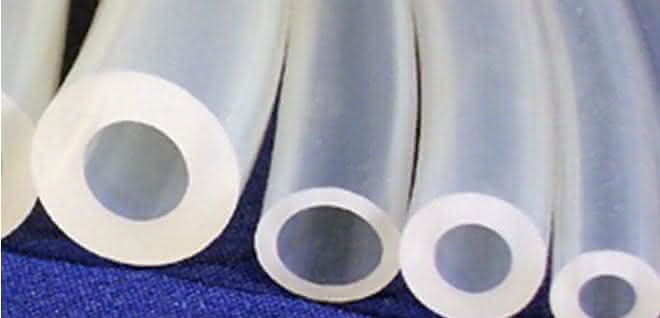
Fluorosilicone rubber, FVMQ or fluorosilicone for short, combines the chemical resistance and swelling resistance of fluororubber with the elasticity and low-temperature resistance of silicones. The molecular structure of the material differs from that of pure silicone rubber in that some of the methyl groups in the silicone backbone have been replaced by trifluoropropyl groups. The physical properties of fluorosilicone rubber are comparable to those of pure silicone rubber. In terms of chemical resistance, however, fluorosilicone offers additional compatibility with various aromatic mineral oils, fuels and aliphatic and low-molecular aromatic hydrocarbons.
Advantages and areas of application of fluorosilicone
The advantages of fluorosilicone over other elastic hose materials, according to Reichelt Chemietechnik: The material is extremely temperature-resistant with a permissible application range of -60 °C to +230 °C and remains rubber-elastic even at lower temperatures. In contrast to conventional rubber hoses, fluorosilicone hoses are also highly resistant to weathering, ozone and ageing. Particularly noteworthy is the chemical resistance, especially the resistance to mineral oils and aliphatic and aromatic hydrocarbons.
Thanks to these properties, fluorosilicone rubber is suitable for use in sealing technology and hose technology. In addition to round cords, profiles, O-rings and other seals, hoses and hose liners in particular are made from it. Fluorosilicone materials are used as conveyor hoses and seals in the automotive industry, in engine technology, the oil and gas industry and in aerospace technology.
The hose material is available in nominal widths from 2 mm to 12 mm and can be ordered from just one meter in length without a minimum quantity surcharge.


You might also be interested in
Motors, gearboxes and encoders: Faulhaber expands Ø 16 mm portfolio
Faulhaber is expanding its portfolio with new DC motors from the SXR and GXR family, a 16 mm planetary gearbox and the IEX3 magnetic encoder for compact drive solutions.
 read more...
New drive solutions for industrial automation and robotics
Faulhaber presents drive solutions with the new GXR and SXR motor family, which offer high efficiency and flexibility in combination with powerful gearboxes and encoders. These optimized components open up new possibilities for applications in...
read more...Marco Altherr becomes new Chief Financial Officer
The Supervisory Board of Ziehl-Abegg has appointed Marco Altherr as the company's new Chief Financial Officer (CFO). Altherr will take up his post in May 2025.
read more...Hydrogen storage in metal hydride
With its focus on storage systems for green hydrogen in solid form (metal hydride), GKN Hydrogen presents itself as a pioneer in safety and efficiency for the industry. GKN Hydrogen offers safe storage systems for green hydrogen and focuses on two...
read more...INDUSTRIAL Production Products of the year...
2nd place, Robotics category: EGS Automation
The SUMO automation systems from EGS Automation - economical standard solutions for automating a wide range of processes in plastics and metalworking - took second place in the robotics category in the competition for Product of the Year 2024.
read more...More productivity with Drive Intelligence
The trends in automation are productivity, sustainability and connectivity. Baumüller is launching new products on the market that address these trends, including new tools for smart energy monitoring, condition monitoring in the drive and new...
read more...Intelligence in Motion
At SPS, Koco Motion will be showcasing its expertise in customized drive solutions based on DC and BLDC motors, stepper motors, servo motors, linear drives and controllers.
read more...Nomination Products of the Year 2024
EGS Automation: SUMO automation systems
The SUMO automation systems from EGS Automation, economical standard solutions for automating a wide range of processes in plastics and metalworking, have been nominated in the Robotics category in the competition for Product of the Year 2024.
read more...Transport technology from the modular system
Many transport tasks can be realized with the help of linear technology. Pre-configured solutions are available to simplify the interaction between the linear unit, motor, gearbox and controller. This minimizes the effort required for research and...
read more...