

Digital twin
The digital twin in production
For production and manufacturing, the use of digital twins means a significant push towards automation. This article looks at what production-related companies should consider when working with the digital twin and what specific benefits they can expect from it.
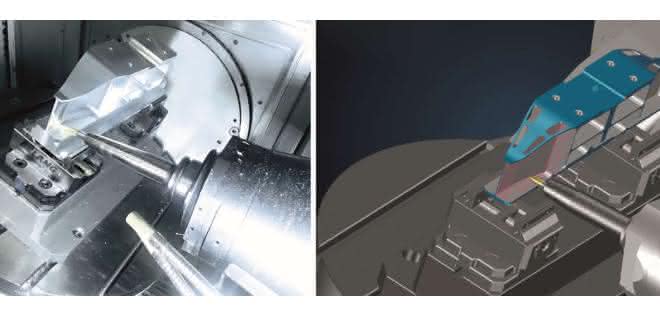
The concept of the digital twin has long been established in numerous industries and for numerous applications. In the production-related world of tool and mold makers and mechanical engineering, this refers to the virtual planning and programming of the real production world. This makes it possible to simulate the real production situation and the calculated tool paths at the desk; run-in processes are no longer necessary. In the market environment of tool and mould making, which is characterized by increasing competitive pressure, working with digital twins stands for faster and, above all, safer production.
Getting started is easy: the market already offers programs with the corresponding digital counterpart for almost all milling machines. However, if you want to be sure that your software supports you in actually and reliably eliminating the risk of an expensive and potentially dangerous collision, you should not be satisfied with a standard solution. This is because even the smallest differences between non-obvious deviations can have serious consequences. It is therefore advisable to opt for a solution from the outset that is continuously updated by the manufacturer.
Detailed reproduction of the scaffolding situation
A milling process is also a sometimes highly complex process in which numerous parameters such as material selection, data import, set-up and so on are interlinked. In other words: The aim is to map the complete set-up situation down to the last detail. In addition to the actual milling machine, this includes all associated manufacturing equipment. Against this background, Tebis defines the digital twin as the mapping of all actually existing manufacturing equipment and processes in the software. The real manufacturing situation is pre-planned 1:1 in the virtual world - regardless of whether it is the digital twin of a standard milling machine or a complex setup situation.
Tebis equipped the first full version of its software with postprocessors and quickly integrated the virtual machine library. Over time, the digital twins became more detailed against the background of the increasing spread of the "digital twin" concept. In the area of tools, it began with the simple milling cutter, followed by component-based milling and drilling tools and, in a subsequent step, component-based 3D turning tools. In addition to the digital twins for tools, the machine library contains over 1,400 virtual models in 3,700 variants of the standard machine types on the market. The respective geometric and kinematic properties are also stored there. Jaw chucks, steady rests and centers as well as machine tables, attachments and partitions are listed in the separate unit library for additional equipment. Even virtual clamping devices are part of this CAD/CAM system.
In order to carry out the simulations as accurately as possible, Tebis follows a very special approach. The simulator is fully integrated into the CAD/CAM environment. The simulation and collision check are already carried out during NC programming. The procedure of checking the toolpaths for collisions in the CAM environment before the NC output and correcting them if necessary means a noticeable increase in safety and short change loops if collisions are detected. Above all, this procedure also provides a basis for unmanned production or unmanned production at the weekend. For the latter in particular, it is essential that all machines run without interruption.
Digital process mapping via MES
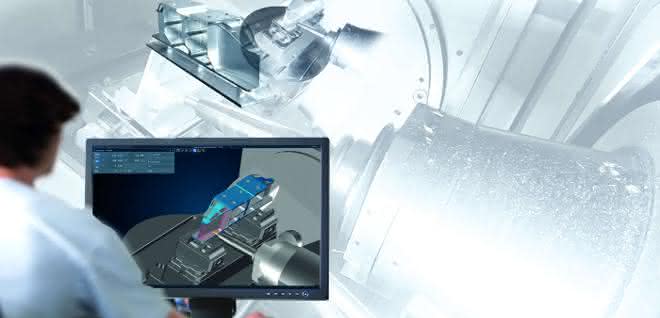
Not only the milling, laser cutting or turning process can now be realized fully digitally and highly automated, the same also applies to the associated planning, processing and control processes. If you want to create a sustainable basis for Industry 4.0 in this context, there is no way around an integrated MES solution (Manufacturing Execution System). Anyone looking for a suitable tool should make sure they choose an MES solution that has been specially developed for production-related companies. In MES ProLeiS from Tebis, the manufacturing environment and manufacturing knowledge are stored in templates as well as findings from past projects. In addition, the software also maps all other relevant data such as parts lists, availability of resources or production times. This means that all order processes can be managed. These relate to material logistics as well as the respective internal company deadlines and the deadlines of suppliers and service providers. All production-relevant processes can be digitally mapped in a modern MES. Comparable to a "digital twin of production", this software enables order control.
The MES software also enables predictive planning. To do this, it links the data from machines, storage locations and empirical values. A digital shadow is created on the basis of the machine data acquisition. ProLeiS uses this to compare the remaining tool life of the tools. If a supply of replacement tools is required, the machine operator receives a corresponding display in good time and can generate the corresponding order automatically with a click.
In order for production-related companies to exploit the potential of Industry 4.0 and realize it in a manageable amount of time, processes must be digitized and linked in a meaningful way. The fundamental choice of system is of crucial importance here. The more future-proof the software, the greater the added value.
Dietmar Streicher, Product Manager at Tebis / ag


You might also be interested in
Compact machine concepts with intelligent software
The grinding machine manufacturer Okamoto supports high-tech industries with state-of-the-art grinding, polishing and lapping machines. The company will be presenting a cross-section of these technologies at EMO.
 read more...
Processing workpieces up to 12 m long
Complex workpieces up to a length of 12 m can be machined with the M175 turning-boring-milling center from WFL Millturn Technologies. The model expands the Millturn series.
read more...Efficiency with digital twins
Digitalization and automation are the way to increase efficiency and flexibility in machining. The Tebis team will be presenting suitable solutions for mechanical engineering at EMO.
read more...Quality controls in production
Robots check car floor pans fully automatically
How can complex components in automotive production be inspected fully automatically and in real time with the help of machine vision and robotics? The case study shows how floor pans are measured and inspected fully automatically.
read more...New platform facilitates chip design
Siemens opens access to EDA software in Europe
Siemens is cooperating with the Chips JU within the framework of EuroCDP and is facilitating access to modern EDA software for chip design, development and innovation for European companies. The aim is to strengthen start-ups, SMEs and research...
read more...Cybersecurity provider strengthens top...
Frank Kölmel becomes CRO in Bitdefender's B2B business
Bitdefender has appointed Frank Kölmel as Chief Revenue Officer of the Business Solutions Group. The experienced cyber security manager will assume responsibility for global growth, sales, marketing and the partner strategy in the company's...
read more...Further development of robotic AI
Sereact secures 110 million dollars
Sereact secures 110 million US dollars in a Series B round. The capital will be used to further develop the Cortex 2 AI platform - a solution in which robots actively take over picking processes in warehouses and production.
read more...Industry 4.0 in miniature format
Industry 4.0 places new demands on qualification and process understanding. An industry-oriented production simulation illustrates agile production and networked automation and enables complex processes to be analyzed and optimized in a practical...
read more...Increased efficiency through simulation...
Assembly lines optimized for automotive displays
Schnaithmann Maschinenbau has planned and implemented three assembly lines for the automated production of automotive displays. Together with Schnaithmann's customer, a German automotive supplier, various system concepts were simulated, validated...
read more...