

Autonomous factory
Software-defined manufacturing makes factories more flexible
Products are becoming increasingly intelligent. Getting manufacturing on the same path is one of the key challenges of our time. The key word here is interaction: just as smart devices react independently to our needs, software can redefine manufacturing in such a way that factories will adapt to changing production requirements as a matter of course in the future.
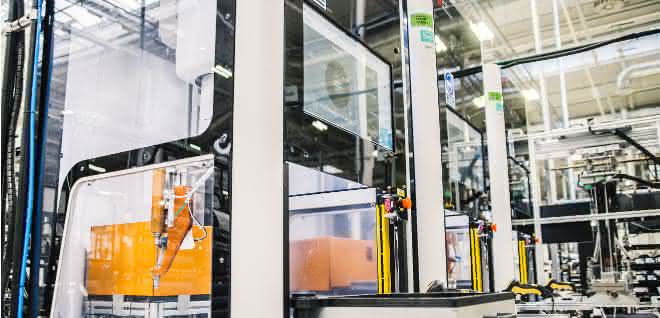
Every day, we interact with smartphones and smart home systems that can respond to our speech and touch thanks to intelligent software. Factories should work in a similar way in the future. However, a direct comparison with the capabilities of intelligent everyday devices makes it clear: The factory has so far looked old in the truest sense of the word. Comparatively little change has taken place in production facilities over the last 30 years: Modernization processes are gradually taking place, but hundreds of people continue to work there, performing one and the same task repeatedly. In stark contrast to the consumer market, the digital revolution has yet to take place in manufacturing.
Production today is extremely inflexible. Even if the opposite is often claimed: Factories are not yet geared towards reacting quickly to changes, adapting promptly to rotating production requirements and customer needs or any quality problems that arise. However, it is precisely these factors that are decisive for competitiveness. Until now, machines have been configured, calibrated and managed manually. As a result, this first generation of automation is too expensive, takes too long and - a very important point - is largely based on the expertise of a limited group, which makes scaling or repeatability difficult.
Even advanced technologies such as robots and 3D printers that operate in such companies constantly repeat the same activities with very little flexibility. This results in machines standing idle while waiting for orders, material or human interaction. Quality issues lead to large amounts of waste, and reports show that employee turnover is as high as 30 percent due to high labor intensity.
Advantages of intelligent automation
These hurdles should have been overcome long ago in the 21st century. We need to usher in a new era and redefine the concept of the factory: Production facilities must become increasingly intelligently networked internally in order to be able to operate autonomously in the long term.
The first concrete starting point is the factory-internal networking of production to create a smart, autonomous platform. This involves merging individual machines into an AI-controlled software level that configures, monitors and manages machines and systems. This so-called "software-defined manufacturing" combines intelligent software, cloud-based architectures, AI and machine learning, vision and robotics technology. The programmable factory is therefore based on a fusion of simulation and engineering with modular robot cells.
Software-controlled production automatically detects quality defects, for example, or can optimize material and resource planning for individual machines. The intelligent, software-defined superstructure thus triggers a series of scalable optimizations. This means that performance increases, while freed-up capacities can be immediately redistributed and utilized as required.
The higher the degree of autonomy, the more flexible production is and the more opportunities and benefits arise. This is because holistic automation based on this model does not stop at the factory gates, but has a wider impact on the sales market. The result of automated production processes can be seen, for example, in the ability to meet the growing consumer demand for locally produced products and to adapt products more individually to customer needs while still bringing them to market more quickly.
Software takes production to a new level
The manufacturing industry will change over the next few years. The next generation of automation will fully exploit the potential of factories by overcoming automation hurdles with software. Software-defined manufacturing as a core concept will make factories more flexible and agile, and therefore more adaptable to needs. A software-defined approach to manufacturing automation is based on three pillars:
- Configuration, repeatability and scaling of automation are equalized. This has a positive effect on the efficiency, speed and flexibility of the entire production process.
- The manufacturing process itself becomes intelligent. Thanks to AI-based software, smaller, more sustainable factories, for example, can manufacture better products and increase overall performance at the same time. The current image of the factory floor is therefore outdated.
- The new software-defined manufacturing processes are transparent and accessible, making it much easier to initiate and adapt the actual production processes. This is because it is currently difficult for an engineer or designer to gain an overview of the complete manufacturing process of a product. It is only thanks to the highly developed software that production can be traced in all its individual steps.
A "democratization" of innovation
Thanks to the new transparency gained in this way, AI-based software is transforming production. Actual production becomes tangible from start to finish. Every single step can be easily tracked - from the search for a production site to product development, manufacturing and scaling to the right production volumes, as well as adjusting revenue and throughput to meet demand.
This opens up new potential. On the one hand, controlling the entire process becomes less complicated, while on the other, the opportunities for market entry also change. When companies automate their production using software, they set an entire chain in motion: production becomes more transparent, simpler and more cost-effective, which results in a large number of new products in an accelerated form.
Ultimately, this will lead to a "democratization of innovation", which will be the true advantage of software-defined manufacturing. With its novel approach, Bright Machines provides the impetus for companies to rethink their current automation strategies. On the road to the smart factory, software-defined manufacturing is the next big evolutionary step.
Amar Hanspal, CEO of Bright Machines / ag


You might also be interested in
Humanoid robotics from Germany
Igus launches service robots for everyday industrial use
Humanoid robotics: With the Iggy Rob Home, igus presents a service robot for industry and everyday life. What's behind it.
 read more...
New sales and service unit in Gurugram
Yamaha Motor expands robotics business in India
Yamaha Motor is opening a new Robotics Business Support Division in India to strengthen sales and service in the growing robotics market. The unit will support SMT systems and industrial robots, among other things, and will be complemented by a...
read more...Robotics and autonomous order picking
Locus Robotics acquires Nexera Robotics and expands autonomous warehouse logistics
Locus Robotics takes over Nexera Robotics and may have taken a decisive step towards truly universal warehouse automation. A new gripping technology should now make possible what was previously considered difficult to automate.
read more...Factory planning without compressed air...
How vacuum becomes mobile
Modular factories, mobile robotics and rising energy prices are fundamentally changing automation. One solution: into the future without compressed air. Electric vacuum systems reduce costs, save energy and support flexible manufacturing and...
read more...A robot for all occasions
Industrial robots take on many tasks. Even milling with accuracies in the sub-millimeter range is now possible.
read more...Why stator and rotor laminations are becoming a performance factor
Why the future of robotics depends not only on software, but also on high-precision stator and rotor laminations inside the motor.
read more...Infineon Startup Challenge 2026
Focus on humanoid robotics
Infineon brings together young deep-tech companies worldwide to drive innovation in humanoid robotics. The focus is on hardware and system solutions from sensor technology to motor control. Applications are still possible until May 27, 2026.
read more...Synergy in the special machine
Highly automated production line for scaffolding standpipes sets standards in efficiency and process reliability
How is one of the most modern scaffolding tube production lines in Europe created? At MJ-Gerüst, a fully networked high-tech line produces six finished standpipes every 60 seconds. With automation, robotics and precision technology from Schunk. How...
read more...Quality controls in production
Robots check car floor pans fully automatically
How can complex components in automotive production be inspected fully automatically and in real time with the help of machine vision and robotics? The case study shows how floor pans are measured and inspected fully automatically.
read more...