

Sensors
Safe firefighting operations
Sensor solutions for hoists. Shock- and vibration-resistant angle and inclination sensors as well as draw-wire transducers and pressure transmitters are essential for the safety of mobile lifting equipment. Gefran uses modern technologies such as mems or non-contact Hall effect technology.
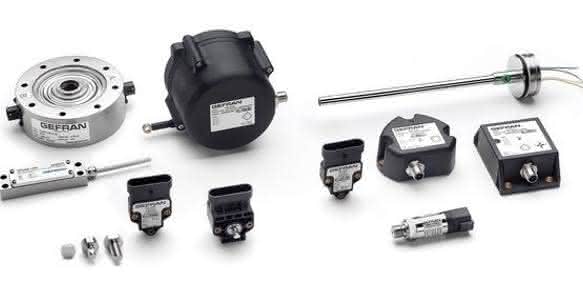
When the fire ladder is no longer sufficient to reach the source of the fire, firefighters and extinguishing agents are lifted to great heights using mobile aerial work platforms. A boom brings the platform precisely into position. A series of sensors monitor the movements of the platform, platform base and boom. For example, special sensors constantly check the inclination and weight of the platform as well as the angle and length of the boom. In one specific case, the inclination of the crane operator's cage was not allowed to exceed plus/minus seven degrees, while the vehicle base was not allowed to tilt by more than plus/minus three degrees. The user therefore installed a special version of Gefran's GIB inclination sensor both on the boom directly below the personnel platform and on the vehicle base. The contactless sensor uses Mems technology (microelectromechanical systems) and has analog and digital (Canopen) outputs.
In addition, an angle sensor controls the position of the turning station, which can be used to rotate the boom through 360 degrees. The operator therefore knows the position of the turning station at all times. This enables him to detect over-rotation and prevent damage such as hoses or cables being torn off in good time. One such angle sensor is the GR from Gefran, which can be programmed in increments of plus/minus 15 degrees. As the sensor is based on the non-contact Hall effect, it is not subject to wear and has an unlimited mechanical service life.
Sensors on the boom
Draw-wire sensors, such as the GSF potentiometric draw-wire sensor, are used to measure how far the boom has been extended. Depending on the length to be measured, it is available for measuring ranges between 1,800 and 8,300 millimetres. Draw-wire transducers are also used on the stabilizers of the platform base. Here, they measure the distance from the vehicle at which each support is already extended. This is particularly important for passenger platforms, which are often used close to houses. Additional information on the supports is provided by pressure sensors for monitoring the hydraulic pressure. On the one hand, this serves to record the extended length of the support and, on the other, to record the load or load compensation.
It is also necessary to monitor the hydraulic pressure of the hydraulic cylinders that move the boom upwards, as the load on the boom influences the pressure in the hydraulic circuit. The heavier the load, the higher the pressure required to lift it. Permanent pressure monitoring is required to prevent overpressure. For this purpose, pressure transmitters such as the KH are used on the hydraulic pump, which regulates the pressure of the hydraulic system depending on the load. The KH is robust against heavy shocks and vibrations. Equipped with a pressure damper, even high pressure peaks, such as those that occur when opening and closing a valve, cannot affect it. as


You might also be interested in
Helu makes its first trade fair appearance under a new brand name
Helu Kabel will be presenting itself as Helu for the first time at Hannover Messe 2026, showcasing system solutions, Heluchain cables and new industrial luminaires.
 read more...
Strategic realignment with brand relaunch
In future, Helukabel will trade as Helu
The Helukabel Group is parting with part of its name: in future, the company will only operate under the Helu brand. With this step, the specialist for electrical connection technology is underlining its strategic development from a classic cable...
read more...Modular plant construction for corrugated board
Insight into the production of corrugators at BHS Corrugated: Automated, modular and equipped with Helukabel components.
read more...Best quality for the steel
Conditions in the steel industry are harsh and inhospitable. The machines used must be able to withstand the demanding environmental conditions in order to deliver the best quality at all times.
read more...If the standard cable is not sufficient
Lapp offers cables for countless applications - but not for all of them. From time to time, the developers have to modify a standard cable or develop a special cable.
read more...Slight decline in sales, strong investments
The Lapp Group has not been spared from the weakening global economy. However, the company only recorded a slight loss in the past 2024 financial year.
read more...Electrical connection technology
Cables and wires for industrial automation
Heukabel offers system solutions for cable routing from a single source. The subsidiary EKD Systems specializes in tailor-made cable drag chains made of steel, stainless steel and plastic, which are used in moving machines and systems as well as in...
read more...Lapp relies on Ultramid from BASF
Mobile charging of electric vehicles
The automotive industry is currently undergoing the biggest transformation in its history. The boom in battery electric vehicles in particular is presenting the industry with major challenges. Lapp, as a supplier of cables and connection...
read more...Cable handling application
At this year's Motek, ArtiMinds Robotics is showcasing a robot-based automation solution for the sensor-assisted assembly of flexible cables in connector housings.
read more...