

plastoSENS T
Rethinking measurement technology
With Plastosens T, Jumo presents a new process for manufacturing temperature sensors. The sensors are not encapsulated in a metal tube, as was previously the case, but are encased in plastic using an injection molding process.
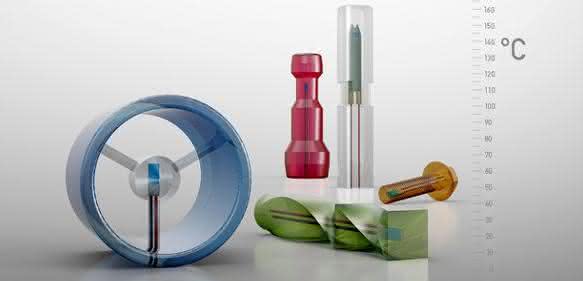
The patented system offers a number of advantages over conventional temperature sensors. The biggest advantage of plastic sensors is the complete freedom of design. Plastosens products from the Fulda-based manufacturer adapt to the respective installation situation. For example, a temperature sensor can be completely integrated into a plastic pipe. Another advantage, apart from the low weight, is the high reproducibility.
A sensor with an insulation resistance of five kilovolts for use in transformers, a vibration-resistant insertion sensor for the medium oil and a waterproof and vapour-tight sensor for sterilization applications are currently under development. These temperature sensors are suitable for temperature ranges from minus 50 to plus 200 degrees Celsius. Thanks to the use of special plastics, thermal conductivity comparable to that of metal can be achieved. The use of special additives enables the development of customized plastics for a wide range of applications.
Plastosens products from Jumo are created in close cooperation with customers. The process starts with a feasibility study and a design proposal and continues with the design and simulation of the temperature sensors and the construction of the injection molds. After a sampling phase, testing begins, culminating in a functional prototype and series production. With the help of modern software, the response behavior and heat dissipation capacity of the planned sensor can be simulated early on in the development process. pb


You might also be interested in
AI automation specialist reorganizes...
Generation change at Insiders Technologies
After almost 30 years at the helm, Werner Weiss is handing over the management of Insiders Technologies. Andree Albrecht takes over the management after a transition phase.
 read more...
Intelligent brownfield networking
Many industrial companies are struggling with established plant structures and proprietary interfaces. Stefan Klaus' presentation will show in a practical way how brownfield environments can be efficiently networked with open technologies and made...
read more...Factory-X in practice
How can set-up processes in highly variant production be automated efficiently? Markus Benndorff from soffico shows how Factory-X, industrial data rooms and modular architectures create new possibilities for flexible production concepts.
read more...Quality controls in production
Robots check car floor pans fully automatically
How can complex components in automotive production be inspected fully automatically and in real time with the help of machine vision and robotics? The case study shows how floor pans are measured and inspected fully automatically.
read more...Measurement software with integrated calibration wizard
The WinControl measurement software from Ahlborn is designed for the acquisition and processing of measurement data with Almemo measuring devices and offers functions for complex calibration tasks. A graphical user interface and context-sensitive...
read more...New platform facilitates chip design
Siemens opens access to EDA software in Europe
Siemens is cooperating with the Chips JU within the framework of EuroCDP and is facilitating access to modern EDA software for chip design, development and innovation for European companies. The aim is to strengthen start-ups, SMEs and research...
read more...AI and virtual twins for the industry
Dassault Systèmes confirms annual forecast after solid start to 2026
The French software group Dassault Systèmes has made a solid start to 2026 and is continuing to focus on artificial intelligence, cloud applications and virtual twins as growth drivers in its industrial business.
read more...Use data consistently and uniformly
New connectors and an app solution for the IIoT framework from PLCnext Technology make it easier to collect data from controllers, sensors and field devices - especially in existing systems.
read more...How companies can prevent cyberattacks
Instead of using traditional malware, attackers use legitimate programs and system tools within their victims' IT environments. Malicious behavior can hardly be distinguished from normal user behavior. For companies, this means that security...
read more...