

Quality assurance in industrial cell production
Leak test on filled lithium-ion battery cells
While the engine in conventional cars is considered the heart of the vehicle, in electric vehicles it is the battery. The battery also accounts for at least a quarter of the added value of the electric vehicle.
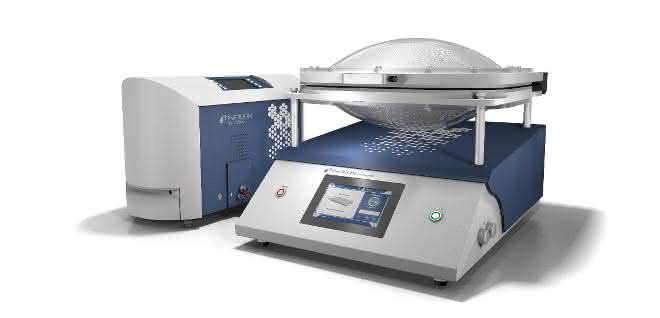
Traction batteries in fully electric vehicles consist of thousands of lithium-ion cells. Their tightness is an important quality requirement. The liquid electrolyte solution must not be allowed to leak out of a cell, nor must humidity be allowed to penetrate it. Only then will the traction battery achieve its intended service life of ten years. However, testing filled lithium-ion cells for leaks is no trivial task. Until now, only indirect methods were available for such integrity tests, which were either too insensitive or too unreliable. Inficon, a specialist in leak testing based in Cologne, Germany, has developed a method that reliably detects even small leaks in the industrial production of battery cells. This is because the new testing device detects leaking electrolyte solvent directly - in a vacuum chamber.
Failure modes for battery cells
Lithium-ion cells for traction batteries can be differentiated according to their housing shapes. On the one hand, there are cells with rigid, stable housings. These include so-called prismatic cells and round cells. The other category consists of cells with a soft, pouch-like exterior: the so-called pouch cells. Two damage mechanisms are common to all these cell types. If electrolyte leaks from the cell, its capacity is reduced - the service life of the battery is shortened. And if humidity penetrates the cell, the electrolyte can react with water to form hydrofluoric acid - which leads to further leaks in the cell housing and reduces its service life even further.
There is another damage mechanism for soft pouch cells. This is because all cell types - whether prismatic, round or pouch cells - are generally filled with electrolyte at a pressure of less than one atmosphere, with negative pressure prevailing in the cell. If a soft pouch cell has a leak, it inflates due to the penetrating air, loses mechanical stability and loses capacity as a result.
Problematic printing process
Until now, leak tests on operationally filled cells have been hampered either by the insensitivity of the method - as with the pressure decay test - or by its unreliability - as with helium bombing. In the supposedly cost-effective pressure decay test, a test chamber is filled with air up to a defined overpressure of a few bars and any changes in pressure resulting from air entering the cell through a leak are measured over a defined time interval. In practice, this allows limit leakage rates of up to 10-3 mbar∙l/s to be determined.
A major problem with this method is its susceptibility to temperature fluctuations. If the temperature only rises by fractions of a degree during the test, leaks often remain undetected, whereas if the temperature falls, the pressure drop test detects phantom leaks.
Unreliable helium bombing
Helium bombing is a method that is highly sensitive in principle, but proves to be unreliable in the application scenario of cell testing. During bombing, the battery cell is placed in a vacuum chamber and exposed to a helium atmosphere at a pressure of around 5 bar. This allows the helium tracer gas to penetrate the cell through any leaks. The tracer gas is detected in a subsequent step when the penetrated helium escapes back into the now evacuated vacuum chamber.
However, the exact leak location and the position of the battery cell are decisive for the success of the bombing method. If the helium gas bubble inside the cell is no longer directly in front of the leak, electrolyte solution will escape into the vacuum of the test chamber during the final helium test instead of the test gas: The leak remains undetected.
The sniffer leak search also fails
As the electrolyte solution is never filled into the cells up to atmospheric pressure, sniffer leak detection also fails in this cell production application scenario. The principle of sniffer leak detection is to suck in a gas escaping at a leak point through a sniffer tip so that it can be detected. However, in this case - under atmospheric external pressure and at a room temperature of 20 °C - the vapor pressure of the electrolyte solvent escaping from a leak in the cell wall is simply too low.
For solvents such as ethyl methyl carbonate (EMC) or dimethyl carbonate (DMC), the vapor pressure under the conditions described is only 43 or 53 mbar. For diethyl carbonate (DEC) it is as low as 13 mbar. Direct detection of escaping electrolyte solvent is therefore not possible with conventional sniffer leak detection. The situation is only different if the filled cell is tested in a vacuum chamber.
Direct detection of leaking solvent
Inficon makes use of this effect in its new test method for pre-filled battery cells. If the cells are in a vacuum, sufficient solvent can escape into the vacuum chamber in the event of a leak, where it evaporates quickly and is easy to detect.
The new ELT3000 from Inficon makes use of precisely this fact. The innovative testing device detects all common electrolyte solvents directly as they escape from the cell: whether DMC, DEC, EMC or PP - whereby mixtures of these solvents are also very often used for battery cells. The new method from Inficon also detects leaks in lithium-ion cells with rigid housings, i.e. prismatic and round cells, as well as in soft pouch cells.
Leak rate and leak diameter
The liquid solution in the cell can seal a leakage channel itself - provided it is small enough. At most, there is minimal evaporation at the leakage point, which does not significantly shorten the service life of the cell. This is why battery cells do not require absolute tightness. Rather, the decisive factor is that the cell complies with the required limit leakage rate during the test. The new Inficon method detects leaks up to a helium-equivalent leakage rate of 1∙10-6 mbar∙l/s.
For soft pouch cells with an internal pressure of 400 mbar and a film thickness of around 150 µm, this results in a minimum detectable leak diameter of 1.9 µm. For stable prismatic cells with a wall thickness of 2 mm and an internal pressure of 800 mbar, the new method identifies leaks up to a diameter of 2.6 µm. Such leaks of a few µm in diameter are usually sealed by the liquid electrolyte solution. During operation and under atmospheric pressure, there is therefore only a negligible evaporation effect. Neither whole drops of electrolyte solution can escape from leaks of this size nor can humidity penetrate into the cell. A leak test against the limit leakage rate of 1∙10-6 mbar∙l/s therefore ensures the service life of 10 years that the industry aims for its battery cells.
Vacuum testing for all cell types
The new testing system for the direct detection of leaking solvent consists of several components: a gas detection system for electrolyte solvents (the Gas Detection Unit, GDU) and a control unit for the gas flows (the Gas Control Unit, GCU). In addition, there is the vacuum chamber in which the cells are subjected to the test process. Inficon supplies various test chambers for - predominantly manual - tests on prismatic and round cells, but also a chamber for tests on the soft, more sensitive pouch cells.
Once the battery cells are in the respective chamber, the test can be started at the push of a button. The control unit then generates a vacuum of 5 mbar absolute in the chamber. The pressure difference to the inside of the cell, which is filled with electrolyte at a pressure of several hundred mbar, ensures that the electrolyte solution escapes from the cell through any leaks and the solvent component evaporates in the vacuum of the test chamber. The mass spectrometer of the gas detection system then detects this solvent and thus the leak in the cell.
Vacuum testing of soft pouch cells
Until now, vacuum tests on the soft pouch cells were impossible because the pressure difference between the inside of the cell and the vacuum of the test chamber would have deformed and damaged the cells. With its flexible FTC3000 test chamber, Inficon has solved this problem for the first time. This is because a film membrane fits snugly against the cell surface during evacuation, thus stabilizing the sensitive cells. This prevents deformation or even bursting of the pouch cell and enables fast and reliable vacuum testing.
The flexible membrane also reduces the dead volume of the test chamber, which in turn speeds up evacuation. The flexible test chamber is also a very interesting tool for development departments, which sometimes have to test cell prototypes of various shapes for leak tightness.
Whether with a rigid or flexible chamber, the new test device from Inficon minimizes sources of human error and is intuitive to use thanks to its simple test procedure and touch display. It can be reliably calibrated using the special Inficon E-Check test leak - for different solvents. The detection system compares the result of each test with a previously defined trigger value and indicates leaks immediately.
It is also very easy to assign test results to the specific test specimen. To do this, a barcode scanner is connected to the standardized interface of the device, with which each cell can be individually recorded. The system then links the exact test results with the respective part ID and a time stamp. It also saves all test data for export - this also guarantees traceable results.
Batch testing and short test cycles
Inficon has designed the test device so that it is suitable for manual workstations in the development department as well as for the simultaneous testing of several cells in automated production lines. For industrial use, however, it is advisable to design the test chamber individually. The duration of a test cycle ultimately depends on the size of the test chamber and whether a user wants to use various protective mechanisms such as a rinsing phase between two cycles.
Typically, the test cycle time for the smaller chambers offered by Inficon is in the range of 30 to 60 seconds. 10 to 30 seconds of this is pump-down time, and the actual measuring process takes 10 seconds. For tests in large chambers, it is advisable to use additional external pumps for rough evacuation in order to reduce cycle times. In industrial cell production in particular, it makes sense to automatically feed a larger, individually designed chamber, for example using a robot arm, and to test several dozen cells in one batch. It is no particular challenge for system integrators to design such vacuum chambers and integrate them into test systems. Inficon also works with system integrators to automate flexible test chambers.
Quality-assured cell production
Using its mass spectrometer and vacuum method, Inficon's new device can detect leaks thousands of times smaller than conventional pressure methods when testing the tightness of filled lithium-ion cells. At the same time, the new method delivers highly reliable results, unlike helium bombing. The direct detection of leaking electrolyte solvent opens up completely new possibilities for quality assurance in cell production - essential for a long service life of the traction battery.
Sandra Seitz, Market Manager Automotive Leak Detection Tools, Inficon


You might also be interested in
Atlas Copco takes over long-standing sales partner
Atlas Copco has taken over Heide-Pumpen. The specialist for mobile pumps has been working closely with Atlas Copco in sales and service for a long time, especially for surface pumps for construction site dewatering and wastewater detour or in the...
 read more...
Lutz Pumpen at the Achema 2024
New mobile drum pump with battery drive
The new B3 Battery from Lutz Pumpen promises mobile and safe working with aggressive liquids without having to compromise on pumping performance compared to wired versions. The battery-powered drum pump will be on display at Achema, the world's...
read more...Maintenance and Pumps&Valves in February
Final preparations are underway in Dortmund: On February 21, 2024, maintenance will start as the leading trade fair for industrial maintenance and with it Pumps&Valves as the trade fair for industrial pumps, fittings and valves.
read more...Liquid separator keeps pumps dry
Vacuum clamping minimizes distortion and enables five sides to be machined in one clamping operation. The use of cooling lubricants poses a challenge: If they get into the vacuum generator, they can cause serious damage.
read more...Spring clutches for construction machinery
Spring clutches from Torsion Control Products (TCP) are ideal for use in construction machinery where modern diesel engines are used.
read more...Protection against cooling lubricant
Liquid separator from Schmalz keeps pumps dry
Anyone clamping with a vacuum during CNC machining must protect the pump from cooling lubricant. The NLS liquid separator from Schmalz separates the cooling lubricant and returns it to the running process - without interrupting the vacuum.
read more...Which clutch for what?
Mechanical engineering and its applications are multifaceted. Every application is special and requires a perfect machine design. Individual components in the system must also be optimally designed.
read more...Energy efficiency needs electrical engineering and IT
The energy crisis makes one thing clear: it is not enough to simply screw a photovoltaic system onto your roof or purchase green electricity. Industry is faced with the challenge of reducing consumption in order to counter the rise in energy prices,...
read more...Solutions for a networked and climate-neutral industry
At the world's leading trade fair for industry, around 4,000 companies from the mechanical engineering, electrical and digital industries as well as the energy sector will be showcasing solutions for the production and energy supply of the future.
read more...