

Fine positioning with camera-based sensor
Always to the right shelf compartment
With the IPS 200i, Leuze electronic offers a small camera-based sensor with protection class IP65 for the compartment fine positioning of storage and retrieval machines. It enables simple and fast commissioning and operation.
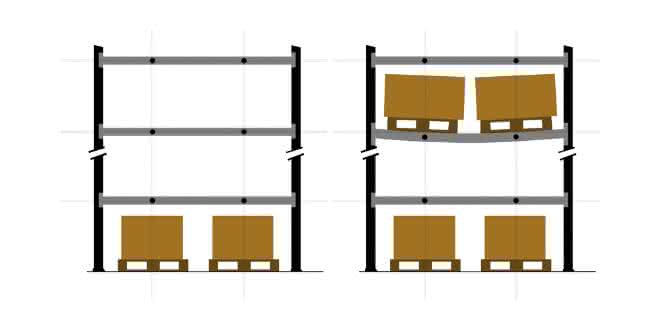
Pallet or container racking essentially consists of vertical uprights and horizontal beams and is subject to increasing thermal and dynamic loads as well as increased impact loads, for example due to the integration of shuttle systems. The resulting deformations of racking components must therefore be carefully considered when positioning a storage and retrieval machine (SRM).
Coarse and fine positioning of RGBs
Coarse and fine positioning are generally used to position the RGB in the X and Y directions. Barcode positioning systems, optical distance sensors with a long range or incremental encoders are used for the coarse positioning of the RBG. Once the coarse position has been reached, the compartment fine positioning system moves the stacker crane precisely to its end position. At least two optical diffuse reflection sensors are mounted on the stacker crane's load handling attachment for each positioning direction - i.e. at least four sensors for the X and Y directions.
Without object detection, the push-button outputs are Off. If a push-button detects the edge of a upright or a transom, the output status changes and the sensor output shows On. The new signal status can be used to detect the direction of movement of the stacker crane and to calculate the desired target position in relation to the edge. The schematic arrangement of the buttons with the associated binary evaluation is shown below. The arrows indicate the imaginary direction of movement of the RBG. Other states result in the same way.
However, the solution with binary sensors has a number of disadvantages. For example, the space available on the load handling attachment is extremely limited, as additional sensors are often fitted - for example for shelf occupancy monitoring, push-through monitoring or protrusion monitoring. In addition, diffuse reflection sensors can relatively easily generate false switching as a result of shiny profile surfaces, undesired reflection signals from edges in the background or the effect of extraneous light (especially HF light from energy-saving lighting equipment). This results in downtimes that lead to a lower number of storage/retrieval operations.
The biggest disadvantage, however, is the time-consuming alignment of the binary sensors - both during setup and operation - so that all storage positions are approached with the required accuracy. This requires trained specialist personnel. In addition, a binary sensor does not provide any further status information, for example with regard to function reserve or sensor status. New possibilities and solutions resulting from digitalization in the context of Industry 4.0 for diagnostics and predictive maintenance cannot be supported either.
Alternatives for compartment fine positioning
With the IPS 200i, Leuze electronic offers a small camera-based sensor with IP65 protection for the fine positioning of storage and retrieval machines. It enables simple and fast commissioning and operation. The web-based, multilingual configuration tool with a user-guided wizard reduces commissioning time to a minimum. Four feedback LEDs help to align the sensor. These flash with a frequency that is proportional to the distance to the target position. When the sensor is perfectly aligned, all four LEDs light up simultaneously.
By introducing a quality indicator for the first time, the IPS 200i reports changes to the sensor or shelf compartment, helping the user to detect potential malfunctions in the operating process at an early stage and carry out preventive maintenance in the sense of predictive maintenance, one of the most frequently mentioned areas of application for Industry 4.0. The quality indicator also helps to identify special features that precede a system failure. For such areas, the IPS 200i can also be used for optional image transmission.
Thanks to the integrated Ethernet interface (TCP/IP or UDP) and planned Profinet interface, both direct integration into the customer's network environment and fast, location-independent diagnostics via remote control are possible without any problems.
The new sensor, which is optimized for a high depth of field, has a fixed focus position and is used for the optical fine positioning of a stacker crane in the X or Y direction after rough positioning has been completed. It is able to transmit the correction coordinates to a stacker crane for the exact approach of a shelf. In concrete terms, it works like this: the smart sensor detects circular holes or reflectors in a single-deep bolt or upright of a pallet warehouse and determines the position deviation of pallets or containers in the X and Y directions relative to the target position. The positioning sensor generates one or more images as a gray value. In this image, the sensor first searches for a defined, round marking (hole/reflector). The X/Y deviation is output in millimetres relative to the target position or as quadrants using the available switching outputs.
Use in different temperature ranges
Intelligent image processing algorithms ensure reliable positioning and high throughput. The powerful, infrared LED illumination is independent of ambient light and enables short exposure times, so that high object speeds in combination with a high depth of field are also supported. The typical measurement cycle time is 35 milliseconds with a reproducibility of typically 0.1 millimeters (1 sigma). The IPS 200i is suitable for use both in the normal temperature range and, with optional integrated heating, in the deep-freeze range down to minus 30 degrees Celsius. as


You might also be interested in
Predictive maintenance in retrofit
Predictive maintenance pays off. This is because early detection of impending failures means that systems can be serviced in a targeted manner before production downtime occurs. But how complex is it to integrate such a maintenance concept into an...
 read more...
Maintenance instead of replacement
The circular economy starts with the machinery
Sustainability in industry starts with machines, says our guest author from Deguma: How maintenance, modernization and the 5R strategy save resources, energy and CO₂.
read more...3D printing for unplanned requirements
The material fails and the machine suddenly stops? Then you need to take the right measures to be able to resume production quickly. Material failure in the form of faulty components or material wear in the frame are a risk for any production.
read more...High demands in terms of safety, application and robustness
Demanding work in the electrical trade and energy supply as well as smooth processes in production require innovative and customized measurement technology that scores points for safety, ease of use and resilience.
read more...Car meets e-bike: riding with lubrication-free polymer bearings
Studies show that the proportion of pedestrian and bicycle traffic is increasing in urban areas. With the JetBike, JetBike GmbH from Braunschweig presents a mixture of e-bike and car and relies on lubrication-free polymer bearings from Igus.
read more...Hydraulic hub for more efficient servicing
Bosch Rexroth presents a digital toolbox for service and maintenance. With a comprehensive range of digital services, the Hydraulic Hub simplifies and accelerates the service and maintenance of hydraulic products and increases machine availability.
read more...Arnold Umformtechnik expands after-sales...
Faster help with VR glasses
Arnold Umformtechnik is expanding the after-sales service for its machines to include digital remote services. The focus is on data security, simple operation and clear processes.
read more...147,000 euros per hour: high costs for German companies due to unplanned downtime
According to the "Value of Reliability" study, 67% of industrial companies in Germany experience unplanned downtime at least once a month. This costs the German economy 147,000 euros per hour. Nevertheless, reactive maintenance concepts are not...
read more...Maintenance starts with a maintenance planner
Legal requirements stipulate that machines and systems must be serviced regularly. The maintenance work serves to ensure occupational safety and economic efficiency.
read more...